Camera-Based RPM vs Pulse Oximeter Programs: Adherence and Accuracy Compared
A research-based look at camera RPM vs pulse oximeter programs, with the real tradeoffs in adherence, signal quality, workflow burden, and health system scale.
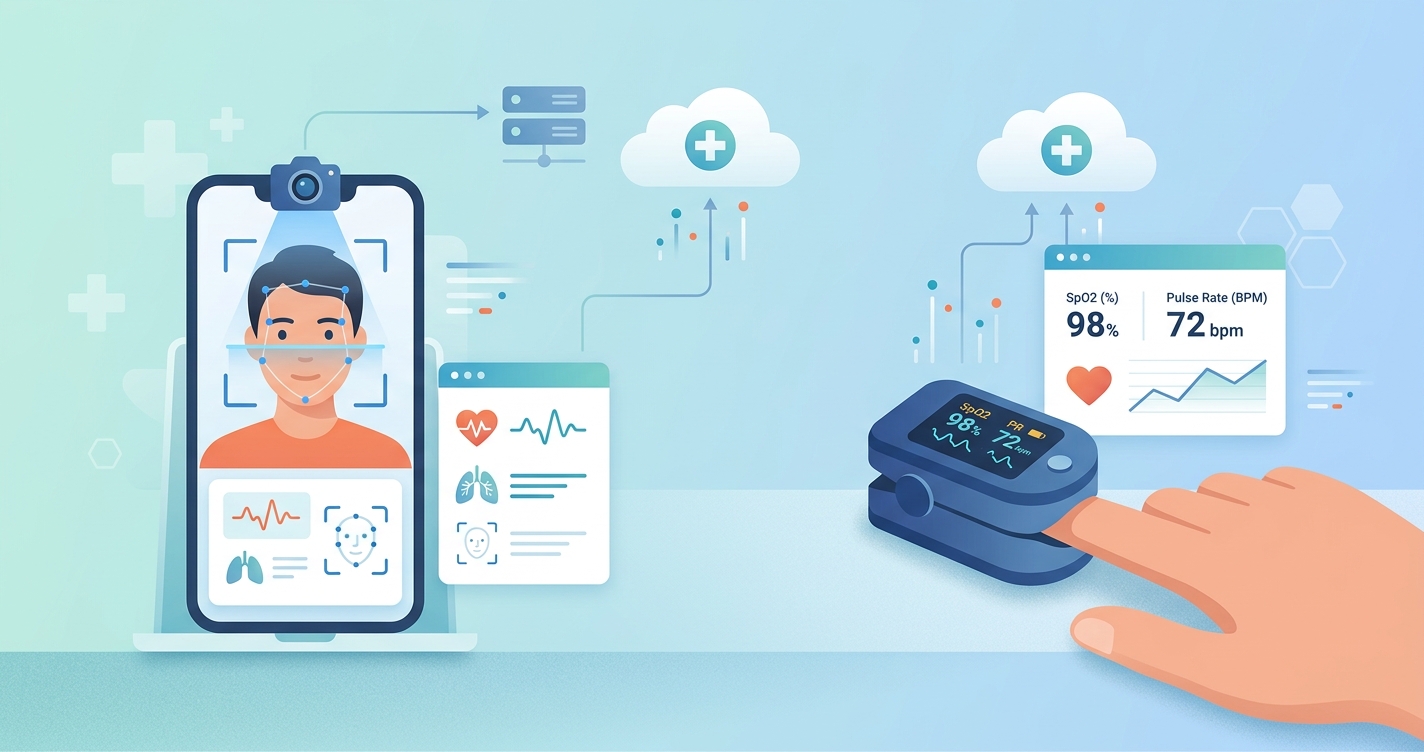
Camera RPM vs pulse oximeter adherence accuracy has become a practical question for health systems, not a speculative one. Most remote patient monitoring programs already know the clinical value of oxygen saturation checks and basic vital sign surveillance. The harder problem is getting patients to keep using the tools after the first week. Pulse oximeters are familiar and clinically useful, especially in respiratory and post-acute programs, but they still depend on a separate device, patient technique, and repeat engagement. Camera-based RPM changes the operating model by moving part of the monitoring workflow onto the phone, tablet, or webcam the patient already has.
"The evidence suggests that remote patient monitoring can improve adherence and safety, but those gains depend heavily on usability and sustained patient participation." — Al-Samarraie et al., systematic review, 2023
Camera-based RPM vs pulse oximeter programs: what is really being compared?
This is not a clean device-versus-device contest. Pulse oximeter programs are built around a dedicated hardware measurement: peripheral oxygen saturation. Camera-based RPM programs are built around software, short guided sessions, and contactless extraction of signals such as heart rate and respiratory rate through remote photoplethysmography.
That difference matters because adherence problems often have less to do with whether a sensor works and more to do with whether a patient will keep reaching for it. Al-Samarraie and colleagues, reviewing RPM interventions in 2023, found that adherence improves when monitoring fits daily routines and creates low friction for patients. That sounds obvious, but health systems still design many RPM pathways as if shipping a device guarantees long-term use.
Pulse oximeter programs remain important, especially when oxygen saturation is the measurement that drives escalation. Alboksmaty, Beaney, Elkin, and colleagues concluded in their 2022 systematic review that pulse oximetry can be a safe part of home monitoring for COVID-19 patients and may help identify deterioration earlier. That is a meaningful result. But it does not answer the separate enterprise question: how well do these programs hold patient engagement over time when the workflow depends on a peripheral device?
Camera-based RPM is getting attention because it attacks that friction directly. A patient does not have to locate a clip, align a finger correctly, wait for a stable read, and then troubleshoot battery or connectivity issues. They open a link, hold still, and complete a short scan.
| Program dimension | Camera-based RPM | Pulse oximeter RPM | |---|---|---| | Primary hardware | Smartphone, tablet, laptop, kiosk, or webcam | Dedicated fingertip pulse oximeter, often paired with phone or portal | | Main signals | Heart rate, respiratory rate, perfusion-related optical signals | SpO2 and pulse rate | | Patient setup burden | Low if patient already has a camera-enabled device | Moderate because it adds a separate device and technique step | | Training needs | Positioning, lighting, and stillness | Finger placement, warm hands, correct device use, syncing if connected | | Common failure points | Motion, poor lighting, weak camera quality | Cold fingers, nail polish, poor perfusion, low battery, device loss | | Best-fit programs | Frequent check-ins, broad outreach, post-discharge follow-up, virtual nursing | Respiratory surveillance, oxygen-focused pathways, condition-specific monitoring | | Adherence risk over time | Lower hardware fatigue, but still depends on reminders and workflow design | Higher because patients must keep using and maintaining another device | | Accuracy question | Depends on algorithm quality and scan conditions | Stronger for oxygen saturation because that is the device's core job |
The practical conclusion is straightforward: pulse oximeters still own oxygen saturation, while camera-based RPM has an easier path on convenience and repeat engagement.
Why adherence is usually the bigger RPM problem
Health systems do not struggle to buy RPM devices. They struggle to keep patients using them correctly for 30, 60, or 90 days.
The gap between enrollment and sustained use shows up across remote care programs. Reviews of RPM repeatedly point to usability, support burden, and routine fit as major determinants of success. That is why camera-based models are appealing to hospital-at-home teams, virtual nursing leaders, and population health groups. If the monitoring step looks like another app interaction instead of another piece of equipment, completion rates have a better chance.
A pulse oximeter workflow seems simple on paper. In real life, several small points of friction stack up:
- patients misplace the device
- hands are cold, which can degrade readings
- patients forget whether the program wants spot checks or repeated measurements
- Bluetooth pairing or portal upload steps break
- caregivers end up acting as the support desk
None of those issues makes pulse oximetry a bad tool. They do make it a tool with operational drag.
Camera-based RPM has its own requirements. Patients need reasonable lighting, a stable camera, and enough stillness for a usable signal. Wang and colleagues, writing in IEEE Transactions on Biomedical Engineering in 2017, showed why this is possible at all: subtle skin color changes captured on video can be processed into a pulse waveform. Since then, contactless-vitals research has improved signal extraction under more realistic conditions, which is why camera-based monitoring has moved from lab curiosity to deployment conversation.
Accuracy is not one number
When people ask about camera RPM vs pulse oximeter adherence accuracy, they usually combine two different questions.
The first question is whether patients will keep using the tool. The second is whether the signal is reliable enough for the intended clinical task.
Those questions need to stay separate.
Pulse oximeters remain the correct choice when the program must measure oxygen saturation directly. That is the core reason respiratory programs adopted them so widely during COVID-era home monitoring. Alboksmaty et al. found enough evidence for safety and clinical utility to support their continued use in appropriate populations.
Camera-based RPM is stronger when the health system wants frequent low-friction vital sign checks and does not want hardware logistics to dominate the program budget. Camera systems are not trying to replace every peripheral. They are trying to remove avoidable friction where software can do the job.
A more realistic way to think about accuracy is fit-for-purpose accuracy:
- If the care pathway depends on SpO2 thresholds, pulse oximetry has the more direct measurement.
- If the pathway depends on repeated engagement, short check-ins, and broader virtual surveillance, camera RPM may produce more usable data simply because more patients complete the session.
- If the pathway needs both, hybrid models make the most sense.
That last point is important. A highly accurate device that sits unused in a drawer does not create a strong RPM program.
Industry applications
Post-discharge monitoring
Post-discharge RPM often fails at the exact moment simplicity matters most. Patients are tired, routines are unsettled, and every extra instruction lowers follow-through. Camera-based RPM works well in this setting because a nurse can send a link and ask for a quick check-in rather than coordinate another device workflow.
Respiratory and escalation pathways
Pulse oximeter programs are still the better fit when the clinical pathway revolves around desaturation risk. COPD surveillance, COVID-style respiratory monitoring, and some post-acute recovery models still need direct oxygen saturation readings to guide escalation.
Hospital-at-home and virtual nursing
Bruce Leff, David Levine, and colleagues have helped push hospital-at-home from fringe pilot to mainstream strategic topic. In those models, monitoring architecture matters. Programs scale more easily when each added patient does not require a full shipping, replacement, and troubleshooting cycle. Camera-based RPM aligns well with software-first workflows inside virtual nursing and home-based acute care.
Current research and evidence
The evidence base does not yet offer many clean head-to-head trials that compare camera-based RPM programs directly against pulse oximeter programs on the same patient population over the same time period. That is worth stating plainly.
What the literature does show is enough to frame the decision:
- Al-Samarraie et al. (2023) found that RPM outcomes, including adherence and safety, depend heavily on usability and patient engagement.
- Alboksmaty, Beaney, Elkin, et al. (2022) found pulse oximetry to be a safe and potentially useful component of home monitoring in COVID-19 RPM pathways.
- Wang et al. (2017) established one of the foundational remote photoplethysmography methods that made camera-based vital sign extraction practical from facial video.
- More recent camera-monitoring reviews have generally reached the same middle-ground conclusion: heart rate and respiratory rate measurement are increasingly credible, but implementation quality still matters.
That is enough for a health system leader to make a sensible architecture choice. The question is not whether one modality wins in the abstract. The question is which modality creates dependable, clinically actionable participation in the real world.
The future of camera RPM vs pulse oximeter programs
The likely outcome is not replacement. It is segmentation.
Pulse oximeters will stay in pathways where oxygen saturation is central. Camera-based RPM will keep expanding where hospitals want easier onboarding, wider reach, and less device fatigue. The most resilient programs will mix both approaches instead of forcing one tool into every workflow.
Three shifts look especially likely:
- broader use of camera-based check-ins for post-discharge and virtual nursing programs
- pulse oximeters reserved for oxygen-sensitive pathways rather than used as a default for every RPM deployment
- hybrid program design, with contactless scans used for frequent engagement and peripherals used only where measurement specificity demands it
For health systems, that is probably the right destination. Better RPM architecture is not about choosing the most advanced-looking tool. It is about choosing the monitoring design patients will actually complete.
Frequently asked questions
Is camera-based RPM more accurate than a pulse oximeter?
Not for oxygen saturation. Pulse oximeters are built to measure SpO2 directly. Camera-based RPM is usually better understood as a lower-friction way to capture other vital signs and engagement-friendly check-ins.
Which RPM model has better adherence?
In most cases, camera-based RPM has the easier adherence profile because patients do not need to manage a separate device. That said, adherence still depends on reminders, onboarding, and how well the workflow fits patient routines.
Should health systems replace pulse oximeter programs with camera RPM?
Usually no. Most organizations should think in terms of pathway design, not full replacement. Use pulse oximeters where oxygen saturation drives care decisions. Use camera RPM where convenience, reach, and repeat participation matter more.
Where does camera-based RPM fit today?
It fits especially well in post-discharge follow-up, virtual nursing, hospital-at-home check-ins, and broad remote surveillance workflows where adding more hardware would slow adoption.
If your team is evaluating lower-friction RPM models, solutions like Circadify are part of the shift toward software-first monitoring. For more context, see How to Reduce RPM Device Attrition Rates With Camera-Based Monitoring and What Is Passive Patient Monitoring? No-Touch RPM Explained for Clinicians.