Camera-Based RPM vs Traditional RPM Devices: Compared
A research-based comparison of camera RPM vs traditional RPM devices, covering adherence, workflow burden, reimbursement design, and health system deployment tradeoffs.
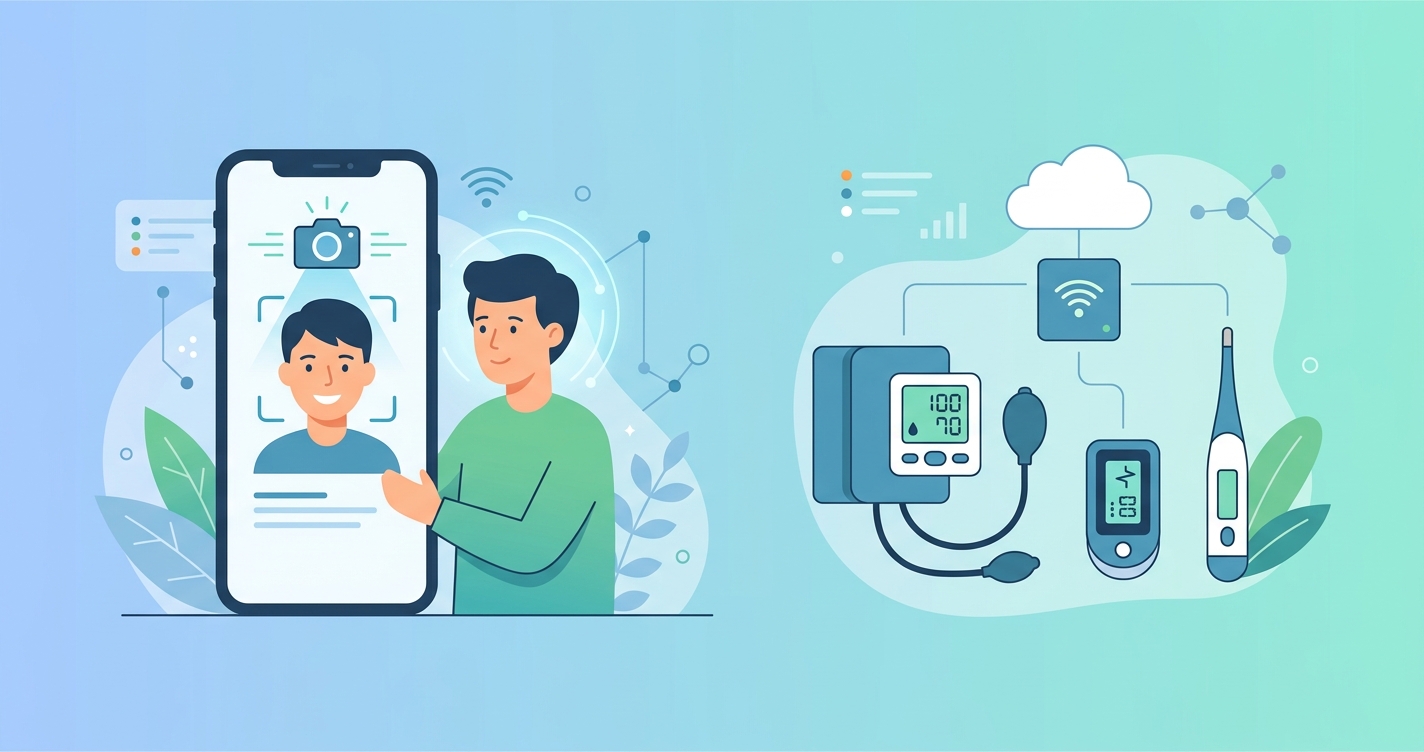
Camera RPM vs traditional RPM compared is no longer a fringe technology question for health systems. It is an operating-model question. Traditional remote patient monitoring programs were built around cuffs, pulse oximeters, scales, and wearables shipped to the home. That model created real clinical value, but it also created a second problem: logistics, charging, replacement, training, and adherence. Camera-based RPM changes the architecture. Instead of asking patients to wear or maintain dedicated hardware, it uses the smartphone, tablet, or webcam they already have. For hospital CMOs and population health leaders, the real comparison is not device versus no device. It is operational friction versus scalable engagement.
“The question is no longer whether remote monitoring works. The question is which monitoring architecture delivers the data density clinicians actually need at a cost structure the enterprise can sustain.” — Advisory Board, 2025 Health System Technology Survey
Camera RPM vs Traditional RPM Compared Across the Health System Stack
Traditional RPM devices are still the reference model for many programs because they fit the original CMS reimbursement structure and support specific measurements such as weight or cuff-based blood pressure. They also come with a familiar clinical workflow. The trouble is that familiar does not always mean scalable. Every shipped device introduces supply-chain cost, patient support work, and a point of failure.
Camera-based RPM starts from a different assumption: if the patient already has a front-facing camera, the monitoring layer can be software. That lowers the hardware burden and can reduce the dropout that happens when patients are asked to remember a box of equipment each morning.
A 2024 systematic review by Al-Jumaili and colleagues examined adherence to wearable devices in RPM for heart failure and hypertension and concluded that adherence remains a central bottleneck in translating RPM into reliable long-term monitoring. That finding matters because many RPM business cases quietly assume patients will keep wearing, charging, syncing, and troubleshooting devices for months. In the real world, many do not.
At the same time, contactless monitoring is becoming more credible as the evidence base improves. A 2024 systematic review on continuous vital-sign monitoring using cameras found that camera systems can capture heart rate and respiratory rate reliably enough to support growing remote-care and telehealth use cases, while still facing predictable issues around lighting, motion, and implementation design. That is a more mature position than the old “interesting but experimental” framing.
RPM Model Comparison Table
| Dimension | Traditional RPM Devices | Camera-Based RPM |
|---|---|---|
| Primary hardware | BP cuffs, pulse oximeters, scales, wearables | Smartphone, tablet, laptop, kiosk, or webcam |
| Patient burden | Wear, charge, pair, remember, store | Open app or link and complete short scan |
| Logistics model | Ship, replace, recover, sanitize, support | Mostly software deployment |
| Adherence risk | Higher over time as device fatigue grows | Lower hardware fatigue, but session completion still matters |
| Data cadence | Continuous or scheduled depending on device | Usually scheduled or on-demand sessions |
| Best-fit use cases | Disease programs needing device-specific measurements | Broad screening, frequent check-ins, virtual care, hospital-at-home workflows |
| Clinical staffing burden | More device onboarding and troubleshooting | More workflow design and digital engagement planning |
| Marginal cost per patient | Often rises with each shipped kit | Usually lower once the platform is deployed |
| Failure points | Lost devices, battery issues, Bluetooth, non-use | Poor lighting, motion, weak camera quality, no-show sessions |
| Scalability constraint | Inventory and support operations | Clinical workflow and digital access |
The important point is that these models do not compete on the same variables. Traditional RPM devices are strongest when a program needs dedicated peripherals. Camera-based RPM is strongest when the health system wants low-friction check-ins across large populations.
Where Traditional RPM Devices Still Make Sense
Traditional RPM remains well suited to high-acuity chronic disease programs where the protocol depends on a specific peripheral. Heart failure pathways still rely heavily on daily weights. Hypertension programs still treat cuff-based readings as the formal measurement anchor. Diabetes programs may need glucometer integration. In those settings, the value of the device is not just data transmission. It is the underlying clinical standard attached to that measurement.
There are other advantages too:
- Continuous passive data collection is possible with some wearables
- Established reimbursement patterns still favor device-based workflows in many organizations
- Clinical teams may trust devices more because the workflow is already familiar
- Certain populations prefer a dedicated medical device over a consumer-facing app experience
That said, the tradeoff is rarely hidden for long. Device programs create a support desk, an inventory system, and a nontrivial percentage of unused kits sitting in patient homes.
Why Camera-Based RPM Is Getting Serious Attention
Camera-based RPM is attractive because it attacks the weakest point in many RPM programs: patient compliance with hardware. If the patient can complete a short session on a phone they already use, the barrier to participation falls. That matters for post-discharge monitoring, virtual nursing, and hospital-at-home programs where the goal is frequent physiological check-ins without turning the patient into a part-time device technician.
The broader care model is moving that way. In their 2024 Annals of Internal Medicine brief report on Acute Hospital Care at Home in the United States, Bruce Leff, David Levine, and colleagues described the rapid expansion of home-based acute care as health systems looked for clinically credible alternatives to inpatient beds. Programs like that need monitoring, but they also need simplicity. A home-based care model becomes harder to scale when every patient requires a customized kit, device education, and a replacement loop.
Camera-based monitoring also lines up with virtual nursing and digital front door workflows because it can be launched through links, portals, or existing telehealth sessions. That makes it easier to embed into:
- discharge follow-up programs
- nurse-led escalation pathways
- hospital-at-home rounds
- post-surgical surveillance
- high-volume population health outreach
Industry Applications
Post-Discharge Monitoring
Post-discharge RPM programs live or die on participation. Patients are home, often tired, sometimes confused, and rarely eager to manage another device kit. Camera-based RPM has an advantage here because it can reduce onboarding friction and fit into a text message, portal reminder, or nurse-led follow-up. Traditional devices still matter for patients whose pathway requires connected blood pressure or oxygen data, but the operational burden is higher.
Hospital-at-Home and Virtual Care
Hospital-at-home and virtual nursing programs need monitoring tools that feel light enough for patients and fast enough for staff. That is where camera-based RPM keeps showing up in strategic planning. Bruce Leff and David Levine's hospital-at-home work matters here because it frames the home as a real care setting rather than a low-acuity afterthought. Once that shift happens, health systems start looking for monitoring models they can deploy broadly without building a parallel logistics company.
Reimbursement and Workflow Design Still Shape the Choice
Technology decisions in RPM are rarely about technology alone. CMS design still influences architecture. CMS guidance for CPT 99454 has historically required 16 days of data in a 30-day period, which pushed many programs toward device-centric workflows built for frequent transmission. That rule helped create the traditional RPM market.
The operational problem is that reimbursement logic and patient behavior are not always aligned. A device program may be billable on paper but fragile in practice if patients stop using the hardware after the first few weeks. A camera-based program may feel easier for patients and staff, even if health systems have to think more carefully about session cadence, patient prompts, and clinical documentation.
That is why the real comparison is program fit:
- If the clinical pathway depends on cuff-grade blood pressure or connected peripherals, traditional RPM still has the edge.
- If the program depends on broad adoption, fast onboarding, and low logistics overhead, camera-based RPM often has the stronger operating model.
- If the health system wants both, hybrid architectures are increasingly sensible.
Current Research and Evidence
The evidence base is converging on a simple point: RPM outcomes depend as much on adherence and workflow fit as on the sensor itself.
Al-Jumaili et al. reported in their 2024 systematic review that wearable adherence in heart failure and hypertension RPM remains inconsistent, with engagement shaped by usability, support, and patient burden. That review is a useful corrective to the assumption that a mailed device automatically becomes a durable monitoring habit.
A 2024 review of camera-based continuous vital-sign monitoring found strong momentum behind contactless heart-rate and respiratory-rate measurement, especially as computer vision and signal-processing methods improve. The authors also noted familiar implementation constraints, including motion artifact and lighting variability. In other words, camera RPM is promising, but it still succeeds or fails on deployment quality.
Levine and colleagues' work on hospital-at-home expansion gives this comparison real strategic context. As more care shifts into the home, health systems need monitoring approaches that do not import the full friction of bedside equipment into every living room. That does not eliminate traditional devices. It does mean software-first monitoring will keep getting a harder look.
The Future of RPM Architecture
The next phase of RPM will probably not be a winner-take-all fight. It will be segmentation.
Higher-acuity pathways will continue to use dedicated peripherals where the measurement demands it. Lower-friction care pathways, especially virtual follow-up, recovery monitoring, and broad population screening, will increasingly favor camera-based check-ins. The health systems that scale fastest are likely to combine both rather than defending one model on principle.
Three shifts are worth watching:
- Hybrid RPM programs that use devices for a subset of patients and camera scans for the broader population
- Workflow-native monitoring embedded inside telehealth, patient portals, and discharge pathways instead of separate device programs
- Software-first economics as health systems look for RPM models with less shipping, fewer replacements, and lower support overhead
Frequently Asked Questions
Is camera-based RPM replacing traditional RPM devices?
No. It is expanding the RPM toolkit. Traditional devices still matter for use cases that require dedicated measurements such as cuff-based blood pressure, weight, or glucometer data. Camera-based RPM is most compelling where low-friction check-ins matter more than shipping hardware.
Which RPM model has better adherence?
Published evidence suggests adherence is a persistent challenge for wearable and device-based RPM, especially over longer monitoring periods. Camera-based RPM can reduce hardware fatigue, but it still depends on good onboarding, reminders, and workflow design.
Is camera-based RPM better for hospital-at-home programs?
It can be, especially when programs need fast deployment and low patient burden. Hospital-at-home models benefit from simpler monitoring workflows, though many programs will still use a mix of device-based and camera-based tools depending on acuity.
Should health systems choose one RPM architecture?
Usually not. The better question is which architecture fits each clinical pathway. Many organizations will end up using hybrid RPM models that match the monitoring method to the patient population and care objective.
For health systems, camera RPM vs traditional RPM compared is ultimately a question of operating leverage. Traditional devices offer measurement depth and protocol familiarity. Camera-based RPM offers simplicity, reach, and lower logistics drag. The smart move is rarely ideological. It is architectural: use the monitoring model that gives clinicians reliable data without asking patients to do more work than the program can realistically sustain. Solutions like Circadify are part of that shift toward software-first RPM design. For related reading, see What Is Remote Patient Monitoring? RPM Technology Explained and What Is Virtual Nursing? How Camera-Based Vitals Enable Remote Care.