How can my healthcare team see my health trends from last week to today?
How a contactless RPM platform turns daily vitals into longitudinal trends, helping hospital teams spot decline early and intervene before readmission.
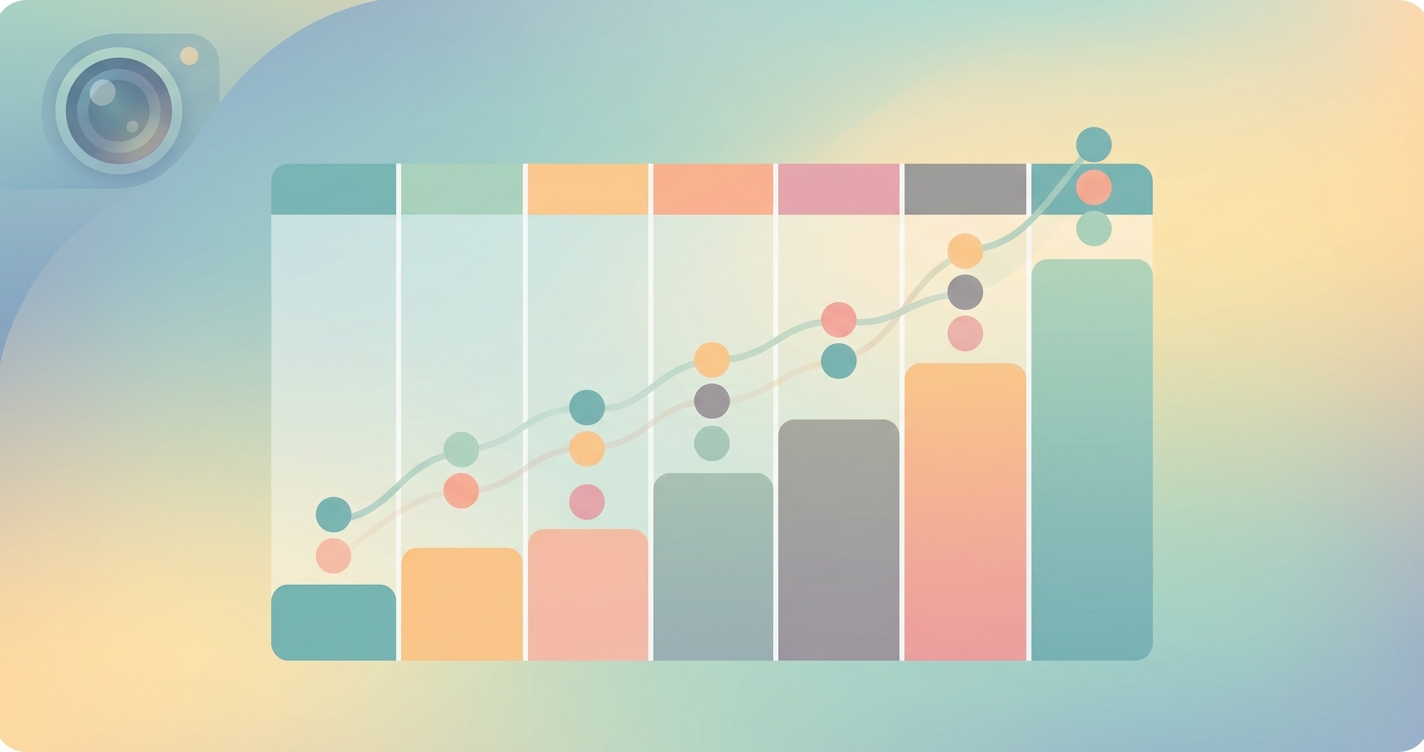
A single vital sign reading tells a care team almost nothing on its own. A resting heart rate of 78, a respiratory rate of 18, a blood pressure of 132 over 84 are all unremarkable in isolation. What changes the clinical picture is the line they form over seven days. When a patient or a hospital chief medical officer asks how a care team can compare last week's health to today's, they are really asking about the difference between a snapshot and a trajectory. A contactless RPM platform exists to close that gap by capturing measurements often enough, and storing them consistently enough, to make the trajectory visible. The value is not the individual number. It is the slope.
A 2024 prospective cohort study published in JMIR Formative Research found that home digital monitoring significantly reduced hospitalizations, emergency department visits, and total hospital stay days among high-risk post-discharge patients with cardiovascular and respiratory conditions, with the strongest benefit in programs that detected health decline early.
What a contactless RPM platform actually shows your care team
A contactless RPM platform measures vital signs through a camera rather than a strapped-on device. Remote photoplethysmography (rPPG) reads subtle color changes in facial skin caused by blood moving through capillaries, and from that signal the software derives heart rate, respiratory rate, and related measures. The clinical relevance for a hospital program is not any single capture. It is that the same patient, using the same phone or tablet, produces a comparable reading day after day, building a record that a clinician can read as a curve.
That longitudinal record is what answers the "last week to today" question. When measurements arrive consistently, the platform can plot a baseline, flag deviation from it, and surface the moment a trend bends in the wrong direction. A resting heart rate climbing three beats per minute each night for four nights is invisible in a single visit and obvious on a seven-day chart. Early-warning research consistently shows that physiologic drift often precedes a patient feeling unwell, which is exactly the window proactive teams want to act inside.
The practical contrast between snapshot care and trend-based care looks like this:
| Dimension | Episodic check-ins | Contactless RPM platform trends | |---|---|---| | Data cadence | Office visit or single call | Daily or more frequent captures | | What clinicians see | One reading in isolation | Baseline plus trajectory over days | | Decline detection | After symptoms appear | When the slope changes, often before symptoms | | Patient effort | Travel, appointments | A short camera capture at home | | Device dependency | Cuffs, oximeters to ship and charge | No wearable, no peripherals to lose | | Intervention timing | Reactive | Proactive |
The operational appeal for hospital leaders is the bottom two rows. A camera-based approach removes the device logistics that quietly erode most monitoring programs, and consistent capture is what makes proactive intervention possible at all.
Why trends matter more than thresholds
Many monitoring programs are built around fixed alarm thresholds: alert if systolic blood pressure exceeds a set ceiling, or if oxygen saturation drops below a floor. Thresholds catch crises but miss the slow slide that precedes them. Trend analysis adds a second layer of intelligence.
- A patient whose readings stay inside normal limits but drift steadily upward week over week may be decompensating before any alarm fires.
- A patient whose numbers swing widely day to day may signal adherence problems, medication issues, or an unstable condition that a single value would hide.
- A patient whose curve flattens and improves gives a care team the confidence to step down monitoring intensity and reallocate nursing attention.
For a population health VP managing thousands of enrolled patients, trend logic also functions as a triage filter. Instead of nurses reviewing every reading, the platform elevates the patients whose trajectories have changed, concentrating scarce clinical time where it shifts outcomes.
Industry applications
Post-discharge and hospital-at-home programs
The transition home is the highest-risk window in the care journey. A contactless RPM platform lets a care team watch the recovery curve rather than wait for a follow-up appointment. Comparing today's respiratory rate to last week's establishes whether a patient is genuinely improving or quietly heading back toward the emergency department. Hospitals running acute care at home use this longitudinal view to decide when to escalate a visit and when to safely discharge from the program.
Chronic disease management
Conditions such as heart failure and hypertension reward continuous observation. A 2024 retrospective cohort analysis published in MDPI's Journal of Clinical Medicine reported that remote monitoring was associated with improved hypertension control, including reduced rates of uncontrolled and stage 2 hypertension. Those gains depend on seeing the trend, not a one-off reading, so that medication titration and lifestyle coaching respond to the real trajectory.
Virtual nursing and centralized monitoring
A centralized virtual nursing team can cover a large panel only when the technology does the first pass. Trend dashboards let one nurse oversee many patients by drawing attention to the curves that have moved, turning a flood of raw measurements into a short, prioritized worklist.
Current research and evidence
The two pillars under any contactless RPM platform are signal accuracy and clinical benefit, and recent literature speaks to both.
On accuracy, a 2023 clinical validation study published in PMC evaluated rPPG-enabled contactless pulse rate monitoring in cardiovascular disease patients and reported a mean absolute error of about 1.06 beats per minute against ECG, with a Pearson correlation of 0.962. Separate 2023 smartphone-based work using rPPG reported high predictive accuracy across heart rate, blood pressure, and respiratory rate, while researchers consistently note that movement, lighting, and skin tone remain active engineering challenges that affect any camera-based method.
On clinical benefit, the evidence is encouraging but conditional. The 2024 JMIR Formative Research cohort found meaningful reductions in acute care use for high-risk post-discharge patients. A 2024 realist review in BMJ Open by researchers studying factors that influence RPM effectiveness concluded that successful programs share specific traits: they target high-risk populations, accurately detect decline, deliver timely personalized responses, and embed monitoring inside collaborative care. Notably, other 2024 analyses found RPM did not reduce readmissions for some groups, such as patients after sepsis and lower respiratory tract infections, which reinforces that the data only helps when a team acts on the trend. The technology surfaces the slope; clinicians and workflow turn it into an outcome.
The future of contactless RPM platforms
Several directions are taking shape. Deep learning models, particularly convolutional neural networks, are improving rPPG robustness under the real-world conditions of home lighting and patient movement, which should make daily captures more comparable and trends cleaner. Frontiers researchers reviewing contactless physiological measurement in 2024 describe steady gains in algorithm reliability as the central trajectory of the field.
The second direction is predictive analytics layered on top of longitudinal data. As patient histories accumulate, models can move from describing a trend to forecasting one, estimating the probability that a given curve leads to an event within a defined window. For a hospital CMO, that converts monitoring from documentation into decision support. The third direction is reach: removing wearables lowers the cost and adherence barriers that have kept monitoring out of underserved and older populations, widening the pool of patients who can be followed over time at all.
Frequently asked questions
How does a contactless RPM platform compare last week's readings to today's?
It stores each capture as a time-stamped data point and plots them as a continuous record. The platform establishes a personal baseline from early readings, then displays day-over-day and week-over-week changes so a clinician can see direction and rate of change, not just the latest value.
Is a single camera reading accurate enough to trust?
Validation studies report close agreement with reference devices for measures like pulse rate, though accuracy can be affected by movement, lighting, and skin tone. In practice, the trend across many captures is more clinically informative than any one reading, because consistent daily measurement smooths out individual variation.
What makes trend data better than threshold alarms alone?
Thresholds only fire during a crisis. Trends reveal gradual decline that stays within normal limits but moves steadily in the wrong direction, giving care teams a chance to intervene before a threshold is ever crossed.
Does this work for patients who struggle with wearables?
Yes. Because measurement uses a camera rather than a worn device, there is nothing to charge, strap on, or lose. That removes the adherence and logistics problems that often cause gaps in longitudinal records.
Circadify is building toward this kind of trend-aware, camera-based monitoring so health systems can follow patients over time without the device burden that undermines most programs. Hospital and population health leaders evaluating how to make longitudinal insight operational can explore a remote patient monitoring pilot program to see how contactless capture and trend analysis fit existing care workflows.