What if I get dizzy at home; can my hospital see it happening from far away?
How dizziness monitoring without devices works through camera-based RPM, what the evidence shows, and what population health leaders should know before piloting.
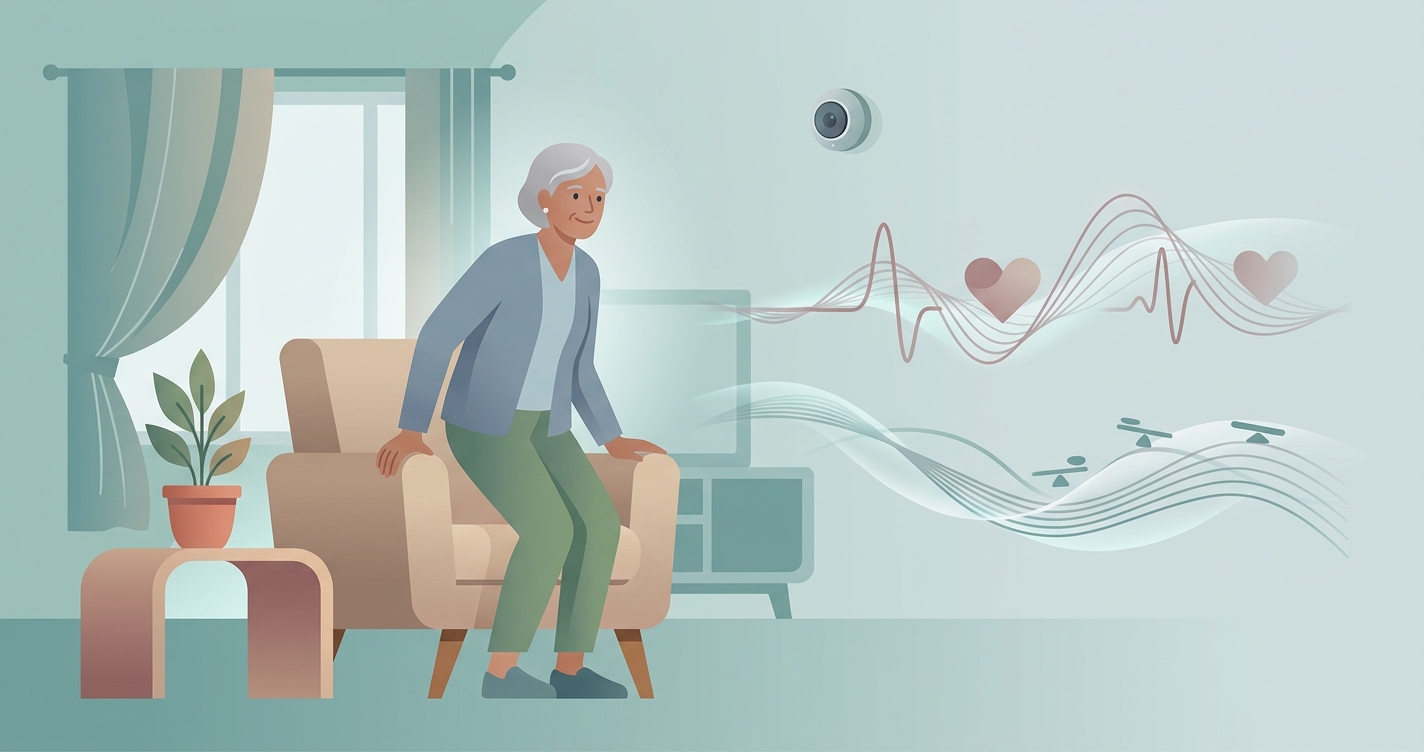
If you live with a condition that makes you light-headed when you stand up, or you run a population health program responsible for patients who do, the same worry keeps surfacing: dizziness is brief, it happens at the worst moments, and it almost never coincides with a scheduled vitals check. By the time a patient mentions it on a weekly call, the episode is long gone. The practical question for both the person at home and the care team watching over them is whether dizziness monitoring without devices is actually feasible, or whether subtle, transient symptoms simply slip through the cracks of remote care.
Dizziness is not a fringe concern. It is one of the most common and most under-investigated symptoms in older adults, and it sits directly upstream of falls, emergency visits, and avoidable readmissions. For health systems building care-at-home capacity, the inability to observe these moments is a measurable gap in coverage.
Dizziness affects roughly one in three adults aged 65 and older, and research from Imperial College London found that older people who report dizziness are more than 60 percent more likely to fall in the future and roughly twice as likely to experience recurrent falls.
What dizziness monitoring without devices actually measures
It helps to separate the symptom from its physiology. Dizziness is what the patient feels. What a remote system can observe are the cardiovascular and behavioral signals that often accompany it: a sudden drop in blood pressure when standing, a compensatory spike in heart rate, unsteady movement, or a patient sitting back down abruptly. Orthostatic hypotension, one of the most common drivers of dizziness, is defined by a measurable fall in blood pressure within seconds to minutes of standing, which makes it a physiological event rather than a purely subjective one.
Camera-based remote patient monitoring approaches this through remote photoplethysmography, or rPPG. The technique reads tiny color changes in the skin caused by each heartbeat, using an ordinary camera in a phone, tablet, or fixed sensor. From those signals a system can estimate heart rate and, with more difficulty, trends in blood pressure. The appeal for dizziness monitoring without devices is that the patient does not have to strap on a cuff at the exact moment they feel unwell. The most vulnerable seconds, standing up from a chair or getting out of bed, are precisely when wearables and manual cuffs are least likely to be in use.
A 2023 review of remote photoplethysmography for contactless cardiovascular monitoring (published in MDPI Electronics) describes rPPG as a maturing method for continuous, unobtrusive vital-sign capture, with particular promise for elderly and at-risk populations who struggle with device adherence. That said, the same literature is candid about the limits, which matter enormously for anyone evaluating these systems at scale.
How monitoring methods compare
| Monitoring approach | Captures transient dizziness episodes | Patient effort required | Adherence over time | Best-fit use | | --- | --- | --- | --- | --- | | Manual blood pressure cuff | Rarely (only if used during episode) | High | Low to moderate | Scheduled orthostatic checks | | Wearable patch or watch | Sometimes (continuous HR, limited BP) | Moderate (charging, wearing) | Moderate, declines over weeks | Continuous heart rate trends | | Symptom diary or call-in | Only as recalled later | High | Low | Qualitative history | | Camera-based contactless RPM | Potentially, during routine in-view moments | Low (no device to wear) | Higher, no compliance burden | Trend surveillance, triage flags |
The pattern that matters for population health leaders is in the last two columns. The clinical value of any monitoring tool is the product of its accuracy and the rate at which patients actually use it. A highly accurate measurement that never gets taken contributes nothing to a risk model.
- Manual cuffs are accurate but episodic, and dizziness rarely waits for the scheduled reading.
- Wearables add continuity but introduce charging, skin tolerance, and abandonment problems that erode data over time.
- Camera-based methods trade some single-point precision for far better coverage, because there is nothing to remember, wear, or charge.
Industry applications for population health programs
Post-discharge and hospital-at-home surveillance
In the days after discharge, autonomic instability, dehydration, and new medications converge to make dizziness common. A contactless platform that captures heart rate trends and movement patterns during routine video check-ins can surface a developing problem before it becomes a fall or a return trip to the emergency department. This is less about diagnosing a single episode and more about flagging a trajectory for a nurse to investigate.
Medication titration monitoring
Many cardiovascular and psychiatric medications carry orthostatic hypotension as a known side effect. When a patient starts or changes one of these drugs, the first weeks are the highest-risk window. Trend-level monitoring without devices gives a titrating clinician a way to watch for postural instability without asking an older patient to perform a structured stand test alone at home.
Fall-risk stratification for community-dwelling patients
With about 3 million older adults visiting emergency departments each year for fall-related injuries, according to the CDC, even modest improvements in early identification carry real cost and quality implications. Dizziness is an independent and often overlooked predictor. Layering passive physiological signals onto existing risk scores can help programs prioritize who gets a home-safety visit or a medication review.
Current research and evidence
The evidence base is encouraging on heart rate and more cautious on blood pressure, which is the harder of the two signals to read from a camera. A 2023 validation study of a non-contact photoplethysmography mobile application reported about 99.1 percent accuracy for heart rate, while accuracy for blood pressure was far more modest at roughly 61 percent for systolic and 56 percent for diastolic values, leading the authors to position camera-based blood pressure as a screening signal rather than a diagnostic one.
Researchers exploring blood pressure estimation in ambulatory cardiovascular patients reported a 71 percent positive predictive value for identifying elevated systolic pressure, again framing the technology as useful for trend detection and triage rather than for replacing a validated cuff. A 2023 algorithm-development study in a preoperative setting found mean absolute percentage errors of roughly 7.5 percent for diastolic and 9.5 percent for systolic pressure, which is meaningful progress but still short of high-precision medical-device standards.
The honest summary for decision-makers: camera-based monitoring is strong at detecting that something has changed, such as a heart-rate response consistent with a postural drop, and weaker at producing a single, cuff-grade number. For dizziness, where the goal is often to catch a pattern and prompt human follow-up, that profile can be a reasonable fit. The recurring caveats in the literature also deserve attention: motion artifacts, lighting variation, skin-tone representation in training data, and performance at elevated heart rates all affect reliability and should be part of any vendor evaluation.
The future of dizziness monitoring without devices
The next phase is less about a single perfect measurement and more about fusion. Combining rPPG-derived cardiovascular signals with movement analysis, gait changes, and contextual cues such as how often a patient sits down abruptly is where camera-based systems are likely to add the most value. Deep-learning methods for non-contact heart rate estimation already outperform earlier signal-processing approaches, and the same trajectory is expected for multi-signal dizziness detection.
For population health leaders, the strategic question is shifting from whether contactless monitoring can produce a perfect blood pressure reading to whether it can reliably flag the patients and moments that warrant a human response, at a coverage rate that wearables and manual checks cannot match. As validation broadens across diverse populations and comorbidities, the role of these platforms in fall prevention and post-discharge safety is positioned to grow.
Frequently asked questions
Can a camera really detect a dizzy spell as it happens?
Not the subjective sensation itself, but it can capture the physiological signatures that often accompany it, such as heart rate changes and unsteady movement, during moments the patient is in view. The strength is trend detection and triage rather than diagnosing a single episode.
Is camera-based blood pressure accurate enough to manage dizziness?
Current research positions camera-based blood pressure as a screening and trend signal, not a replacement for a validated cuff. Heart rate accuracy is high, while blood pressure accuracy is more moderate, so most programs use it to flag changes that prompt a clinical follow-up.
Why not just use a wearable for this?
Wearables can capture continuous heart rate but depend on the patient charging and wearing the device consistently, and adherence tends to decline over weeks. Contactless monitoring removes that compliance burden, which improves the odds of capturing data during high-risk moments.
What should health systems evaluate before piloting?
Ask about validation across skin tones and age groups, performance under real-world lighting and motion, how the system handles missing data, and how flags are routed to clinical staff. The integration into nursing workflow matters as much as the raw signal quality.
Circadify is building camera-based remote patient monitoring designed around exactly this problem: capturing the subtle, transient changes like dizziness that conventional check-ins miss, without asking patients to wear or charge anything. Health systems evaluating contactless surveillance for fall prevention and post-discharge safety can explore a structured RPM pilot program at circadify.com/solutions/remote-patient-monitoring.