
Expand Hospital at Home Capacity Without More Nursing Staff
Discover how virtual nursing technology allows health systems to scale their hospital-at-home programs and manage more patients without linearly increasing staff.
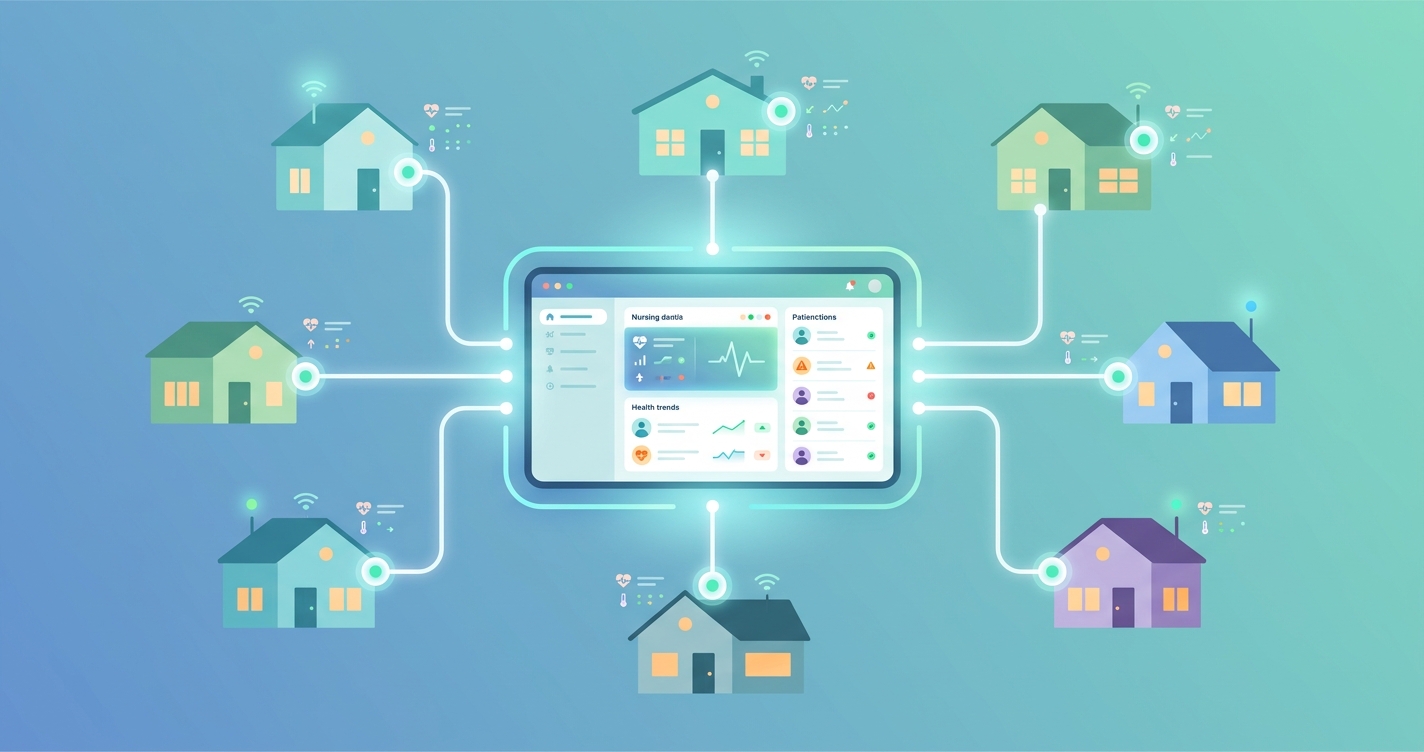
The rapid expansion of acute care beyond traditional hospital walls has exposed a structural flaw in how health systems operate. Expanding a hospital-at-home program historically required a linear increase in clinical headcount, more beds at home meant hiring more bedside nurses to monitor them. In an era of critical staffing shortages, this arithmetic quickly caps program growth. Health systems cannot simply hire their way out of capacity constraints. Instead, program directors and chief medical officers are turning to virtual nursing technology to fundamentally change the operational math. By decoupling patient volume from physical nursing rounds, hospitals can scale their remote care capacity without exhausting their workforce.
"In evaluating the impact of virtual nursing models on acute care delivery, early data indicates that 53% of clinical staff believe these remote support roles directly improve the overall quality of care, allowing experienced nurses to manage broader patient populations." , 2024 Nursing Workforce Study, Penn Nursing
Breaking the linear staffing model
For decades, hospital capacity was dictated by the physical presence of a nurse in a room. Hospital-at-home programs initially replicated this model, sending clinicians driving across town to check vital signs, assess recovery, and manage medications. While this provided high-quality care, it was operationally inefficient. The introduction of virtual nursing technology shifts this paradigm by enabling a single centralized nurse to monitor multiple patients simultaneously.
When continuous vital sign data flows into a central dashboard, virtual nurses can prioritize interventions based on clinical need rather than geographic proximity. A single remote nurse can oversee dozens of patients, stepping in via video or dispatching a physical care team only when necessary. This model drastically increases the patient-to-nurse ratio, allowing health systems to enroll more patients in acute home care without straining their existing clinical staff. Furthermore, it offers an alternative career path for experienced nurses who may be experiencing burnout from the physical demands of the floor, retaining their clinical expertise within the organization. By migrating the observational and administrative burdens away from the physical clinician, hospitals can optimize the time spent by mobile paramedics and visiting nurses, ensuring they are only dispatched for hands-on interventions.
| Metric | Traditional Hospital at Home | Virtual-Forward Hospital at Home | | :--- | :--- | :--- | | Nurse-to-Patient Ratio | Often 1:3 or 1:4 (due to travel) | Can reach 1:10 or higher | | Monitoring Style | Episodic physical visits | Continuous centralized oversight | | Staff Workload | High travel time, manual vitals | Reduced travel, data-driven alerts | | Program Capacity | Capped by local hiring limits | Highly scalable across regions |
Integrating a virtual nursing strategy into a hospital-at-home program yields several immediate operational advantages:
- Decreased reliance on physical dispatch for routine check-ins.
- Centralized management of medication reconciliation and discharge instructions.
- Real-time physiological data that flags deterioration before a scheduled visit.
- Retention of veteran nursing staff through physically less demanding remote roles.
- Improved patient satisfaction through immediate access to clinical support.
Industry Applications
Implementing a virtual care model across a hospital-at-home program allows health systems to manage diverse patient populations with a unified remote workforce. The ability to observe and assess patients without a physical visit fundamentally changes how acute care is delivered across various clinical pathways.
Post-Surgical Recovery
Patients recovering from major operations require close observation, but not necessarily physical intervention, during their first few days home. Virtual nurses can monitor heart rate, respiratory stability, and movement remotely. If a patient shows signs of tachycardia or respiratory distress, the virtual nurse can immediately initiate a video assessment and coordinate an escalating response, preventing a readmission while minimizing unnecessary home visits.
Managing chronic disease exacerbations
Patients experiencing acute exacerbations of heart failure or chronic obstructive pulmonary disease (COPD) are prime candidates for hospital-at-home care. Virtual nursing technology allows care teams to track resting heart rate and respiratory trends overnight. A centralized nurse can manage a large cohort of these patients, adjusting diuretics or coordinating oxygen therapy based on continuous data rather than waiting for morning physical rounds.
Geriatric care and aging-in-place
For elderly patients receiving acute care at home, the frequent disruption of physical visits can be exhausting and confusing. Virtual monitoring combined with a dedicated remote nurse provides continuous safety oversight. If a patient exhibits abnormal vital signs or inactivity, the virtual nurse can assess the situation visually and verbally before dispatching a mobile health paramedic.
Current research and evidence
Recent data points to the viability of scaling care through virtual nursing models. In a 2023-2024 deployment, Lee Health successfully implemented a pilot program utilizing a 1:10 virtual nurse-to-patient ratio. This effectively multiplied the capacity of their nursing staff compared to traditional physical ratios. Furthermore, a 2024 study conducted by Penn Nursing, which surveyed 880 registered nurses, highlighted that 53% of respondents believed virtual nurses improved the quality of care provided.
By mid-2023, over 330 hospitals had secured Centers for Medicare & Medicaid Services (CMS) waivers to operate hospital-at-home programs, indicating a massive industry shift toward remote acute care. As these programs mature, the integration of continuous, passive monitoring platforms will be required to maintain these higher patient ratios safely. The American Hospital Association's 2024 Health Care Workforce Scan further emphasized that retaining clinical staff requires innovative care delivery models, specifically pointing to virtual nursing as a structural solution to the ongoing workforce shortages.
The future of virtual nursing technology
The next phase of hospital-at-home expansion will rely entirely on removing friction from the patient experience while maximizing clinical efficiency. Current remote patient monitoring often depends on wearable devices, which introduce compliance issues. Elderly patients forget to charge them, take them off due to discomfort, or fail to sync them correctly. When a wearable goes offline, the virtual nurse loses their clinical visibility, forcing a physical visit and defeating the purpose of the virtual model.
To truly scale virtual nursing, health systems are shifting toward ambient and contactless monitoring. Utilizing standard devices like smartphones or tablets to measure vital signs visually removes the burden of hardware logistics and patient adherence. A virtual nurse can monitor an entire panel of patients seamlessly, relying on continuous data streams that do not require the patient to strap on a device or remember to take a reading. This frictionless data collection is the engine that will allow virtual nursing models to reach their full operational capacity.
Frequently asked questions
What is the typical patient-to-nurse ratio in a virtual nursing program?
While traditional hospital-at-home models often cap at 1:3 or 1:4 due to the logistics of travel and in-person assessments, virtual nursing programs can significantly increase this capacity. Some health systems have successfully piloted ratios of 1:10, allowing a single remote nurse to oversee a larger cohort using continuous monitoring data.
How does virtual nursing reduce bedside staff burnout?
Virtual nurses take on time-intensive administrative and observational tasks, such as medication reconciliation, discharge education, and routine vital sign monitoring. This allows bedside or mobile care nurses to focus strictly on physical interventions and acute patient needs, reducing their overall workload and travel time.
Can virtual nursing work if patients refuse to wear monitoring devices?
Yes, but it requires the right infrastructure. Programs that rely heavily on complex wearables often face compliance drops. By transitioning to contactless remote patient monitoring platforms that use existing cameras to measure vital signs, health systems can maintain continuous data flow to their virtual nurses without forcing patients to manage hardware.
Are virtual nurses replacing physical care teams in hospital-at-home programs?
No. Virtual nurses act as a force multiplier, not a replacement. They handle continuous observation and triage, dispatching physical care teams (such as mobile paramedics or visiting nurses) only when a patient requires physical assessment, medication administration, or emergency intervention.
As health systems look to expand their acute care capacity without breaking their staffing models, eliminating patient compliance barriers is essential. TryCareScan's unique approach to vital sign tracking allows your virtual nursing team to monitor patients seamlessly without shipping hardware or managing wearables. Circadify is actively addressing this space by providing technology that turns standard patient devices into powerful clinical tools. To see how a contactless approach can help scale your hospital-at-home capacity, explore our RPM pilot program today.