How does my hospital know if my heart rate is normal at 2 AM without touching me?
How a heart rate monitor no contact works overnight: passive camera, radar, and bed-sensor methods for continuous vitals in hospital-at-home programs.
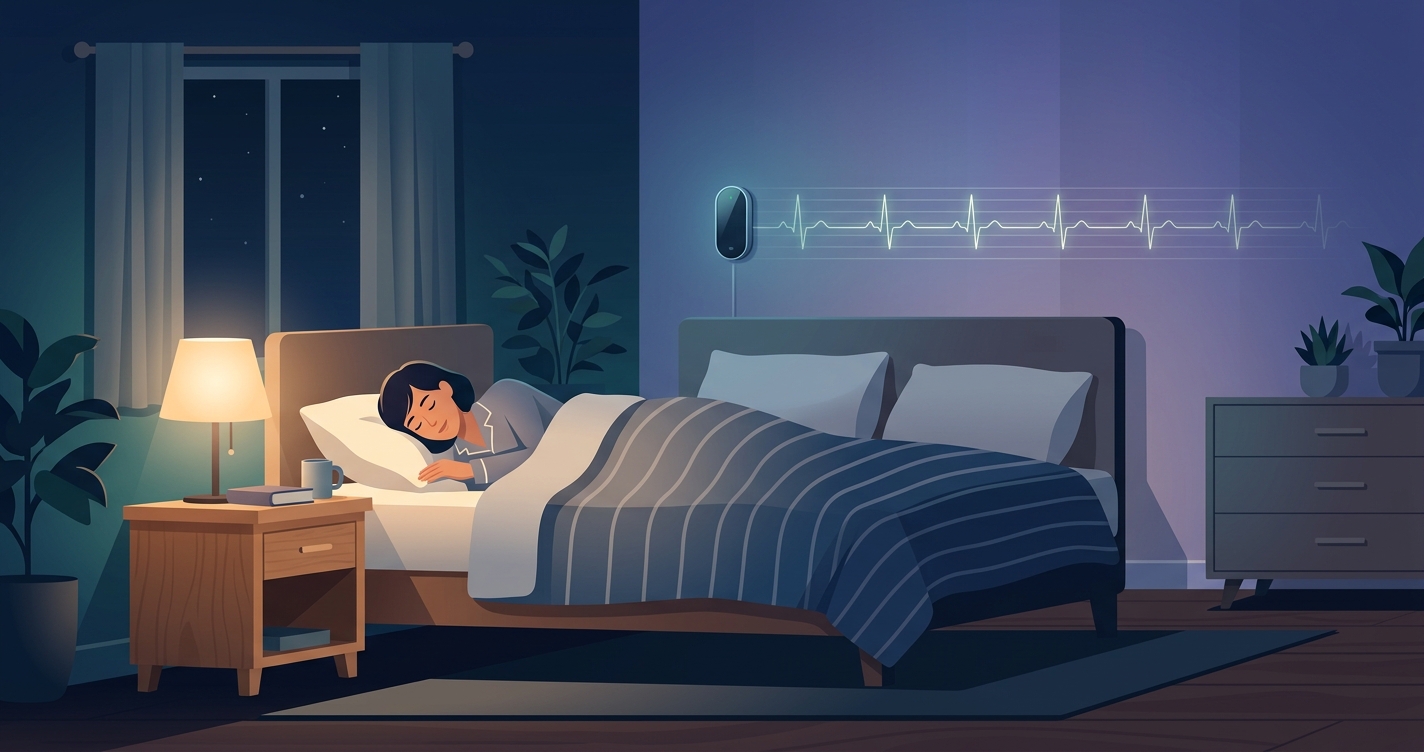
If your care team can report that your pulse was steady at 2 AM without anyone walking into the room or strapping anything to your wrist, the natural reaction is suspicion. It sounds like marketing. It is not. A heart rate monitor no contact relies on physical signals your body broadcasts whether you are awake or asleep: tiny color changes in your skin as blood pulses through it, micro-movements of your chest wall, and the faint recoil of your body each time your heart ejects blood. For hospital-at-home directors and CMOs, the question is less about whether this is possible and more about whether it is accurate enough, and reliable enough, to act on overnight when no clinician is at the bedside.
A 2023 clinical validation of remote photoplethysmography (rPPG) software in cardiovascular disease patients reported a mean absolute error of 1.061 bpm against ECG-derived pulse rate, placing camera-based pulse estimation within the tolerance most bedside protocols already accept.
What a heart rate monitor no contact actually measures
The phrase "no contact" covers three distinct sensing families, and they do not work the same way. Understanding the differences matters because the failure modes, the lighting and positioning requirements, and the night-time performance vary considerably.
The first family is remote photoplethysmography, or rPPG. A standard RGB camera, like the one in a tablet or a wall-mounted unit, records subtle fluctuations in skin color caused by the changing volume of blood in the capillaries just under the surface. Software isolates that pulsatile signal from the video and converts it into a heart rate. This is the same underlying principle as the fingertip pulse oximeter, except the light source and sensor never touch the patient.
The second family is radar. A low-power Doppler or millimeter-wave radar sensor emits a signal and reads the reflections off the chest wall. Because the chest moves with both breathing and heartbeat, signal processing can separate the two and recover a pulse rate, even through bedding and clothing. A study of one prototype radar system reported 95.3 percent accuracy for heartbeat detection in healthy subjects.
The third family is ballistocardiography (BCG), which places load cells or pressure sensors under a mattress or in the bed frame. Every heartbeat produces a tiny full-body recoil, and the sensors detect that mechanical signature. Research using an array of load cells built into a hospital bed achieved an average mean absolute error of 1.76 bpm for heart rate in the supine position, which is precisely the position most patients are in at 2 AM.
Why night-time is the harder problem
Daytime monitoring benefits from a cooperative, often seated patient. Overnight monitoring has to survive darkness, movement during sleep, blankets, and long stretches with no human in the room. Camera-based rPPG can struggle in low light and needs a visible skin region, usually the face. Radar and BCG do not care about lighting at all, which is part of why they are attractive for continuous overnight coverage. The practical answer for many programs is not one technology but a combination matched to the setting.
Comparing the contactless heart rate methods
| Method | How it senses heart rate | Works in darkness | Tolerance to movement | Reported accuracy | Best night-time use | |--------|--------------------------|-------------------|-----------------------|-------------------|---------------------| | rPPG (RGB camera) | Skin color change from blood volume | Limited without IR | Moderate; motion artifacts reduce accuracy | ~1.06 bpm MAE vs ECG (2023) | Spot checks, periodic readings on a visible face | | Radar (Doppler / mmWave) | Chest-wall micro-motion | Yes | Moderate; needs gating for gross motion | ~95.3% heartbeat detection (prototype) | Continuous overnight, works through bedding | | Ballistocardiography (bed sensors) | Whole-body recoil per beat | Yes | Good when patient is in bed | ~1.76 bpm MAE supine | Continuous overnight in a stationary bed | | Wearable PPG (for contrast) | Skin contact optical sensor | Yes | Good during sleep | Reasonable for HR/HRV in sleep | Requires charging and patient adherence |
A few operational takeaways follow directly from this comparison:
- No single contactless method dominates across every condition. Lighting, patient mobility, and bed setup decide which approach holds up overnight.
- Camera-based rPPG offers the lowest infrastructure cost because patients often already own a capable device, but it depends on a visible face and adequate light.
- Radar and BCG shine for unattended continuous coverage but require dedicated hardware placed in the home.
- The contrast with wearables is the adherence question. A device that delivers good sleep data is useless if it is on the nightstand uncharged.
Industry applications for care-at-home programs
Hospital-at-home acute monitoring
For acute patients managed at home, the overnight window is where deterioration often hides. Continuous contactless heart rate, paired with respiratory rate from the same sensor stream, lets a virtual nursing team set thresholds and receive alerts without waking the patient for manual vitals. Radar and bed-based BCG are the natural fit here because they run unattended through the night.
Post-discharge and readmission reduction
Many readmissions trace back to subtle trend changes in the days after discharge. A heart rate monitor no contact that captures a nightly resting pulse gives clinicians a clean baseline, since resting heart rate measured during sleep is less confounded by activity. Rising overnight heart rate can be an early signal worth a phone call before a patient lands back in the emergency department.
Patients who cannot tolerate contact sensors
Contactless sensing was originally championed for patients with burns, fragile skin, infectious isolation needs, or cognitive conditions that make wearables impractical. For these populations, a camera or radar unit is not just convenient, it may be the only feasible continuous option.
Current research and evidence
The evidence base for contactless heart rate has matured quickly. The 2023 rPPG validation in cardiovascular disease patients is notable because it tested the method in a clinical population rather than healthy volunteers, reporting agreement with ECG within roughly one beat per minute. Reviews of rPPG methods published through 2024 consistently identify motion artifacts and skin-tone diversity as the central challenges, and they document deep-learning approaches developed specifically to suppress motion noise during activity.
On the radar side, work on millimeter-wave (76 to 81 GHz) sensing firmware has demonstrated short-range vital sign detection through clothing, and a comparison of ballistocardiography against conventional bedside monitors found good correlation for heart rate in hospital settings. The load-cell hospital-bed study, with its sub-2-bpm supine error, is particularly relevant to overnight care because it reflects the exact body position and stillness of a sleeping patient.
What the literature is careful to note is the gap between a validated method and a fully validated commercial system across all conditions and demographics. Accuracy reported in controlled cohorts does not automatically transfer to a poorly lit bedroom with a restless patient. Programs evaluating these tools should ask for performance data that matches their own patient mix and home environments, not just laboratory benchmarks.
The future of contactless heart rate monitoring
The trajectory points toward multi-modal sensing. Reviews of contactless vital sign monitoring increasingly frame the future as combining camera, radar, and bed-based signals so that the system falls back gracefully when one modality degrades. When the room goes dark, radar carries the load. When the patient sits up to read, the camera can confirm. Fusion of these streams, with on-device processing to protect privacy, is where the field is heading.
The second shift is from single readings to trends. The clinical value of overnight monitoring is not one perfect 2 AM number; it is the night-over-night pattern that reveals a patient drifting toward trouble. As these systems accumulate baselines, the alerting logic becomes less about absolute thresholds and more about deviation from an individual's own normal.
Frequently asked questions
Can a camera really measure my heart rate without touching me? Yes. Remote photoplethysmography reads tiny color changes in your skin caused by blood pulsing through capillaries. A 2023 clinical study in cardiovascular patients found camera-based pulse rate agreed with ECG to within about one beat per minute, though performance depends on lighting and a visible face.
How does the hospital monitor me overnight when it is dark? Camera methods need light or infrared, so overnight coverage often relies on radar or under-mattress bed sensors instead. Both work in complete darkness and through bedding by detecting chest-wall motion or the body's recoil with each heartbeat.
Is contactless heart rate as accurate as a wrist wearable? In controlled studies the accuracy is comparable, with errors around one to two beats per minute. The bigger practical difference is adherence: contactless systems keep working whether or not you remember to wear or charge anything, which is a frequent failure point for wearables overnight.
What happens if I move around in my sleep? Movement is the main source of error for all contactless methods. Modern systems use signal processing and motion gating to discard unreliable segments and report a rate only when the signal is clean, which is why continuous overnight monitoring captures many valid readings across a night even with normal tossing and turning.
Circadify is building toward this contactless future with a camera-based remote patient monitoring approach designed around the adherence problem that undermines wearable programs. Care-at-home leaders evaluating continuous overnight vitals without devices can explore a structured RPM pilot program to test the model against their own patient population and home environments.