Will my recovery at home be as good as in the hospital without all the wires?
An evidence review of hospital at home vital signs monitoring, comparing wired inpatient telemetry with contactless tools for safety, satisfaction, and recovery.
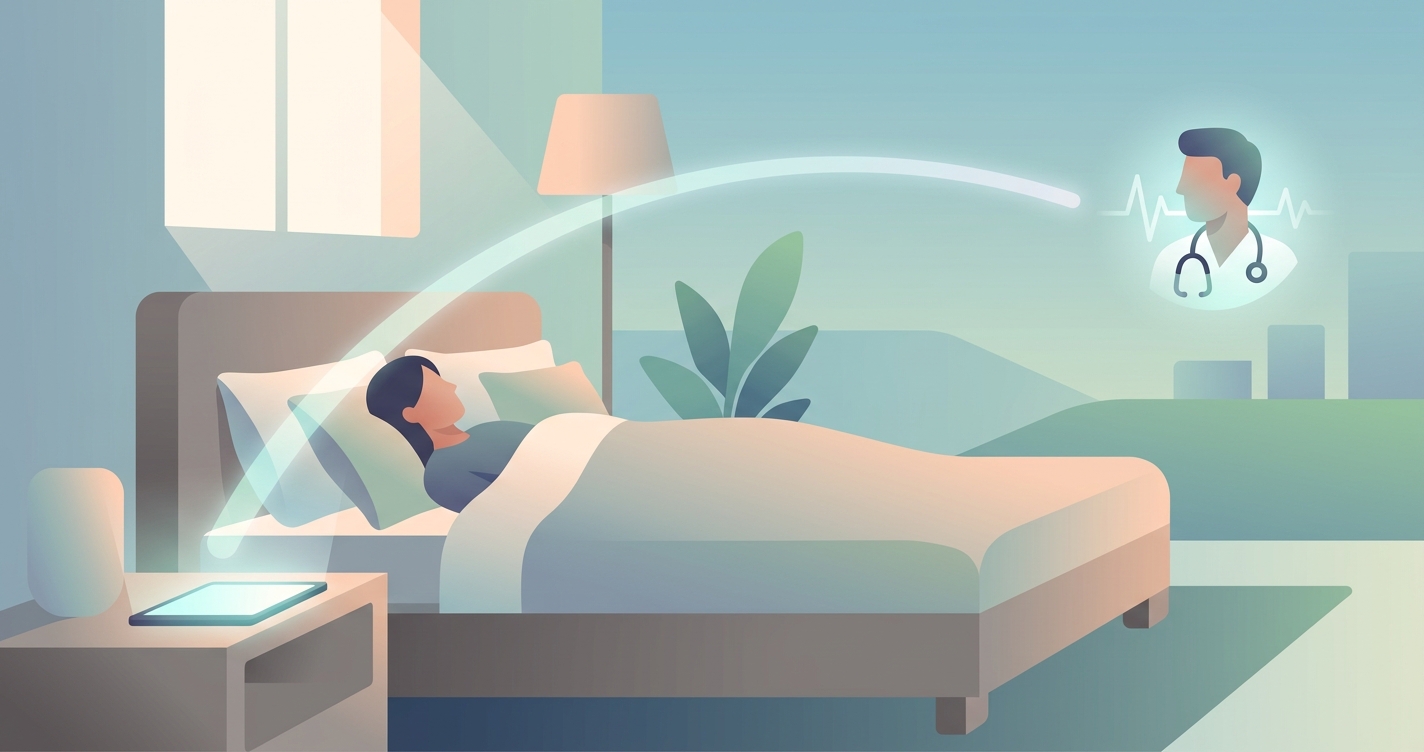
If your care team is offering to finish your recovery at home, the absence of the bedside monitor and its tangle of cables can feel like a downgrade. The reassuring beep, the wires taped to your chest, the cuff that squeezes every hour: these have become shorthand for "someone is watching." So the worry is understandable. The question of whether hospital at home vital signs monitoring can match a staffed ward is now one of the most common conversations between patients, families, and the program directors who design these services. The short answer, supported by a growing body of national data, is that home-based acute care is producing outcomes that are equal to or better than the traditional inpatient stay, and the monitoring methods have matured well beyond a chest full of leads.
A national study of Medicare data from July 2022 to June 2023 reported a 0.5% mortality rate during acute care at home and a 3.2% mortality rate within 30 days of discharge, results that a September 2024 CMS report found generally favorable compared with brick-and-mortar inpatient care.
What "hospital at home vital signs" monitoring actually means
The phrase covers more than a single device. In a conventional hospital room, continuous telemetry tracks heart rhythm, oxygen saturation, and respiration through adhesive electrodes and finger clips. That setup exists because a nurse cannot stand at every bedside around the clock. At home, the same clinical question, is this patient stable, is answered through a layered system rather than a single wired box. Hospital at home vital signs programs typically combine scheduled clinician check-ins, periodic spot measurements, and increasingly, contactless tools that read heart rate, breathing rate, and other signals without anything touching the skin.
The important distinction for patients is that "no wires" does not mean "no monitoring." It means the monitoring has been redistributed. Instead of one continuous feed watched intermittently, home programs use defined measurement windows, automated alerts, and a virtual nursing layer that reviews data and calls when something looks off. The wires were never the source of safety. The clinical judgment behind the data was.
Most acute hospital at home programs in the United States operate under the CMS Acute Hospital Care at Home waiver, which requires two daily clinician contacts and the ability to escalate to in-person care quickly. That regulatory floor is part of why outcomes have held up.
How the home model compares to the ward
The table below summarizes how the two settings handle the same monitoring tasks.
| Monitoring dimension | Traditional inpatient ward | Hospital at home program | | --- | --- | --- | | Vital sign capture | Continuous wired telemetry and clips | Scheduled checks plus contactless or connected readings | | Who reviews data | Floor nurses, intermittent rounding | Virtual nursing team plus in-home visits | | Patient comfort | Adhesives, cables, frequent interruptions | Sleep in own bed, fewer nighttime disturbances | | Infection exposure | Hospital-acquired infection risk present | Reduced exposure at home | | Escalation path | On-site rapid response | Defined transfer protocol to facility | | Patient satisfaction | Variable, noise and disruption common | Consistently high in published studies | | Family involvement | Restricted visiting hours | Caregiver present and engaged |
The pattern that emerges is not that home care removes oversight. It is that home care trades the constant low-level interruption of a ward for a structured, less intrusive rhythm, while preserving a fast route back to the hospital if needed.
Why patients often recover at least as well at home
Several factors explain why outcomes hold up when the wires come off.
- Sleep quality improves. Hospital wards are noisy, and frequent overnight checks fragment rest, which matters for healing.
- Hospital-acquired infections and delirium, both more common in older inpatients, drop when the patient is in a familiar environment.
- Mobility tends to increase at home, where patients walk to their own kitchen rather than staying in bed.
- Caregivers become active participants, providing an extra layer of observation that no ward can match.
- Medication routines often align better with the patient's normal life, improving adherence after discharge.
A widely cited review summarized by AHRQ's PSNet found that hospital at home care for elderly patients reduced costs, lowered readmissions and complications, and improved satisfaction relative to inpatient care. The 44% reduction in readmissions reported by one home-recovery program is at the stronger end of these findings, but the direction is consistent across studies.
Industry applications for care-at-home program directors
For the people building these services, the monitoring layer is where patient confidence is won or lost. Three application areas stand out.
Post-surgical and acute episode recovery
Patients discharged after surgery or an acute medical episode are the core population. Here the goal is early detection of deterioration: a rising heart rate, a climbing respiratory rate, or falling oxygen saturation. Contactless measurement through a tablet or phone camera lets programs capture these signals during routine video check-ins without shipping and tracking a kit of peripherals.
Patients who struggle with device compliance
The quiet failure mode of remote patient monitoring is the unworn wearable and the unused cuff. Cameras sidestep this entirely. A patient who can sit in front of a screen can be measured, which removes the charging, syncing, and wearing burden that drives device attrition. For program directors, that translates into more complete data and fewer gaps that force a phone call or a visit.
Patients living alone or in rural areas
For isolated patients, the virtual nursing layer is the safety net. Contactless checks paired with scheduled clinician contact extend a program's reach without putting a staff member in a car for every reading. This is where camera-based hospital at home vital signs monitoring meaningfully expands capacity.
Current research and evidence
The evidence base now spans both the care model and the measurement technology.
On the care model, the July 2024 USC Schaeffer Center study found that most Americans view hospital-level care at home as appealing and safe, with 56% believing they would recover faster at home. Mass General Brigham's research program, one of the most studied in the country, has reported that inpatient-level care delivered at home achieves outcomes comparable to traditional admission. The national Medicare analysis covering July 2022 to June 2023 reinforced this with low mortality and the encouraging CMS assessment published in September 2024.
On the measurement side, contactless monitoring has moved from laboratory curiosity to validated tool. A 2023 systematic review published in PMC, "Continuous Monitoring of Vital Signs Using Cameras," catalogued the maturation of remote photoplethysmography (rPPG), the technique that reads tiny color changes in the skin to estimate heart rate. A separate PMC evaluation compared a camera-based solution against regulated medical devices for heart rate, respiratory rate, oxygen saturation, and blood pressure. Smartphone rPPG studies have reported high predictive accuracy for heart rate, with respiratory rate close behind, though researchers consistently note that motion, lighting, skin tone variance, and camera distance can affect readings and must be controlled.
The honest reading of the literature is that contactless monitoring is strong for the common vital signs that drive home-care alerts, with documented limits at the extremes of physiology. That is exactly why these tools sit inside a clinician-supervised program rather than replacing professional judgment.
The Future of hospital at home vital signs monitoring
The direction of travel is toward measurement that disappears into the background of daily life. Several shifts are underway.
- Deep learning is steadily improving rPPG accuracy across skin tones and lighting conditions, narrowing the gap that earlier camera systems struggled with.
- Passive monitoring during normal video visits will reduce the number of discrete "measurement tasks" a patient has to perform.
- Payer and provider interest is converging, as partnerships increasingly treat home-based monitoring as a lever for lowering total cost of care.
- Regulatory frameworks, currently tied to temporary waivers, are likely to stabilize as the outcome data accumulates, giving program directors a firmer planning horizon.
The combined trend is clear. The wires were a constraint of the building, not a requirement of safe recovery. As monitoring becomes contactless and continuous in the background, the home is positioned to become a default site of care for a widening set of conditions.
Frequently asked questions
Is home monitoring without wires as safe as hospital telemetry?
For appropriately selected patients in a structured program, the published evidence shows comparable safety. National Medicare data reported a 0.5% in-program mortality rate, and a September 2024 CMS report found home outcomes generally favorable versus inpatient care. Safety comes from the clinical program around the data, not from the wires themselves.
How can a camera measure my heart rate and breathing without touching me?
Camera-based systems use remote photoplethysmography, which detects subtle color changes in your skin caused by blood flow, and motion analysis to count breaths. Peer-reviewed evaluations in 2023 found good agreement with regulated medical devices for heart rate and respiratory rate under controlled conditions.
What happens if my vital signs look abnormal at home?
Acute hospital at home programs operate under defined escalation protocols, including at least two daily clinician contacts under the CMS waiver and a rapid path back to the facility. Abnormal readings trigger a clinician review and, if needed, a call or in-person visit.
Will I recover faster at home than in the hospital?
Many patients do. Improved sleep, lower infection and delirium risk, and more mobility contribute to recovery. The 2024 USC Schaeffer survey found 56% of Americans believe they would recover faster at home, and outcome studies show readmissions and complications often fall.
Circadify is addressing this space with camera-based remote patient monitoring designed to capture hospital at home vital signs without the wearables and peripherals that patients abandon. Care-at-home program directors evaluating how to keep patients confident and monitored after discharge can explore a structured RPM pilot program at circadify.com/solutions/remote-patient-monitoring.