How can my hospital keep an eye on me after I go home?
How hospitals monitor patients at home after discharge, with research on remote patient monitoring, readmissions, hospital-at-home models, and caregiver burden.
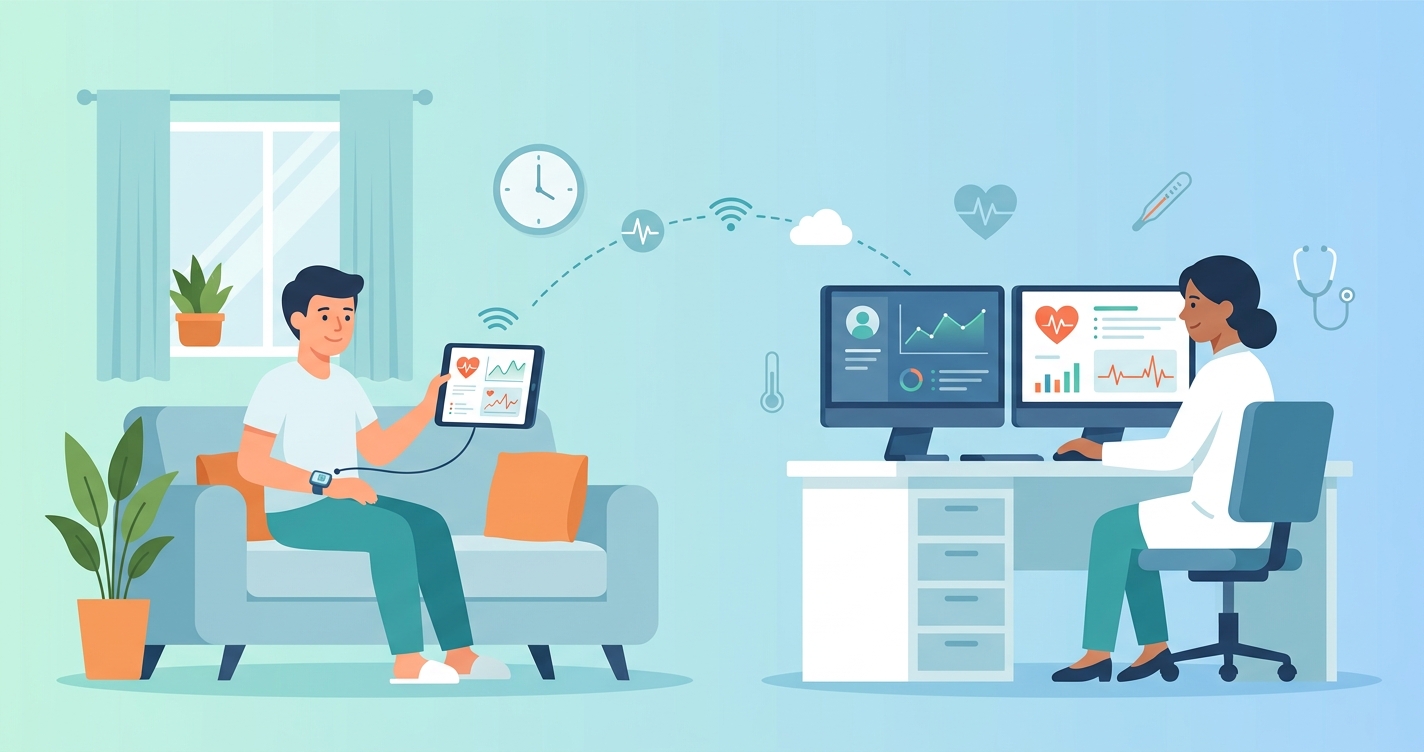
Hospital monitor patient at home is the plain-English version of a much bigger healthcare shift. After discharge, many hospitals now try to keep a closer watch on patients through remote patient monitoring, symptom check-ins, virtual nursing, and hospital-at-home programs. The goal is simple: catch trouble early enough that a patient does not end up back in the emergency department a few days later. What changes from program to program is how that watch happens, how much equipment is involved, and how quickly a care team can act when something starts to drift.
"Patients are generally positive" about hospital-at-home services, but the model still depends on clear accountability, workable technology, and realistic support for families. — Sally Howard, The BMJ, 2024
How hospitals monitor patients at home after discharge
When people ask, "How can my hospital keep an eye on me after I go home?" they are usually imagining one of three models.
The first is classic remote patient monitoring. A patient is sent home with a blood pressure cuff, pulse oximeter, scale, thermometer, tablet, or some mix of those tools. Readings are transmitted to a hospital team that reviews trends and follows up when thresholds are crossed.
The second is a virtual follow-up model. Instead of constant device feeds, the patient gets scheduled symptom check-ins, nursing calls, text-based questionnaires, or video visits during the first days or weeks after discharge.
The third is hospital-at-home or advanced care at home. In that model, the patient still receives hospital-level oversight, but part of the observation happens through remote monitoring, digital communication, and home-based clinician visits.
None of this means a hospital is literally watching a patient every minute. That image makes the model sound more intrusive than it usually is. In practice, hospitals watch for changes in risk. They look for worsening vital signs, missed check-ins, symptom escalation, or patterns that suggest the patient needs a nurse call, medication adjustment, urgent clinic visit, or return to acute care.
| Post-discharge monitoring model | How it works | Typical tools | Main advantage | Main tradeoff | |---|---|---|---|---| | Device-based RPM | Patient sends readings from home | BP cuff, pulse oximeter, scale, glucometer, tablet | Direct physiologic data | More equipment and setup burden | | Virtual nursing follow-up | Scheduled outreach after discharge | Phone, text, portal, video visit | Lower friction for many patients | Less continuous biometric data | | Hospital-at-home | Acute care oversight continues in the home | Remote monitoring plus home visits | Can extend higher-acuity care beyond hospital walls | Requires strong logistics and escalation workflows | | Camera-based monitoring | Short guided scans through existing cameras | Smartphone, tablet, laptop, webcam | Lower hardware burden and easier repeat use | Still depends on signal quality, lighting, and workflow design |
What hospitals are really trying to prevent
Most post-discharge programs are built around the same ugly problem: the first days at home are unstable.
Medication changes may still be confusing. Symptoms may worsen before the patient realizes they matter. Family caregivers may not know which changes are normal and which need a call. That's why the discharge period gets so much attention from care-at-home teams.
Ali Al-Samarraie and colleagues published a 2023 systematic review and meta-analysis in BMJ Open covering 100 remote patient monitoring studies. Their headline result was encouraging but not magical. RPM was associated with lower hospital admissions and fewer emergency department visits in some conditions, especially heart failure and COPD, but the effect was not uniform across every population and every program design. I like that the paper leaves some room for reality. It suggests the model can work, but it does not pretend every dashboard automatically fixes transitions of care.
That point matters for patients and families. A hospital can keep a closer eye on you after discharge, but the program has to be set up well. Good monitoring is not just about owning devices. It is about making sure someone sees the data, knows what to do with it, and reaches out before a bad day becomes a readmission.
Useful warning signs hospitals commonly watch for include:
- rising blood pressure after discharge for cardiovascular patients
- low oxygen readings or worsening shortness of breath in respiratory pathways
- sudden weight gain in heart failure monitoring
- fever, pain, or mobility decline after surgery
- missed check-ins, which often signal confusion, fatigue, or disengagement
- caregiver concern, even when the numbers look acceptable
Why simplicity often matters more than people expect
The technology story is important, but the workflow story is usually bigger.
Hospitals can send home a kit full of devices and still get weak follow-through if the patient is exhausted, the instructions are confusing, or the login process breaks. That is one reason lower-friction monitoring models keep getting attention. A program that fits into ordinary life tends to produce more usable data than a more elaborate one patients stop using after day four.
A 2024 prospective cohort study in JMIR Formative Research looked at high-risk post-discharge patients using home digital monitoring with regular follow-up. The study found average hospitalizations dropped from 0.45 to 0.19 at three months, and average emergency department visits fell from 0.48 to 0.06. At six months, hospitalizations were still lower than baseline, dropping from 0.55 to 0.23. Those are not universal guarantees, but they do show what can happen when monitoring is paired with actual follow-up instead of just passive data collection.
This is where hospitals start asking harder operational questions:
- Does the patient need another piece of hardware, or can the program use a phone they already have?
- Will a nurse review alerts in real time or only during business hours?
- Is the goal chronic disease stabilization, post-surgical recovery, or short-term discharge surveillance?
- What happens if the patient misses two days of readings?
- How much of the burden lands on a spouse, adult child, or home aide?
Those questions are not technical trivia. They are the difference between a monitoring program that feels reassuring and one that quietly shifts work onto the patient.
Industry applications
Cardiac and heart failure follow-up
Cardiovascular pathways remain one of the clearest post-discharge use cases. Al-Samarraie's review found a significant reduction in hospital admissions for heart failure, with a relative risk of 0.77, and a significant reduction in emergency department visits, with a relative risk of 0.79. That helps explain why heart failure teams still show up early in RPM adoption.
COPD and respiratory recovery
COPD is another area where post-discharge monitoring makes clinical sense. In the same BMJ Open review, COPD programs were associated with reduced hospital admissions, with a relative risk of 0.78. Respiratory pathways often rely on pulse oximeters and symptom escalation protocols because oxygen-related deterioration can become urgent quickly.
Surgical and medical discharge surveillance
Not every patient needs a complex care-at-home setup. Sometimes the hospital just needs a light-touch way to check whether recovery is moving in the right direction. That can mean vital sign prompts, symptom surveys, wound-photo review, or quick video follow-ups during the first week home.
Hospital-at-home and advanced care at home
Bruce Leff and colleagues, writing in 2024 about the current status of hospital-at-home in the United States, describe a model that has grown because digital monitoring, home-based logistics, and reimbursement changes made it more feasible. But even in that more advanced version of care, the same rule holds: remote oversight only works if escalation is clear. Technology alone is not the care model.
Current research and evidence
The evidence base is strong enough to take seriously and messy enough to stay honest.
Al-Samarraie and colleagues reviewed 100 studies and found that RPM can reduce acute care use in specific populations, especially heart failure and COPD. That is a meaningful signal for hospitals trying to lower readmissions without overpromising.
The JMIR Formative Research cohort study adds a second, more practical point: structured home monitoring plus follow-up can reduce hospital use in high-risk discharge populations when patients and caregivers are taught how to use the system and someone is checking the data.
Sally Howard's 2024 reporting in The BMJ adds something clinical studies sometimes miss. Patients often like receiving care at home, but they can still feel unsure about who is responsible when a new symptom appears. Howard cited survey data showing 95.8% of patients preferred hospital-at-home over inpatient care in one referenced survey, largely because of comfort and proximity to family. At the same time, she pointed to risks around digital exclusion and caregiver burden.
I think that combination is the most believable summary of the field right now. People often prefer being home. Hospitals want fewer avoidable readmissions. The part nobody should gloss over is execution. Monitoring only helps when the patient knows what to do, the hospital knows when to intervene, and the caregiver is not left holding the whole system together.
A few evidence-based takeaways keep showing up:
- post-discharge monitoring works best when it starts during the hospital stay and continues after discharge
- condition-specific pathways usually perform better than one-size-fits-all outreach
- adherence and ease of use matter as much as sensor sophistication
- caregiver burden is a real design issue, not an afterthought
- lower-friction monitoring models may widen participation when device-heavy workflows would fail
The future of hospital monitor patient at home programs
The next version of post-discharge monitoring will probably look less like a gadget bundle and more like a layered service.
Some patients will still need dedicated devices because the clinical pathway demands them. Others may do better with virtual nursing, passive symptom surveillance, or camera-based monitoring that avoids the usual wearable compliance problems. For hospitals, that is the appealing part of software-first models: they can reduce shipping, replacement, charging, and training demands while still keeping patients connected.
I would expect three shifts over the next few years:
- more segmentation, with lighter monitoring for lower-risk discharges and more intensive oversight for complex patients
- more emphasis on patient experience, because frustration and dropout can wreck a program faster than bad analytics
- more interest in contactless and camera-based approaches for patients who resist wearables or never stick with device-heavy workflows
The big question is not whether hospitals can keep an eye on patients at home. They can. The harder question is whether they can do it in a way patients will actually use.
Frequently asked questions
How can a hospital monitor a patient at home after discharge?
Usually through remote patient monitoring devices, scheduled symptom check-ins, virtual nursing, or hospital-at-home services that combine digital oversight with home-based care.
Does home monitoring mean someone is watching me all the time?
Usually no. Most programs review scheduled readings, symptoms, and alerts rather than continuously watching a live feed.
What conditions are most often monitored at home?
Heart failure, COPD, hypertension, post-surgical recovery, diabetes, and other conditions where early deterioration can be spotted through symptoms or vital signs.
What if I do not want to manage a lot of equipment?
That is becoming a bigger design focus. Some programs now use lighter-touch workflows, virtual follow-up, or camera-based monitoring to reduce the burden of extra devices.
If your health system is rethinking how to keep patients connected after discharge, Circadify is part of the move toward software-first remote patient monitoring for care-at-home programs. For related reading, see What Is Passive Patient Monitoring? No-Touch RPM Explained for Clinicians and How to Scale Hospital-at-Home Programs Without Adding Logistics Staff.