
How RPM Supports Value-Based Care Contracts
Research-based analysis of how RPM supports value-based care contracts by improving follow-up, lowering avoidable utilization, and strengthening care-at-home operations.
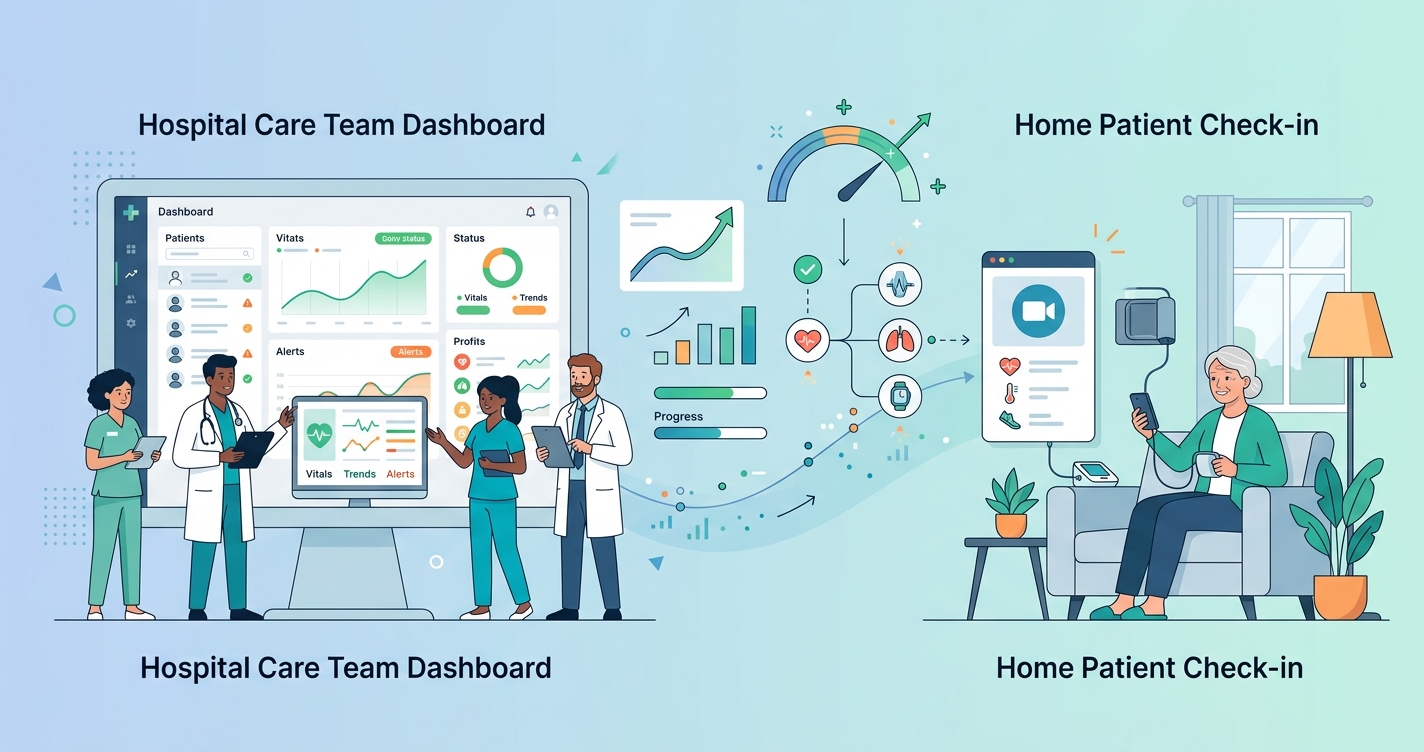
RPM value based care contracts are really about one thing: whether a health system can keep patients stable after the visit, after the discharge, and between touchpoints that used to happen only inside a building. That is why remote patient monitoring keeps showing up in conversations about accountable care, bundled payments, Medicare Advantage risk models, and hospital-at-home strategy. Leaders are not buying RPM because the data looks modern. They are buying it because value-based contracts reward fewer avoidable readmissions, fewer unnecessary emergency visits, better chronic disease follow-up, and more confidence that a patient at home is not quietly getting worse.
"Use of general remote patient monitoring increased 555% from February 2020 to September 2021 in traditional Medicare." — Mitchell Tang, Carter H. Nakamoto, Ariel D. Stern, and Ateev Mehrotra, JAMA Internal Medicine (2022)
Why RPM matters in value-based care contracts
Fee-for-service programs can tolerate some waste. Value-based contracts usually cannot. Once a health system takes downside risk, every preventable ED return, every avoidable readmission, and every poorly managed transition starts to hit both clinical outcomes and financial performance.
That is where RPM becomes useful. It gives care teams more chances to intervene before deterioration turns into acute utilization. Eric W. Maurer and colleagues studied a post-ED discharge RPM program across 10 hospitals and found that patients who activated the program had a 16.2% lower hazard of returning to the emergency department over the following year. I would not pretend one study settles the question, but it points in the direction value-based operators care about most: fewer rebound encounters.
David M. Levine and colleagues made a similar point from another angle in their Annals of Internal Medicine trial of hospital-level care at home. Their home hospital model, which depended on remote monitoring and in-home clinical support, produced lower adjusted costs and lower use of laboratory testing and imaging than traditional hospital care. That matters because value-based contracts reward total-cost performance, not just individual encounter reimbursement.
Comparison table: how RPM supports contract performance
| Contract pressure point | Without RPM | With a well-run RPM model |
|---|---|---|
| Post-discharge visibility | Limited until the next office visit or crisis call | Daily or scheduled review creates earlier visibility into decline |
| Readmission risk | Deterioration often discovered late | Care teams can escalate sooner and redirect follow-up |
| ED utilization | Patients default to the ED when symptoms feel uncertain | Nurse outreach and monitoring data create other pathways |
| Chronic disease management | Follow-up depends heavily on patient initiative | Programs can track trends and adherence more consistently |
| Hospital-at-home scalability | Hard to manage safely without home data | Monitoring supports risk-bearing care outside the hospital |
| Contract economics | Savings depend on blunt utilization controls | Savings can come from better continuity and earlier intervention |
What value-based care buyers are actually trying to buy
Hospital CMOs and population health leaders usually do not talk about RPM as a gadget category. They talk about contract mechanics.
The most common goals are pretty practical:
- reduce readmissions in post-discharge populations
- lower avoidable ED utilization in high-risk cohorts
- extend chronic disease management between visits
- support hospital-at-home or care-at-home pathways
- give virtual nursing teams a clearer triage workflow
- improve documentation around patient engagement and intervention
I keep coming back to that last point. Value-based care contracts do not pay off just because data exists. They pay off when care teams can translate that data into documented actions, faster follow-up, and cleaner escalation logic.
Where RPM tends to create the most contract value
Transitional care after discharge
This is probably the clearest use case. The patient leaves the hospital and enters a period where risk is elevated but traditional follow-up is thin. Maurer and colleagues showed why this matters. If an RPM program can reduce return ED use after discharge, that effect lands directly in the utilization metrics that matter under shared savings and bundled arrangements.
For value-based operators, the logic is straightforward: the cheapest readmission is the one that never happens because the patient got a nurse call, a medication adjustment, or an earlier clinic review instead of waiting until symptoms became urgent.
Chronic disease pathways
Tang, Nakamoto, Stern, and Mehrotra found that early Medicare RPM use was concentrated in patients with common chronic conditions such as hypertension and diabetes. That pattern makes sense. Chronic disease care is exactly where value-based contracts live or die: recurring utilization, measurable trends, and lots of opportunities for small misses to become expensive events.
RPM is useful here because it changes follow-up from episodic to more continuous. The care team does not have to guess who is drifting. They can see more of it.
Hospital at home and home-based acute care
Levine's home hospital trial remains one of the most cited examples because it linked remote oversight to lower cost and strong patient experience. Jared Conley and David Whitehead later argued in JMIR that RPM is a core operating layer for hospital-at-home programs because clinicians need enough visibility to manage acute patients outside the building.
That is relevant to value-based contracts for a simple reason: care-at-home models only work financially when they reduce costly facility use without losing control of patient risk.
Virtual nursing and centralized triage
Some value-based savings do not come from one headline outcome. They come from smoother operations. The American Medical Association's RPM implementation guidance keeps stressing workflow design, dedicated staff, and escalation rules. That sounds boring, but it is the whole game. Contracts get better when the first reviewer is the right reviewer, when alerts do not pile up without ownership, and when clinicians are working at the top of license.
Current research and evidence
The evidence base for RPM in value-based care is really a mix of utilization studies, implementation studies, and payment trend data.
Tang, Nakamoto, Stern, and Mehrotra documented how quickly RPM entered mainstream Medicare reimbursement once the operational pathway became clearer. A 555% increase in use over that early pandemic period tells you RPM stopped being an edge case.
Maurer and colleagues added an outcome signal that value-based executives care about more than adoption curves. Their multi-hospital post-ED study found lower subsequent ED return risk among activated RPM patients. That is not the same as saying every RPM program reduces utilization. It does say the model can influence one of the cost categories that shows up quickly in risk contracts.
Levine and colleagues contributed the acute-care economics angle. In their randomized trial, home hospital care supported by monitoring and in-home clinical services delivered lower adjusted mean cost with lower lab and imaging use. For a system carrying risk, that is exactly the kind of operational substitution worth watching.
There is also the implementation lesson. Katharine Lawrence, Nina Singh, Zoe Jonassen, Lisa L. Groom, Veronica Alfaro Arias, Soumik Mandal, Antoinette Schoenthaler, Devin Mann, Oded Nov, and Graham Dove reported in JMIR Human Factors that RPM adoption inside a large academic health system depended heavily on workflow fit. Clinicians saw value, but only when staffing, routing, and patient expectations were clear. I think that finding matters just as much as the utilization studies, because poorly routed RPM data does not help a value-based contract. It just creates another inbox.
What separates useful RPM from expensive noise
A lot of value-based RPM discussions sound too clean. In practice, programs break down for very ordinary reasons:
- patients are enrolled without a clear intervention pathway
- alert thresholds are too loose or too noisy
- physicians are asked to review too much raw data
- onboarding is weak, so adherence falls off after the first week
- dashboards sit outside the real care workflow
- financial teams measure enrollment instead of actionability
That is why camera-based and lower-friction RPM models are getting attention. If a program reduces hardware logistics and setup burden, the care team can spend more energy on triage and intervention. For a health system under contract risk, that is much more valuable than shipping one more box.
The future of RPM under value-based contracts
The next phase of RPM will probably look less like stand-alone device programs and more like an operating layer inside broader care-at-home strategy. Health systems are trying to combine post-discharge follow-up, chronic disease management, virtual nursing, and hospital-at-home into something coherent. RPM fits because it gives those programs a common visibility layer.
I do not think the winners will be the organizations that collect the most data. They will be the ones that use RPM to answer a narrower question: which patients need outreach now, which patients can safely stay home, and which care teams own the next step?
That is what makes RPM useful in value-based care contracts. It gives risk-bearing health systems a way to move from reactive follow-up to earlier intervention.
Frequently asked questions
How does RPM support value-based care contracts?
RPM supports value-based care contracts by giving care teams earlier visibility into deterioration, improving post-discharge follow-up, and helping reduce avoidable utilization such as ED revisits and readmissions.
Which value-based models benefit most from RPM?
Accountable care arrangements, bundled payment programs, Medicare Advantage populations, chronic disease pathways, and hospital-at-home models are among the settings where RPM can have the clearest financial and clinical impact.
Is RPM mainly a reimbursement tactic or a care model?
It is mostly a care model. Reimbursement matters, but under value-based contracts the bigger question is whether RPM improves continuity, escalation speed, and total-cost performance.
Why do some RPM programs fail in value-based care?
They usually fail because of workflow problems: weak onboarding, unclear staffing ownership, too many low-value alerts, or poor integration into the clinical response process.
RPM supports value-based care contracts when it gives health systems a more reliable way to manage risk between visits instead of reacting only after utilization has already happened. Solutions like Circadify fit into that shift toward lower-friction remote monitoring for health systems trying to manage more care at home. For related reading, see How RPM Reduces Emergency Department Overcrowding and The Clinical Workflow for Camera-Based Remote Patient Monitoring.