Can my hospital watch my breathing all night long without me wearing anything?
How contactless, camera and radar-based patient monitoring without devices lets hospitals track breathing overnight with no wearable, no straps, and no sleep disruption.
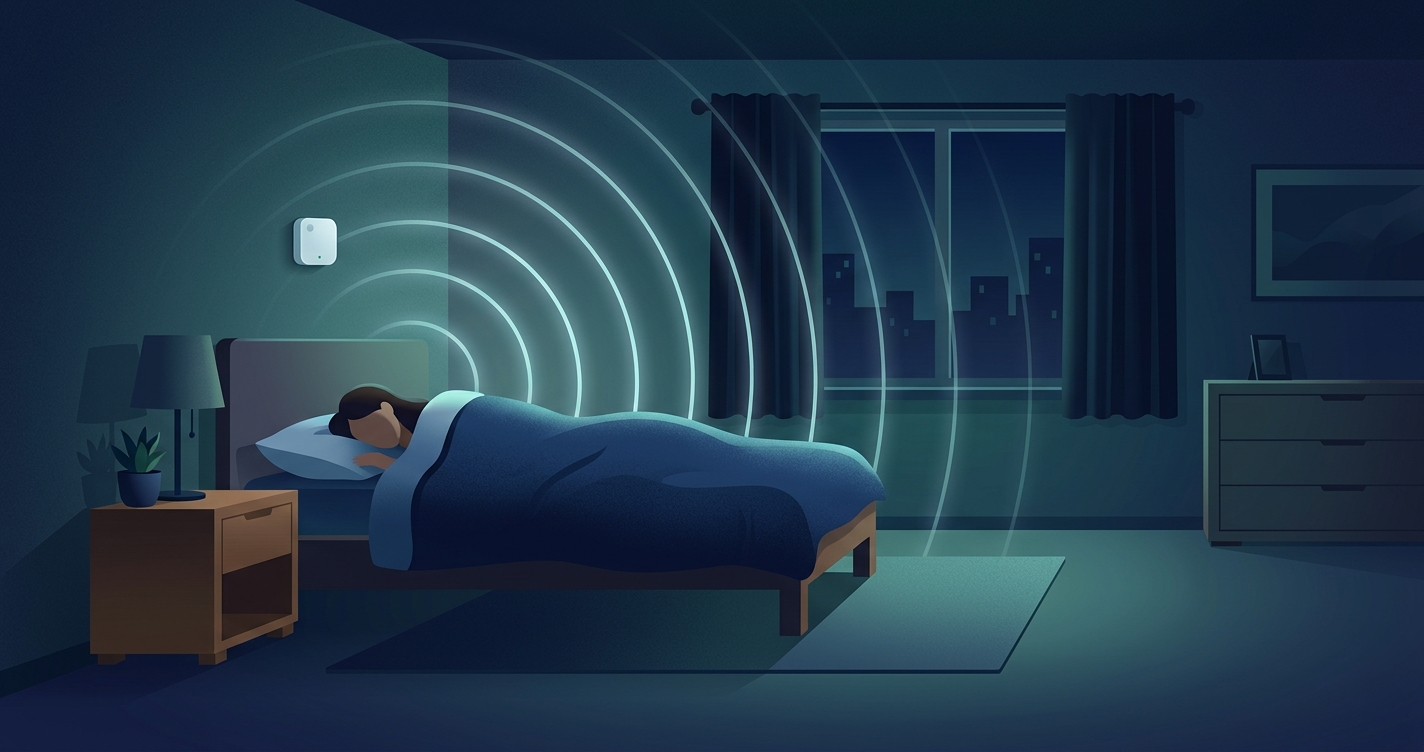
If a clinician told you that your breathing was steady and uninterrupted from 11 PM to 6 AM, but nobody walked into your room and nothing was strapped to your chest, the natural reaction is mild disbelief. Yet that scenario is exactly what a growing class of patient monitoring without devices is built to deliver. For hospitals running inpatient wards, hospital-at-home programs, and post-discharge recovery, the appeal is straightforward: continuous overnight respiratory data with no wearable to charge, no electrode to peel off, and no sleep disturbance from a 2 AM vitals round. The technology relies on cameras and low-power radar that read the tiny chest-wall and skin movements your body makes with every breath, then translate those signals into a respiratory rate trend a care team can review.
A 2023 hospital validation study of a contactless sleep radar system, published in the Journal of Clinical Medicine by Toften and colleagues, reported respiratory rate agreement within roughly one breath per minute against reference monitoring, with no physical contact required.
How patient monitoring without devices reads your breathing overnight
Breathing is one of the easiest vital signs to capture without touching a person, because the act of inhaling produces visible and measurable motion. Two sensing approaches dominate. The first is camera-based monitoring, which uses standard or near-infrared video to detect the subtle rise and fall of the chest and the micro-changes in skin color caused by blood flow, a method known as remote photoplethysmography. The second is frequency-modulated continuous-wave (FMCW) radar, a contactless sensor that bounces low-power radio waves off the body and measures the phase shift created by chest-wall displacement. Both can operate in complete darkness, which matters for overnight monitoring, and both can read breathing through bedding and light clothing.
The clinical value for a patient is the absence of friction. There is nothing to remember, nothing to recharge, and nothing that triggers the skin irritation or claustrophobia that drives wearable abandonment. For the care team, the value is continuity. Instead of four spot checks across a shift, the system produces a continuous respiratory trend, which is far more useful for catching the gradual deterioration that precedes many adverse events.
| Monitoring approach | What the patient wears | Works in the dark | Continuous overnight | Common limitation | | --- | --- | --- | --- | --- | | Camera-based (contactless) | Nothing | Yes, with near-infrared | Yes | Needs line of sight to chest or face | | FMCW / radar sensor | Nothing | Yes | Yes | Sensitive to large body movement | | Chest-strap respiratory band | Elastic band on torso | Yes | Yes, if tolerated | Discomfort, poor sleep adherence | | Wearable patch or wrist device | Adhesive or wrist strap | Yes | Only if charged and worn | Charging gaps, skin irritation, removal | | Manual nursing spot checks | Nothing | Requires lights / entry | No | Labor intensive, disrupts sleep |
A few practical points separate contactless methods from the alternatives:
- No adherence dependency. The patient does not have to do anything for the data to flow, which removes the single biggest failure mode in remote monitoring programs.
- No sleep disruption. Overnight readings happen without anyone entering the room or waking the patient, preserving the rest that recovery depends on.
- Lower infection and skin-injury risk. Nothing touches the patient, so there are no adhesives, no shared sensors to disinfect between uses, and no pressure points.
- Trend over snapshot. Continuous capture surfaces slow respiratory changes that intermittent checks routinely miss.
Industry applications for hospital CMOs
Inpatient med-surg wards
General ward patients are the population most likely to deteriorate unnoticed, because they are monitored less intensively than ICU patients but are sicker than they appear. Contactless respiratory monitoring offers a way to add continuous coverage in rooms that were previously only spot-checked, without expanding the nursing workload or tethering patients to equipment. The overnight window is where this matters most, since respiratory decline frequently begins during sleep.
Hospital-at-home and post-discharge programs
For acute care delivered in the home, sending and retrieving wearables creates logistics costs and compliance gaps. A camera or radar unit placed in the bedroom captures breathing every night with no patient effort, which fits the operational reality that home-based patients will not reliably wear or charge a device. This is the same convenience argument that makes contactless platforms attractive for the elderly and those living alone.
Virtual nursing and centralized monitoring
A virtual nursing team watching dozens of patients benefits from a steady stream of passive data rather than sporadic self-reported readings. Contactless respiratory trends let a remote nurse triage who needs attention tonight, turning overnight monitoring into a managed, exception-based workflow instead of a hope that the patient remembered to check in.
Current research and evidence
The evidence base for contactless overnight breathing monitoring has matured quickly. In the 2023 Journal of Clinical Medicine validation by Toften and colleagues, a sleep radar system measured respiratory rate in a hospital setting with close agreement to reference monitoring, supporting its use for patients in whom contact-based sensors are disruptive or poorly tolerated. The authors highlighted continuous, undisturbed data capture as a core advantage for vulnerable patients.
Radar-based methods have shown they can do more than count breaths. A 2025 FMCW radar study published in MDPI's Sensors demonstrated event-level sleep apnea detection with an F1 score of 0.80 and approximately 91 percent accuracy in grading obstructive sleep apnea severity, indicating the technology can identify breathing interruptions and not only steady-state rate. Separate work surveyed across recent literature confirms FMCW radar can extract respiratory signals through clothing and blankets at low power, with simple hardware.
Home feasibility has also been tested. A 2024 medRxiv proof-of-concept study on long-term nocturnal respiratory monitoring reported that a non-contact, radar-based biomotion sensor was well accepted by respiratory patients over extended home use, an important signal for hospital-at-home deployment where patient tolerance determines whether a program survives. Across these studies, the recurring theme is that removing the device removes the adherence problem while preserving clinically useful respiratory data.
It is worth being precise about limits. Camera systems need a usable view of the chest or face, and radar can be confused by large movements or multiple people in close range. Most validation work has focused on respiratory rate and apnea events rather than the full range of vital signs, and results from controlled studies do not automatically transfer to every real-world bedroom. These are engineering and deployment challenges, not reasons to dismiss the category.
The future of contactless overnight monitoring
The direction of travel is toward multi-parameter, room-level sensing. Research groups are already combining respiratory rate with heart rate, movement, sleep staging, and posture from a single contactless unit, which would let a hospital approximate a bedside monitor without any bedside attachments. Machine learning models trained on overnight signals are moving from simply reporting numbers to flagging patterns, such as the gradual respiratory rate climb that often precedes clinical deterioration.
For health system leaders, the strategic question is shifting from whether contactless monitoring works to where it belongs in the care pathway. The likely answer is that passive overnight monitoring becomes the default safety net for lower-acuity inpatients and home-based patients, with wearables and manual checks reserved for situations that genuinely require them. As reimbursement and clinical validation continue to develop, patient monitoring without devices is positioned to move from pilot projects to standard infrastructure, precisely because it solves the convenience and adherence problems that have constrained remote monitoring for a decade.
Frequently asked questions
Can a hospital really track my breathing all night without me wearing anything? Yes. Camera-based and radar-based systems detect the small chest and skin movements you make when you breathe, then convert them into a respiratory rate trend. They work in the dark and through bedding, so no strap, patch, or wrist device is required, and your sleep is not interrupted.
Is contactless breathing monitoring accurate enough for clinical use? Validation studies, including a 2023 hospital trial of a sleep radar system, have reported respiratory rate agreement close to reference monitors, and 2025 radar research has detected sleep apnea events with strong accuracy. Performance depends on proper setup and clear sensing conditions, and these tools support rather than replace clinical judgment.
Does a camera in my room mean I am being recorded all night? Contactless monitoring is designed to extract physiological signals, not to store identifiable video for viewing. The clinical output is a vital-sign trend. Specific privacy handling varies by platform, so patients should ask their care team how data is processed and protected.
Why would my hospital prefer this over a wearable? Wearables fail when patients forget to wear or charge them, which leaves dangerous gaps in overnight data. A passive contactless sensor removes that dependency entirely, captures continuous trends, and avoids skin irritation and infection risk, which is why care teams find it easier to scale.
Circadify is building toward this exact need, developing contactless remote patient monitoring that captures overnight vital signs without asking patients to wear or manage anything. Health systems evaluating passive, non-intrusive monitoring can explore an RPM pilot program to see how camera-based monitoring fits inpatient wards, hospital-at-home, and virtual nursing workflows.