Patient Monitoring Without Devices: What It Means for Care
Patient monitoring without devices uses cameras and ambient sensing to track vitals at home, removing the logistics, inventory, and adherence problems of wearables.
Every remote monitoring program eventually runs into the same wall, and it has nothing to do with clinical accuracy. It is the warehouse. Cuffs, pulse oximeters, weight scales, and chargers have to be kitted, shipped, tracked, sanitized, and recovered from hundreds of homes. The clinical model works; the supply chain strains under it. That tension is why patient monitoring without devices has moved from a research curiosity to a serious line item in care-at-home strategy conversations. Device-free patient monitoring uses the cameras and sensors patients already own to capture vital signs, removing the hardware layer that quietly drives a large share of program cost and patient drop-off.
By April 2024, more than 320 hospitals across 133 health systems in 37 states were authorized to deliver acute hospital care at home, and physical discomfort or skin irritation remains the single most cited reason patients abandon a wearable monitor. , Centers for Medicare and Medicaid Services authorization data and a 2024 Vivalink patient survey
What patient monitoring without devices actually means
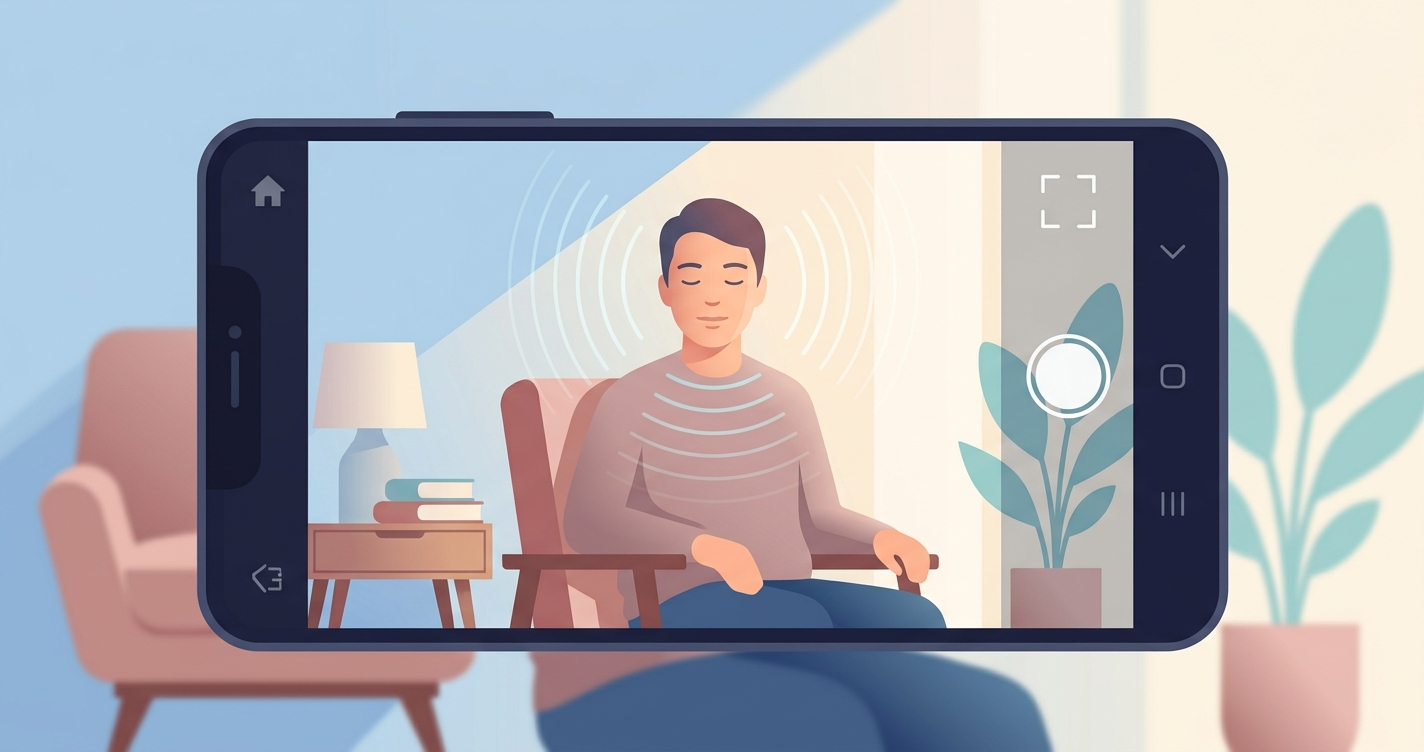
Patient monitoring without devices refers to capturing clinically useful physiological signals without asking the patient to wear, attach, or operate dedicated medical hardware. Instead of a chest patch or a finger clip, the patient looks into a smartphone or tablet camera for a short reading, or an ambient sensor in the room observes them passively. The underlying science is remote photoplethysmography, usually shortened to rPPG. A standard camera detects the tiny color changes in facial skin that occur with each heartbeat, and computer vision models translate those signals into heart rate, respiratory rate, and related measures.
The phrase covers a spectrum. On one end is monitoring patients without equipment that the health system has to procure at all, where a patient uses their own phone. On the other is ambient vitals capture through a fixed sensor that runs continuously without any patient action. What unites the category is the absence of a body-worn or patient-operated medical device in the data path.
This distinction matters because the cost and adherence problems in remote patient monitoring are rarely about the sensor's signal. They are about everything wrapped around the sensor: logistics, training, charging, connectivity, and the patient's willingness to keep using it day after day.
| Dimension | Wearable and peripheral RPM | Device-free patient monitoring | | --- | --- | --- | | Hardware per patient | Cuff, oximeter, scale, hub, chargers | Patient's own phone or a shared room sensor | | Enrollment logistics | Kit, ship, track, recover, sanitize | Send a link or install one ambient unit | | Adherence risk | Skin irritation, charging, lost devices | Brief daily reading or fully passive | | Inventory exposure | Per-patient capital tied up in the field | Minimal to none | | Time to enroll | Days, gated by shipping | Same day | | Infection control burden | Reprocessing between patients | Negligible |
Why the logistics problem is the real problem
Care-at-home program directors consistently rank supply chain among the hardest parts of scaling. Industry analyses of hospital-at-home operations name timely delivery of supplies, inventory management, and integration of multiple device types as recurring bottlenecks. Each enrolled patient represents capital sitting in a living room, plus a reverse-logistics task when the episode ends.
Device-free patient monitoring changes the unit economics by removing most of that overhead. The benefits cluster in a few areas:
- No per-patient hardware to purchase, depreciate, or write off when it disappears.
- Same-day enrollment, since there is no shipping window before monitoring can begin.
- No reprocessing or infection-control steps between patients.
- Fewer support tickets tied to charging, pairing, and connectivity failures.
- A monitoring path that scales with census instead of with warehouse capacity.
There is also an adherence dividend. The 2024 Vivalink survey found that while most acute patients are comfortable with at-home monitoring, comfort and ease of use are the deciding factors, and physical discomfort tops the list of reasons people stop wearing a device. Removing the device removes that failure mode entirely.
Industry Applications
Hospital at home and acute substitution
Acute hospital-at-home programs carry the highest monitoring intensity and the heaviest logistics load. Massachusetts alone saw hospital-at-home discharges climb roughly tenfold, from 461 in 2020 to 4,523 in 2024. At that volume, every step removed from enrollment compounds. Ambient vitals and camera-based readings let programs admit a patient the moment the decision is made rather than waiting for a courier.
Post-discharge and readmission reduction
The 30 days after discharge are where readmissions are won or lost. A monitoring approach that asks only for a 60-second camera check, rather than a charged and correctly worn device, keeps more patients reporting through the vulnerable window. Higher data continuity gives nurses the trend visibility they need to intervene early.
Chronic care and aging in place
For older adults, wearables introduce friction that passive sensing avoids. A 2024 JMIR digital health evaluation showed contactless monitoring could reliably track heart rate, breathing rate, and breathing disturbance during sleep in aging populations without any worn device. That is precisely the group most likely to forget a charger or find a patch irritating.
Current research and evidence
The evidence base for contactless vital signs has matured quickly. A 2024 clinical validation study published in Frontiers tested continuous contactless respiratory rate monitoring on a hospital ward against reference instruments and reported strong agreement. Separately, an MDPI validation study of rPPG-enabled contactless pulse rate software in cardiovascular disease patients found close agreement with ECG, reporting a mean absolute error near 1.06 beats per minute. Respiratory rate work has shown mean absolute errors under half a breath per minute in some controlled settings.
Regulators are responding as well. In 2024, camera-based vital sign measurement reached FDA Class II clearance for contactless respiratory rate and pulse rate measurement from a standard mobile camera, signaling that the technology has crossed from laboratory promise into a regulated medical category. Review articles, including a 2024 current rPPG review on medRxiv, catalog both the gains and the open challenges around motion artifact, lighting variability, and skin-tone fairness that responsible programs must account for.
The honest reading of the literature is that contactless measurement is accurate enough to be clinically useful for trend monitoring across heart rate and respiratory rate, with active research extending it toward oxygen saturation and blood pressure. Programs should match each measure to its validated use rather than assume every vital sign performs identically.
The future of patient monitoring without devices
Three trends will shape the next few years. First, ambient sensing will become continuous rather than spot-check, shifting from a daily reading to a passive baseline that surfaces deviations automatically. Second, fairness and robustness work will close the gap on motion and skin-tone variability, which is the prerequisite for equitable deployment across diverse populations. Third, payment policy will catch up; as device-free monitoring demonstrates equivalent trend visibility at lower operating cost, reimbursement frameworks built around shipped equipment will be pressured to recognize software-driven capture.
The strategic implication for health systems is that the monitoring backbone of the next decade may carry far less physical inventory. Programs that design now for a hardware-light model position themselves to scale census without scaling a warehouse.
Frequently asked questions
Is patient monitoring without devices accurate enough for clinical use?
Peer-reviewed validation in 2024 showed close agreement between camera-based heart rate and ECG, and between contactless respiratory rate and reference monitors on hospital wards. The technology is well suited to trend monitoring for heart rate and respiratory rate, with oxygen saturation and blood pressure still maturing. Programs should align each vital sign with its validated evidence.
How does device-free monitoring reduce program costs?
It removes per-patient hardware purchasing, shipping, tracking, sanitizing, and recovery. Those logistics and reverse-logistics steps account for a large share of remote monitoring operating expense, so eliminating them lowers cost per enrolled patient and shortens time to enroll.
Will older or less tech-savvy patients be able to use it?
Camera-based readings typically require a brief look into a phone or tablet, and ambient sensing requires no patient action at all. A 2024 JMIR study found contactless sleep-time monitoring reliable in aging populations, and removing wearables eliminates charging and skin-irritation problems that disproportionately affect older patients.
What vital signs can be captured without equipment?
Validated measures include heart rate and respiratory rate, with research extending to oxygen saturation, heart rate variability, and blood pressure estimation. The maturity varies by measure, so programs should confirm the evidence for each vital sign they intend to act on clinically.
Circadify is building toward this hardware-light future with camera-based remote monitoring designed to remove the equipment layer that slows care-at-home programs down. If you are evaluating how device-free capture could shorten enrollment and cut logistics overhead, you can explore a no-equipment RPM pilot program structured for care-at-home teams.