How do hospitals keep an eye on patients at home without sending out lots of gadgets?
How patient monitoring without devices lets hospital-at-home programs scale, cut logistics costs, and keep more patients engaged through everyday cameras.
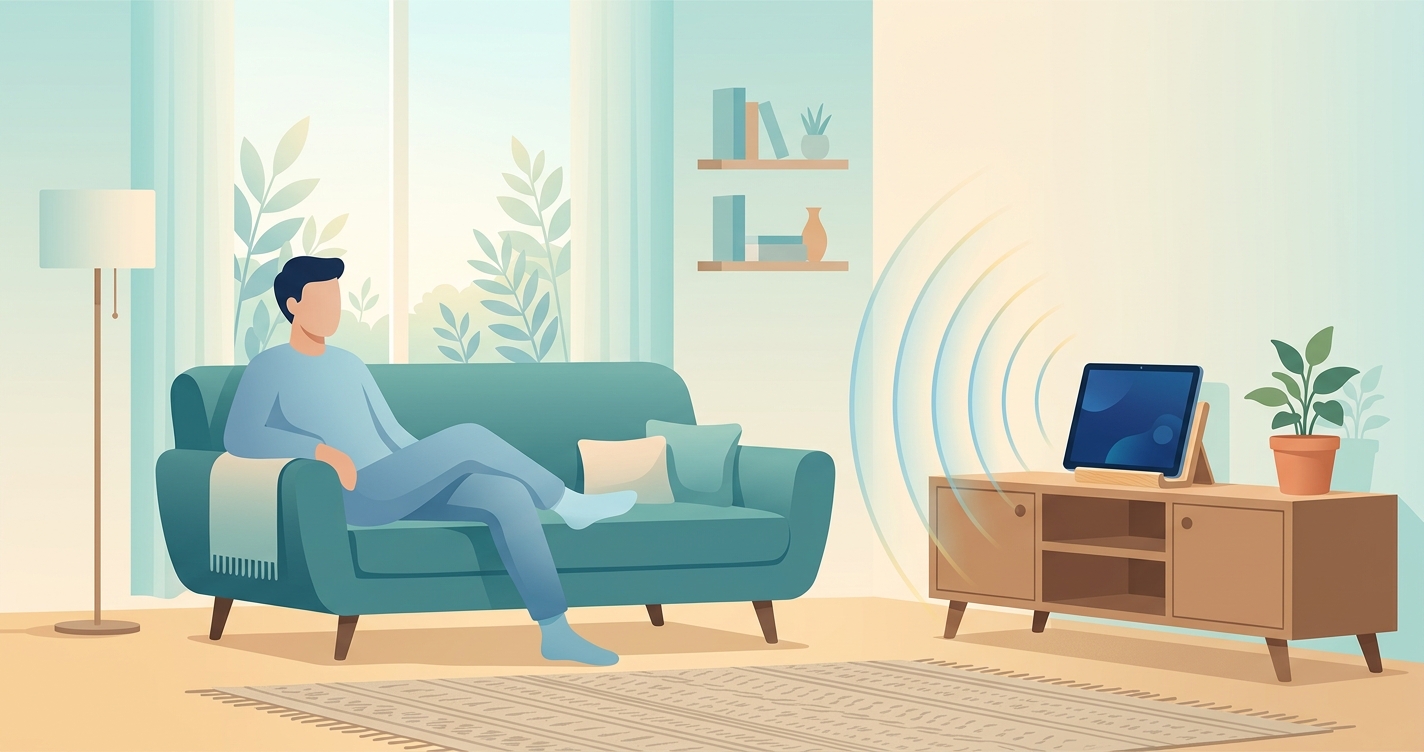
Every hospital-at-home program eventually runs into the same wall, and it has nothing to do with clinical care. It is the warehouse. Before a single patient is monitored, someone has to buy a blood pressure cuff, a pulse oximeter, a weight scale, and a connectivity hub, kit them together, ship them, walk the patient through setup, troubleshoot the Bluetooth pairing, and eventually arrange the return and disinfection of every piece. Multiply that by a few hundred enrolled patients and the operational drag becomes obvious. This is why patient monitoring without devices has moved from a curiosity to a serious line item in care-at-home planning conversations. The promise is straightforward: keep clinical eyes on the patient while removing the physical hardware that makes programs slow, expensive, and hard to grow.
Adherence to remote cardiac device monitoring across 26 Veterans Health Administration facilities ranged from 46% to 96%, a spread that shows how much program success still depends on whether patients keep using the equipment they are sent home with.
Why patient monitoring without devices changes the operational math
The phrase "patient monitoring without devices" is slightly imprecise, and it helps to be honest about that up front. There is still a device involved: the patient's own smartphone, tablet, or a camera already in the home. What disappears is the fleet of single-purpose medical peripherals a program has to purchase, configure, ship, support, recover, and replace. Camera-based approaches use remote photoplethysmography (rPPG), a technique that reads the subtle color changes in skin caused by blood flow to estimate heart rate, respiratory rate, and related signals from ordinary video. Researchers including Wei Chen and Zhe Yi, in a 2024 review of contactless physiological measurement, describe how deep learning has pushed rPPG from a lab demonstration toward practical remote care use.
For a program director, the appeal is not the physics. It is what the physics removes from the workflow. A device-free model collapses the supply chain into a software enrollment step. There is no kit to build, no shipping label, no return envelope, and no inventory write-off when a patient forgets to send the equipment back. The cost structure shifts from per-device capital expense toward per-patient software, which scales far more gracefully when a program goes from 200 patients to 2,000.
The second advantage is behavioral. A 2024 retrospective cohort study of Medicaid patients with diabetes found overall RPM adherence above 70%, but only when staff made dedicated adherence calls, and clinics with higher adherence spent roughly 9.1 hours per week managing monitoring versus 4.5 hours at lower-adherence sites. In other words, traditional device-based adherence is expensive to maintain. Removing the device removes a large category of reasons patients drop out: dead batteries, lost cuffs, pairing failures, and the simple fatigue of operating medical equipment every day.
| Factor | Device-heavy RPM | Patient monitoring without devices | | --- | --- | --- | | Upfront hardware cost | High, per-device capital outlay | Minimal, uses existing phone or camera | | Time to enroll a patient | Days, includes shipping and setup | Minutes, software onboarding | | Logistics burden | Kitting, shipping, returns, cleaning | None beyond app access | | Common adherence failures | Lost devices, dead batteries, pairing issues | Mostly engagement and connectivity | | Scalability | Constrained by inventory | Constrained mainly by clinical staffing | | Recovery and reuse | Manual return and disinfection | Not applicable |
The patient experience side of the equation
Operational savings matter, but program directors know that a model patients reject will fail no matter how cheap it is. Here device-free monitoring tends to help rather than hurt.
- There is nothing to wear, so there is no skin irritation, no charging routine, and no nightly compliance burden.
- Older patients who are uncomfortable with unfamiliar gadgets can use a familiar phone or tablet interface.
- Patients who live alone do not have to manage a tabletop of equipment they are afraid of breaking.
- A single check-in flow can capture several vital signs at once, instead of asking the patient to operate three separate instruments.
A 2024 survey context cited across RPM literature put patient satisfaction with remote monitoring above 94% when the experience felt simple. The friction that erodes that satisfaction is almost always tied to hardware. Remove the hardware and you remove most of the friction.
Industry applications
Post-discharge and hospital-at-home
The most direct fit is acute care at home and the 30-day post-discharge window, where readmission risk is highest and enrollment volume is largest. A device-free model lets a program enroll a patient before they leave the building rather than waiting for a shipment to arrive, closing the dangerous gap between discharge and the first home reading.
Chronic disease population health
Population health teams managing thousands of patients with heart failure, hypertension, or COPD face the steepest logistics tax. Camera-based check-ins let these programs extend monitoring to patients who were previously excluded because device fulfillment was too costly per head.
Virtual nursing and rural reach
Virtual nursing teams already interact with patients through video. Capturing vital signs inside that same video session, rather than asking the patient to read numbers off separate devices, streamlines the encounter. For rural programs covering large distances, eliminating physical device delivery removes one of the hardest logistical constraints entirely.
Current research and evidence
The evidence base for contactless monitoring is maturing quickly. A 2023 systematic review of non-contact vision-based vital sign techniques published in MDPI's Sensors documented growing accuracy for heart rate and respiratory rate measurement from standard cameras, while noting that motion, lighting, and skin-tone variation remain active engineering challenges. The 2024 Frontiers review by Chen, Yi, and colleagues reached a similar conclusion: deep learning has substantially improved robustness, and the realistic near-term role for rPPG is trend monitoring and early warning rather than replacing every cuff measurement.
Blood pressure remains the hardest signal. A 2024 paper in Connected Health and Telemedicine on camera-based rPPG for blood pressure described the clinical evidence as promising but still early, which is an honest framing program directors should carry into vendor conversations. The practical takeaway is that device-free monitoring is strongest as a continuous, low-friction layer that flags change, and that programs should match the measurement type to the clinical question rather than assuming parity with bedside equipment on every parameter.
The adherence data reinforces why this matters operationally. With device-based programs showing adherence swings from 46% to 96% depending on support intensity, any approach that reduces the reasons a patient disengages has direct value. A camera check-in that takes a patient less than a minute and requires no equipment management lowers the daily cost of staying enrolled.
The Future of patient monitoring without devices
The trajectory points toward monitoring that fades into the background of daily life. Several developments are converging:
- Algorithms are improving for darker skin tones and low-light conditions, which has been a real equity gap in earlier rPPG work.
- Passive ambient capture, where a camera reads vitals during a normal video visit without a dedicated measurement step, is becoming feasible.
- Reimbursement frameworks are slowly catching up to software-based monitoring, which will determine how fast adoption scales.
- Integration with electronic health records is turning isolated readings into trend lines clinicians can act on.
None of this eliminates clinical judgment or the occasional need for a physical measurement. The likely future is a hybrid: device-free monitoring as the scalable default, with targeted hardware reserved for the specific patients and parameters that require it. That model gives programs the reach of software with the precision of devices where it counts.
Frequently asked questions
Does patient monitoring without devices mean no equipment at all?
Not quite. It removes purpose-built medical peripherals like cuffs and pulse oximeters, but it relies on a device the patient already owns, usually a smartphone or tablet with a camera. The logistical savings come from eliminating the hardware a program would otherwise have to buy, ship, support, and recover.
How accurate is camera-based monitoring compared with traditional devices?
Research through 2024 shows strong and improving accuracy for heart rate and respiratory rate, with blood pressure still an active research area. The most reliable use today is continuous trend monitoring and early-warning detection rather than replacing every clinical-grade measurement.
Will older or less tech-savvy patients be able to use it?
Often more easily than device-based programs. There are no batteries to charge, no Bluetooth to pair, and no separate instruments to operate. A familiar phone interface tends to lower the barrier for older patients and those who live alone.
Why does this help program scalability specifically?
Because cost shifts from per-device capital expense to per-patient software, and enrollment no longer waits on shipping. Programs can grow patient volume without proportionally growing a warehouse, inventory, and returns operation.
Circadify is building toward this exact problem, focusing on camera-based monitoring that patients actually use without the compliance and logistics burden of wearables. Care teams evaluating how to scale hospital-at-home and post-discharge monitoring can explore a structured RPM pilot program to see how device-free monitoring fits an existing workflow.