Patient Onboarding for Camera-Based RPM: Best Practices
Research-based analysis of patient onboarding for camera-based RPM, with best practices for activation, adherence, staffing, and workflow design.
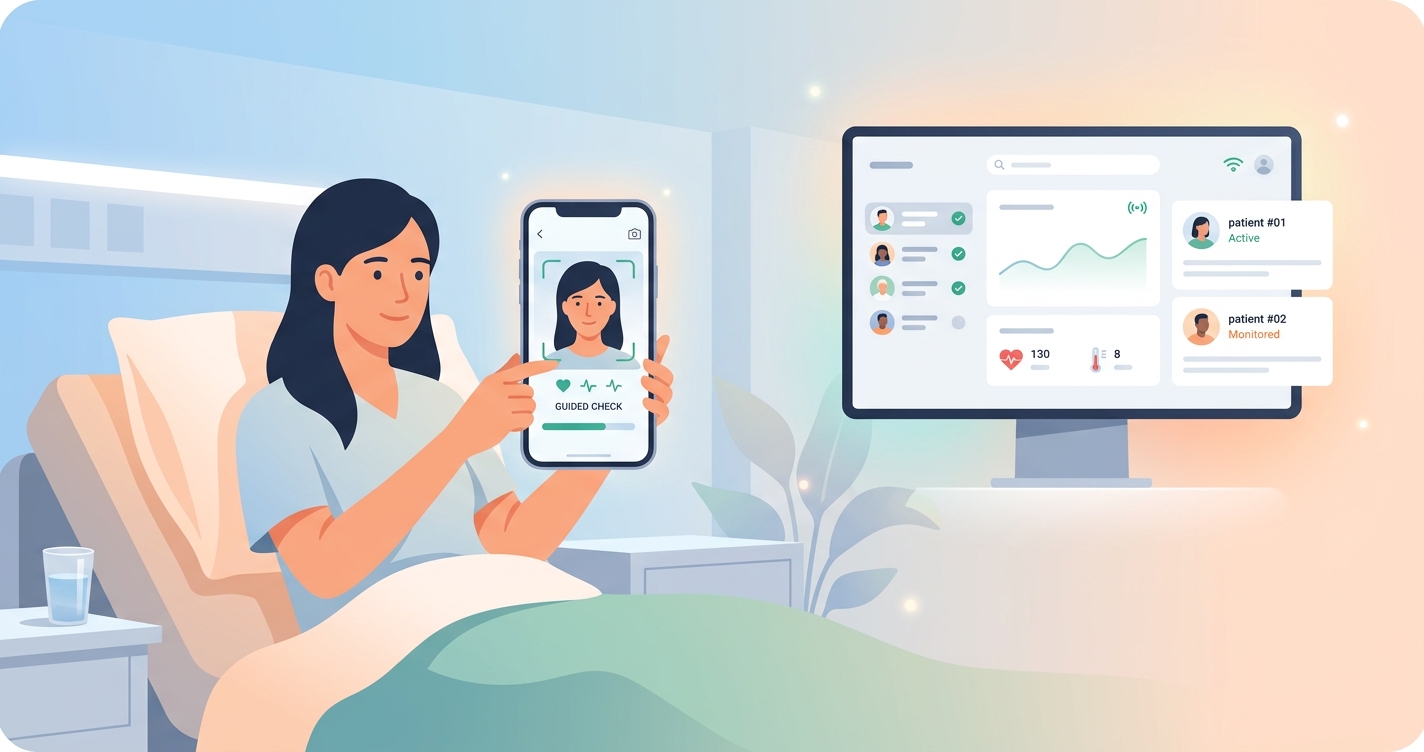
Patient onboarding for camera-based RPM best practices has become a much more pressing topic than the older question of whether remote patient monitoring belongs in mainstream care. Health systems have already answered that part. The harder question is what happens between enrollment and the first reliable week of patient participation. That early window is where many RPM programs either become part of routine care or quietly turn into another half-used digital initiative. Camera-based RPM changes the onboarding conversation because it can remove shipping, pairing, and replacement friction, but it does not remove the need for careful education, clear expectations, and staff ownership.
"Patient education should ensure patients are confident with the technology, motivated to participate, understand how their data contributes to their care, and feel empowered to troubleshoot issues." — American Medical Association, Remote Patient Monitoring Implementation Playbook
Why patient onboarding for camera-based RPM best practices matter
Bad onboarding usually gets misread as bad patient engagement. That is too simplistic. In most RPM programs, early disengagement is often a design problem. Patients may not understand why they were enrolled, what the daily task actually is, who sees the readings, or what happens after an abnormal result. If the program uses delivered devices, those questions get tangled up with setup logistics. If the program uses a phone camera, the logistics are lighter, but the expectations still have to be made explicit.
The AMA's RPM playbook has been fairly consistent on this point: workflow design, staff preparation, and patient partnership come before scale. That sounds obvious until a health system tries to enroll patients at discharge, hand them an app link, and hope the rest sorts itself out.
The research supports a more disciplined approach. Luiza Palmieri Serrano and colleagues, in a systematic review on factors influencing patient engagement in remote patient monitoring, found that engagement depends on a mix of patient-related, technology-related, and healthcare-system factors. That is a useful framing because it keeps onboarding from being treated as a one-time technical tutorial. It is really a handoff between the care model and the patient.
Comparison table: traditional RPM onboarding vs camera-based RPM onboarding
| Onboarding element | Traditional device-heavy RPM | Camera-based RPM |
|---|---|---|
| Starting point | Device order, shipping, and setup | App access, eligibility check, and guided first scan |
| Patient burden | Learn hardware plus workflow | Learn workflow, privacy expectations, and scan routine |
| Staff workload | Kit logistics, troubleshooting, replacements | More focus on education, triage rules, and follow-up |
| Common failure point | Device never activated | First scan never completed or not repeated |
| Best early metric | Device activation rate | Completed first scan within 24-72 hours |
| Best fit | Pathways needing dedicated peripherals | Programs seeking lower-friction recurring check-ins |
A cleaner onboarding model usually starts with a simpler promise. Patients should know three things right away:
- why they were selected for monitoring
- how long each check-in takes
- what action the care team may take based on the result
If those answers are fuzzy, adherence usually becomes fuzzy too.
What strong camera-based RPM onboarding looks like in practice
The strongest programs do not treat onboarding as a single event. They treat it as a sequence.
1. Start with pathway-specific enrollment
A patient should not be enrolled in camera-based RPM just because the technology is available. Enrollment works better when it is attached to a defined clinical pathway such as post-discharge follow-up, hospital-at-home, virtual nursing support, or chronic disease monitoring. The patient needs to hear a concrete reason: we are watching your recovery after discharge, we want trend visibility between visits, or we want earlier escalation if symptoms change.
That specificity matters more than most people admit. Eric W. Maurer and coauthors reported in 2024 that patients who engaged with an RPM program after emergency department discharge were less likely to return to the ED within 90 days. The clinical value is easier to preserve when patients understand the monitoring period as part of a clear episode of care rather than a generic digital add-on.
2. Make the first scan part of onboarding, not homework
One pattern keeps showing up in RPM operations: if the first successful reading is delayed, drop-off risk goes up. The best onboarding flows make the patient complete the first camera-based session while support is still available, either before discharge, during a supervised virtual visit, or through a tightly timed follow-up call.
This is one of those small operational details that matters a lot. A program that says "download the app when you get home" is not really onboarding the patient. It is postponing onboarding and hoping motivation survives the ride home.
3. Explain what the camera is doing in plain language
Patients do not need a technical lecture on remote photoplethysmography, but they do need a believable explanation. A short, plain-language script works better than a dense FAQ. Something like: the app uses the phone camera to detect subtle color changes in the skin and estimate vital-sign patterns during a short scan. The care team reviews those check-ins along with symptoms and context.
That kind of explanation reduces the weirdness factor. It also makes privacy questions easier to answer early instead of after trust starts slipping.
4. Define when the patient should use the app and when they should not
Good onboarding includes boundaries. Patients need to know when a scheduled scan is appropriate and when they should bypass the app and call the care team or seek urgent help. The camera may make monitoring easier, but it should not create false reassurance.
The AMA's guidance on digital health implementation stresses the need to define workflow, responsibility, and escalation before launch. I think this is where that advice becomes real for patients. If the program cannot explain what happens after a concerning reading, the onboarding is incomplete.
Best practices for activation, adherence, and confidence
The phrase best practices can get a little fluffy in RPM writing, so it helps to keep it operational. The most durable onboarding practices are the ones that reduce uncertainty for both patients and staff.
- Use a short eligibility screen to confirm the patient has a compatible phone, workable lighting, and enough comfort with the workflow
- Complete the first scan with live support whenever possible
- Keep educational materials brief, visual, and specific to the care pathway
- Tell patients exactly who monitors the data and what response time to expect
- Follow up within the first 24 to 72 hours if the first scheduled scan is missed
- Track noncompletion as an operational signal, not a personal failure by the patient
- Train staff to explain the value of monitoring in everyday language rather than vendor language
This is also where digital literacy becomes impossible to ignore. Ishaan Ameen and colleagues, writing in BMC Health Services Research in 2025 about RPM programs in rural and regional areas, identified perceived low digital literacy, language barriers, infrastructure gaps, limited training, and governance issues as recurring implementation barriers. Their findings were not specific to camera-based RPM alone, but they map closely to onboarding realities. A camera-first model may remove hardware friction, yet it still depends on a patient being able to complete a repeatable software task with confidence.
Industry applications for camera-based RPM onboarding
Post-discharge monitoring
This is probably the clearest fit. Patients are in a time-limited risk window, often tired, overloaded with instructions, and not eager to manage another device kit. Camera-based onboarding works best here when the first scan happens before discharge or within the first day at home, and when the patient receives one simple explanation of what the daily routine is for.
Hui-Wen Po, Ying-Chien Chu, Hui-Chen Tsai, Chen-Liang Lin, Chung-Yu Chen, and Matthew Huei-Ming Ma reported in 2024 that home digital monitoring for high-risk post-discharge patients reduced hospitalizations, emergency department visits, and total hospital stay days. Results like that tend to get attention, but the operational lesson is easy to miss: utilization gains depend on patients actually staying in the program long enough for the team to act on deterioration.
Hospital-at-home and virtual nursing
In these settings, onboarding has to happen quickly and feel low-friction. The care team is not selling a new app. They are extending clinical visibility into the home. Camera-based RPM can fit because it reduces the logistics layer, which leaves more attention for triage rules, symptom review, and escalation pathways.
Chronic disease follow-up
Longer-term programs have a different problem. Activation matters, but sustained participation matters more. Onboarding therefore has to frame the monitoring habit, not just the first week. Patients need a clear cadence, a reason for that cadence, and reassurance that they are not sending data into a void.
Current research and evidence
The literature on RPM engagement is broad enough now that the same themes show up repeatedly.
Serrano and colleagues' systematic review found that patient engagement is shaped by patient capability, technology usability, and healthcare delivery context. That is a useful corrective to the idea that engagement is mostly a motivational problem. Often it is a systems problem.
Ameen and colleagues' 2025 qualitative study adds a more operational view. Staff in rural and regional settings described digital literacy gaps, language barriers, uneven infrastructure, limited training, and governance uncertainty. Those barriers sound familiar because they are familiar. Most health systems that struggle with onboarding are not dealing with one dramatic failure. They are dealing with several small frictions that pile up.
Maurer and colleagues showed that post-discharge RPM engagement can correlate with lower downstream acute utilization, which makes the onboarding period more important than it looks. If the patient never gets comfortable in the first place, the program may never reach the point where it can change outcomes.
Another useful signal comes from Salaar Liaqat and coauthors, who examined engagement strategies for RPM using asynchronous messaging. Their work points to something practical: onboarding does not really end after the first scan. Ongoing prompts, reassurance, and lightweight communication can keep participation from collapsing after the initial setup moment.
Where onboarding tends to break down
The failure modes are usually ordinary.
- the patient is enrolled without understanding the reason for monitoring
- the first scan is unsupervised and never completed
- educational material explains features instead of the care pathway
- staff cannot clearly describe who reviews incoming readings
- technical support is separated from clinical support in a confusing way
- missed scans are logged but not acted on quickly enough
That list sounds unglamorous because it is. But RPM programs are often won or lost in these basic handoffs.
The future of patient onboarding for camera-based RPM
I think the next wave of RPM onboarding will be less about teaching patients a tool and more about reducing the number of things they need to figure out at all. Better programs will make the first scan immediate, the explanation shorter, the reminder sequence smarter, and the escalation rules more visible. Camera-based RPM fits that direction because it can remove some of the hardware overhead that has historically made onboarding harder than it needed to be.
That does not mean every monitoring program should become camera-first. Some pathways will still need peripherals. But for health systems trying to scale post-discharge monitoring, virtual nursing, and lower-friction recurring check-ins, onboarding quality may matter just as much as sensing quality.
Frequently Asked Questions
What is the most important onboarding metric for camera-based RPM?
Usually it is not total enrollment. A stronger early metric is the percentage of patients who complete their first successful scan within 24 to 72 hours and then repeat the process on schedule.
Why do patients drop out of RPM so early?
In many cases, patients are not rejecting monitoring itself. They are reacting to unclear expectations, low confidence with the workflow, weak support, or the feeling that nobody is actually looking at the data.
Is camera-based RPM easier to onboard than device-heavy RPM?
It can be easier because there is less hardware setup, but the care team still has to explain the workflow, privacy expectations, and escalation process clearly.
Should onboarding be handled by technical support or clinical staff?
The strongest programs usually blend both. Patients need technical confidence, but they also need to hear the clinical reason for monitoring from someone who can explain what the data means in context.
Health systems trying to improve adoption are increasingly looking at lower-friction models, including solutions like Circadify, as they rethink how monitoring starts in the first place. For related analysis, see The Clinical Workflow for Camera-Based Remote Patient Monitoring and How to Measure RPM Program Success: Key Metrics Guide.