How can my hospital track my recovery after surgery from home without all the wires?
How post-surgery monitoring without devices works: camera-based RPM lets care teams track surgical recovery at home with no wearables, cuffs, or wires.
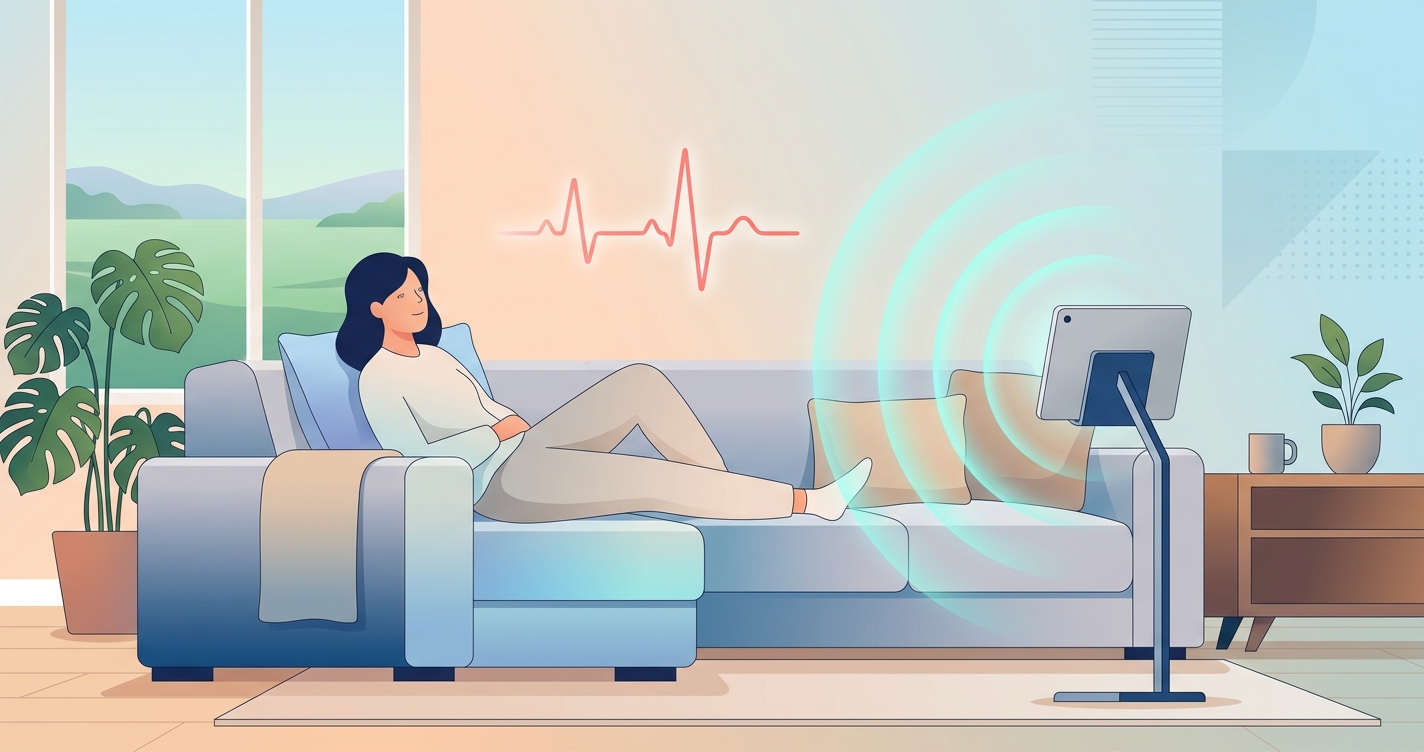
If you have just been discharged after an operation, the last thing you want is a kitchen counter covered in cables, a blood pressure cuff that pinches, and a finger clip you keep forgetting to charge. Yet the days right after surgery are exactly when your care team most wants to see how you are doing. This is the tension behind a fast-growing model in health systems: post-surgery monitoring without devices, where a camera and software do the watching instead of a tangle of wires strapped to your body. For hospitals running care-at-home programs, the shift is less about novelty and more about whether patients will actually stay enrolled long enough for monitoring to matter.
A 2024 systematic review and meta-analysis of remote biometric sensing found an 18% lower all-cause readmission risk among postsurgical patients, and other perioperative programs have reported up to a 33% reduction in 30-day cardiac surgery readmissions.
What post-surgery monitoring without devices actually means
The phrase sounds like a contradiction. How can a hospital track your recovery if you are not wearing anything? The answer is contactless sensing. Modern cameras, including the one already in your phone or tablet, can pick up signals the human eye cannot. The core technology is remote photoplethysmography, or rPPG, which detects tiny color changes in the skin of your face as blood pulses through it. Software then turns those changes into vital signs such as heart rate and respiratory rate. A 2024 review in Frontiers described rapid gains in deep learning and rPPG for contactless physiological measurement, and a separate systematic review published through the National Library of Medicine confirmed that camera-based methods can continuously estimate multiple vitals.
For a recovering patient, post-surgery monitoring without devices means you sit in front of a camera for a short check-in, or in some setups simply move through a room, and your numbers are captured passively. There is nothing to charge, calibrate, or sanitize. For the care team, the appeal is different but related: the biggest failure point in remote monitoring is not accuracy, it is adherence. A device that lives in a drawer collects no data at all.
Here is how the common approaches compare for someone recovering at home.
| Monitoring approach | What you wear | Daily effort for patient | Main failure point | Best fit | |---|---|---|---|---| | Camera-based contactless RPM | Nothing | Low: a short look at the camera | Lighting and positioning | Post-discharge patients who resist devices | | Wearable patch or band | Adhesive or wrist device | Medium: charging, skin care | Charging gaps, skin irritation | Continuous cardiac tracking | | Bluetooth cuff and pulse oximeter | Cuff and finger clip per reading | Medium to high: multiple manual readings | Forgetting or mistiming readings | Hypertension or oxygen-focused programs | | Manual phone or video check-in | Nothing | High: patient self-reports | Subjective, no objective vitals | Low-acuity symptom tracking | | In-person home nurse visits | Nothing | Low for patient, high for system | Cost and staffing limits | High-acuity or complex wounds |
Why care-at-home programs are moving away from hardware
Population health leaders and care-at-home directors keep running into the same wall. The clinical case for monitoring surgical patients is strong, but the operational case collapses when devices have to be shipped, tracked, retrieved, cleaned, and replaced. Every wearable is a logistics line item and a potential point of abandonment.
The advantages program leaders cite for contactless approaches tend to cluster around a few themes:
- No shipping and reverse logistics, since most patients use a device they already own.
- No charging or pairing problems, which removes a frequent source of data gaps.
- Lower infection-control burden, because nothing physical passes between patients.
- Better reach into older and less tech-comfortable populations who balk at strapping on hardware.
- Faster enrollment, since onboarding can happen before the patient even leaves the building.
The market reflects this pull. Industry analysts valued the AI-powered remote vital sign camera segment at roughly $1.48 billion in 2024, and broader projections suggest more than 70 million Americans will use some form of remote monitoring by 2025. Those numbers describe demand, not destiny, but they tell program leaders that contactless capture is no longer experimental.
Industry Applications
Post-surgical step-down at home
The window from discharge to about two weeks after surgery is when complications such as infection, fluid overload, or cardiac strain tend to surface. A 2024 perioperative monitoring study covering 1,000 consecutive cardiac surgery patients reported meaningful reductions in readmission when patients were tracked after they went home. Camera-based check-ins fit this window well because they ask almost nothing of a patient who is still sore, tired, and managing pain.
Hospital-at-home acute care
In full hospital-at-home programs, where acute care is delivered in the residence, contactless monitoring can run alongside scheduled clinician visits. A passive camera does not replace a nurse, but it extends the hours when a patient is observed without adding a staff member for every household.
Virtual nursing and centralized triage
A virtual nurse reviewing dozens of patients needs objective trend data, not just a patient saying they feel fine. Contactless vitals give that nurse heart rate and respiratory trends to prioritize who needs a call first, which is the practical core of virtual nursing technology.
Current research and evidence
The evidence base divides into two questions: does remote monitoring help surgical patients, and can cameras capture vitals reliably enough to feed that monitoring.
On the first question, results are fairly consistent. The 2024 meta-analysis on remote biometric sensing found an 18% lower all-cause readmission risk for postsurgical patients, and perioperative cardiac programs have reported reductions in 30-day readmissions in the 33% range. A prospective cohort study published in JMIR Formative Research found that home digital monitoring significantly reduced hospitalizations, emergency department visits, and total hospital stay days among high-risk post-discharge patients.
On the second question, contactless capture, the research is encouraging but appropriately cautious. The systematic review of camera-based vital sign monitoring concluded that heart rate and respiratory rate can be measured well under controlled conditions, while accuracy still depends on lighting, patient movement, and skin tone. A 2024 Frontiers review noted that deep learning is steadily narrowing these gaps. A Veterans Affairs pilot usability study tested contactless vital sign collection during video telehealth visits and found both providers and patients receptive, which matters because adoption, not just signal quality, determines whether a program survives.
The honest reading for a program leader is this: contactless monitoring is well suited to trend detection and triage for many recovering patients, and it pairs well with clinical judgment rather than replacing it.
The Future of post-surgery monitoring without devices
Three shifts are likely over the next few years. First, vital sign coverage will broaden. Today heart rate and respiratory rate are the most reliable contactless measures; researchers are actively working to extend camera estimation toward blood oxygen and blood pressure, though those remain harder problems. Second, algorithms will get better at the real-world conditions that trip up cameras now, including dim rooms, motion, and the full range of skin tones, which is essential for equitable programs. Third, expect tighter integration with electronic health records and virtual nursing workflows, so a flagged trend routes straight to the right clinician instead of sitting in a separate dashboard.
For population health and care-at-home leaders, the strategic question is shifting from whether contactless monitoring works to where it fits in the portfolio. It will not be the right tool for every patient or every acuity level. But for the large group of post-surgical patients who would simply ignore a wearable, a monitoring model that asks for almost nothing may be the difference between a recovery that is observed and one that is invisible.
Frequently asked questions
Can a camera really measure my vital signs after surgery?
Yes, within limits. Cameras using remote photoplethysmography can estimate heart rate and respiratory rate by reading subtle color changes in your skin. Research shows this works well under good lighting and reasonable stillness. It is strong for spotting trends and changes, and your care team combines it with symptom reports and clinical judgment rather than relying on a single reading.
Is contactless monitoring as accurate as a cuff or finger clip?
For the vitals it captures, contactless monitoring performs well in studies, though factors like poor lighting, movement, and skin tone can affect accuracy. A blood pressure cuff and pulse oximeter still measure things cameras cannot yet reliably capture. Many programs use contactless check-ins for frequent trend tracking and reserve devices for specific clinical needs.
Why would a hospital choose camera monitoring over sending me a device?
The most common reason is adherence and logistics. Devices get left uncharged or unused, and shipping and retrieving them is costly. A camera-based check-in uses equipment you likely already own, which raises participation, especially among older patients, and removes a major operational burden for the program.
Does this mean a nurse is watching me all the time?
No. Most programs use scheduled check-ins or passive capture that produces trend data for clinicians to review, not a live continuous video feed of your home. The goal is to flag meaningful changes so a nurse can reach out, not to surveil your daily life.
Circadify is building toward this contactless model of recovery monitoring, focused on camera-based RPM that patients will actually use without the wearable compliance problems that stall so many programs. Health systems exploring an RPM pilot program can see how post-surgical patients can be tracked at home with no wires, cuffs, or chargers to manage.