Will my doctor know my blood oxygen is low before I start feeling breathless?
How a remote patient monitoring camera can flag falling blood oxygen before symptoms turn severe, and what that means for preventive population health programs.
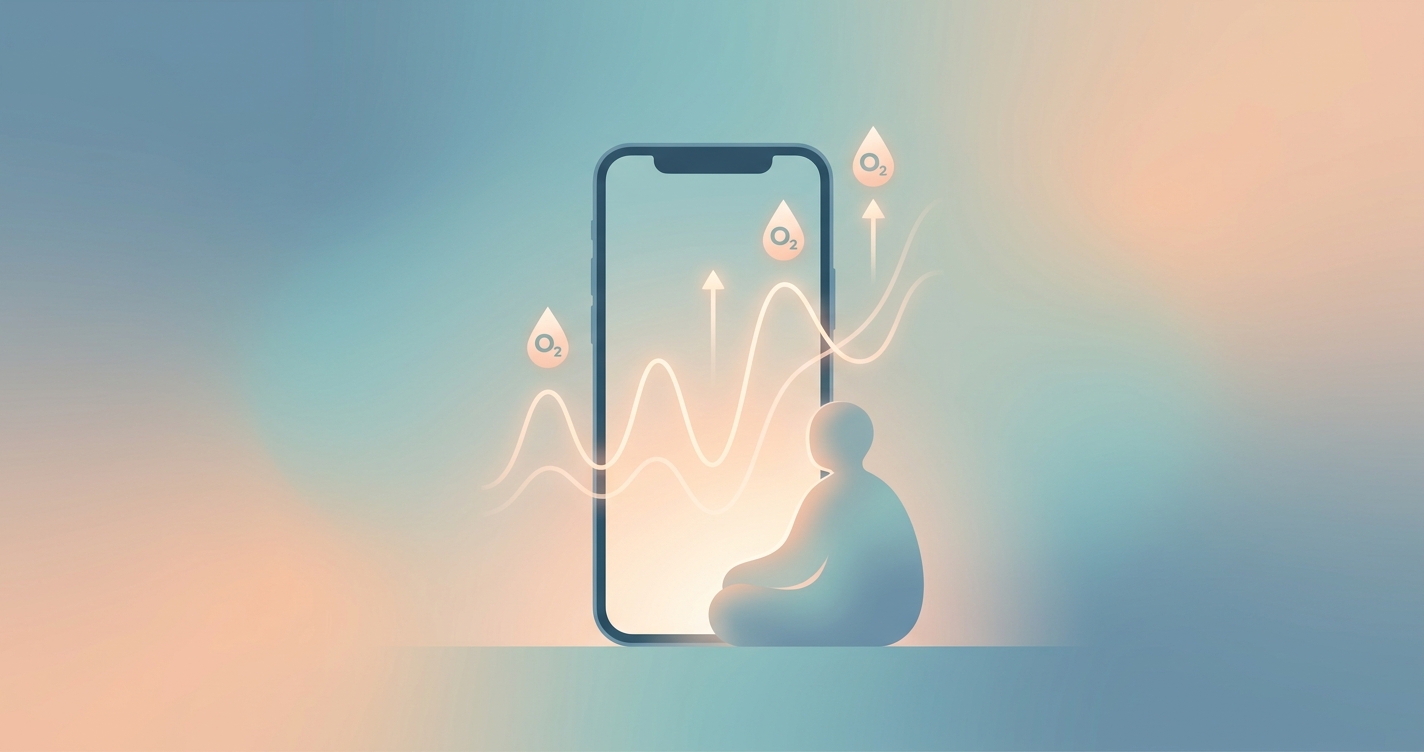
If you live with a heart or lung condition, the most frightening scenario is the one you cannot feel. Blood oxygen can drift downward for hours before the body raises an alarm, and by the time breathlessness arrives, the clinical situation may already be urgent. The question many patients and the population health leaders responsible for them are asking is direct: will a care team see a low reading before the symptom shows up? The short answer is that a remote patient monitoring camera is being studied precisely for this early-warning role, capturing subtle shifts in oxygen saturation, heart rate, and breathing pattern from a phone or tablet without any device worn on the body.
A 2024 validation study of a non-contact photoplethysmography mobile application reported SpO2 estimation with a mean absolute error near 2.1 percent against reference devices, while a separate contactless telehealth portal documented a mean absolute difference of just 0.59 percent for oxygen saturation, well inside the commonly used plus or minus 3 percent target.
How a remote patient monitoring camera detects low oxygen before symptoms
The technology behind a remote patient monitoring camera is remote photoplethysmography, often shortened to rPPG. When light hits the skin, blood absorbs and reflects it differently depending on how oxygenated the hemoglobin is and how much blood is present in the tissue at that instant. A standard camera sensor picks up these tiny color changes across the face, changes far too small for the human eye to register, and algorithms reconstruct a pulse waveform from them. From that waveform the system can estimate heart rate, respiratory rate, and oxygen saturation.
The preventive value sits in the gap between physiology and sensation. Oxygen saturation does not fall and trigger breathlessness at the same moment. In the well-documented phenomenon of silent hypoxemia, sometimes called happy hypoxia, patients can reach saturations far below normal while feeling relatively comfortable. A review by Tobin and colleagues in the American Journal of Respiratory and Critical Care Medicine described why this dissociation between low oxygen and the sensation of breathing distress baffled clinicians during COVID-19. The practical lesson for monitoring programs is that subjective symptoms are a lagging indicator. A measurement taken passively, before the patient notices anything, is the only way to close that window.
A remote patient monitoring camera also captures trend rather than a single snapshot. A saturation of 93 percent on its own means little. The same value observed across several check-ins, declining from a personal baseline of 97 percent over three days, is a signal worth a nurse's attention. The combination of contactless capture and trend analysis is what shifts monitoring from reactive to preemptive.
| Monitoring approach | What the patient does | Captures trend over time | Early-warning potential | Adherence challenge | | --- | --- | --- | --- | --- | | Symptom self-report | Calls or messages when feeling unwell | No | Low, depends on symptom onset | Patient must recognize a problem first | | Worn fingertip or wrist sensor | Wears or applies a device, charges it | Yes, if worn consistently | Moderate to high | Device fatigue, charging, lost equipment | | Remote patient monitoring camera | Looks at a phone or tablet for a brief scan | Yes | High, captures subclinical change | Low, no device to wear or maintain | | Periodic clinic visit | Travels to a facility | No, gaps between visits | Low between appointments | Travel, scheduling, access barriers |
Key reasons camera-based capture suits early detection:
- It removes the recognition step, so a reading does not depend on the patient feeling sick first.
- It produces multiple data points that establish a personal baseline rather than a one-time number.
- It avoids the device attrition that erodes wearable programs after the first few weeks.
- It can fold oxygen saturation in with heart rate and respiratory rate for a fuller picture of deterioration.
Industry applications for population health and care-at-home teams
Post-discharge and hospital-at-home programs
The days after discharge are when quiet deterioration does the most damage. A remote patient monitoring camera lets a hospital-at-home team request a brief facial scan during routine video check-ins and read oxygen trends without shipping, tracking, and recovering hardware. For programs measured on readmissions, catching a downward oxygen trend two days early can be the difference between a medication adjustment and an emergency department visit.
Chronic respiratory and cardiac cohorts
COPD, heart failure, and pulmonary fibrosis populations live with fluctuating oxygenation. For population health VPs managing these cohorts at scale, contactless capture lowers the per-patient cost of vigilance because there is no device logistics line item. The same scan can serve a 200-patient panel as easily as a 20-patient one.
Underserved and access-limited populations
Patients who cannot easily reach a clinic, or who would not reliably maintain a worn sensor, can still contribute usable physiological data through a device they already own. This matters for safety-net programs where equipment loss and connectivity gaps undermine traditional remote patient monitoring.
Current research and evidence
The peer-reviewed base for camera-derived oxygen saturation has strengthened quickly. A 2024 validation study of a non-contact photoplethysmography mobile application reported SpO2 estimates with a mean absolute error around 2.1 percent against clinical references. A contactless telehealth portal validation published in JMIR Formative Research found a mean absolute difference of 0.59 percent for oxygen saturation, comfortably within the plus or minus 3 percent threshold used in many device assessments. Separately, a 2024 normalization-based algorithm reported a root mean square error near 2.8 percent across the full saturation range from 70 to 100 percent, which matters because early-warning value depends on accuracy in the lower, abnormal range, not just the normal band.
The literature is candid about limitations. Reviews of rPPG, including work summarized by researchers at the University of St Andrews, note that accuracy can degrade with motion, poor lighting, and, importantly, across skin pigmentation. Increased error has been observed for individuals with darker skin tones and for anemic patients, the same equity concern that has dogged conventional pulse oximetry. Investigators studying consumer-grade oxygen sensors, reported in PLOS Digital Health in 2023, found mean absolute errors ranging from roughly 2.2 to 5.8 percent across devices, a reminder that not all oxygen estimation is equal and that validation conditions matter.
On the clinical need side, the pathophysiology work on silent hypoxemia, including a Loyola-led analysis and the Tobin review, establishes why a passively captured measurement is valuable: the body's warning system is unreliable in exactly the patients who most need early detection. A camera that reads oxygen trends without depending on symptoms addresses a documented gap rather than a hypothetical one.
The future of camera-based oxygen monitoring
The direction of travel points toward continuous and ambient capture rather than discrete scans. Instead of asking a patient to sit for a measurement, future systems may read oxygenation opportunistically whenever the patient is in front of a screen during a video visit or a routine app interaction. Three developments will shape how useful this becomes for preventive care.
- Skin-tone fairness. Closing the accuracy gap across pigmentation is the single most important validation priority, and algorithm work plus more diverse training data are aimed squarely at it.
- Multi-parameter fusion. Combining oxygen saturation with respiratory rate, heart rate variability, and movement creates composite deterioration scores that are harder to miss than any single vital sign.
- Workflow integration. The clinical value depends on getting a flagged trend to the right nurse with the right context, so alert thresholds and escalation pathways will matter as much as the underlying signal.
For population health leaders, the strategic question is shifting from whether contactless oxygen estimation is feasible to how it fits an early-intervention model that reduces avoidable acute events. The evidence suggests the measurement can arrive before the symptom. The remaining work is operational: validation in the populations you serve, equity testing, and integration into care pathways that act on a trend rather than wait for a call.
Frequently asked questions
Can a camera really detect low blood oxygen before I feel breathless? The aim of camera-based monitoring is exactly this preemptive window. Because oxygen saturation can fall before the body produces breathlessness, a passively captured reading can flag a downward trend while the patient still feels well. The strength of the signal depends on lighting, motion, skin tone, and how the program sets its alert thresholds, so it works best as a trend-tracking tool reviewed by a care team rather than a single diagnostic number.
How accurate is a remote patient monitoring camera for oxygen saturation? Recent validation studies report mean absolute errors in the range of roughly 0.6 to 2.8 percent against reference devices under controlled conditions. Accuracy can decrease with movement, poor lighting, and across darker skin tones, which is why diverse validation and conservative alerting are important. Most programs treat camera readings as a screening and trending layer that prompts confirmation when a value crosses a threshold.
Does this replace a worn oxygen sensor or a clinic visit? It is better understood as a complement. Camera capture lowers the barrier to frequent measurement because there is nothing to wear, charge, or lose, which improves how often data is collected. Confirmatory testing, clinical assessment, and in-person care remain part of the pathway when readings suggest a problem.
What makes camera monitoring useful for preventive population health? Preventive programs depend on catching change early and at scale. Contactless capture removes the device logistics and adherence problems that limit how many patients a team can monitor, and it produces the repeated readings needed to spot a trend before an acute event. That combination supports earlier, lower-cost intervention across large cohorts.
Circadify is building toward this preventive model with camera-based remote patient monitoring designed for the populations health systems struggle to keep engaged with worn devices. If your team is evaluating how contactless oxygen and vital-sign trends could fit an early-intervention strategy, you can explore an RPM pilot program to test the approach with your own cohort.