Can my old phone really help my doctors keep me healthy from afar?
How a remote patient monitoring camera turns an existing smartphone into a vital-signs tool, and why simplicity drives patient adoption in care-at-home programs.
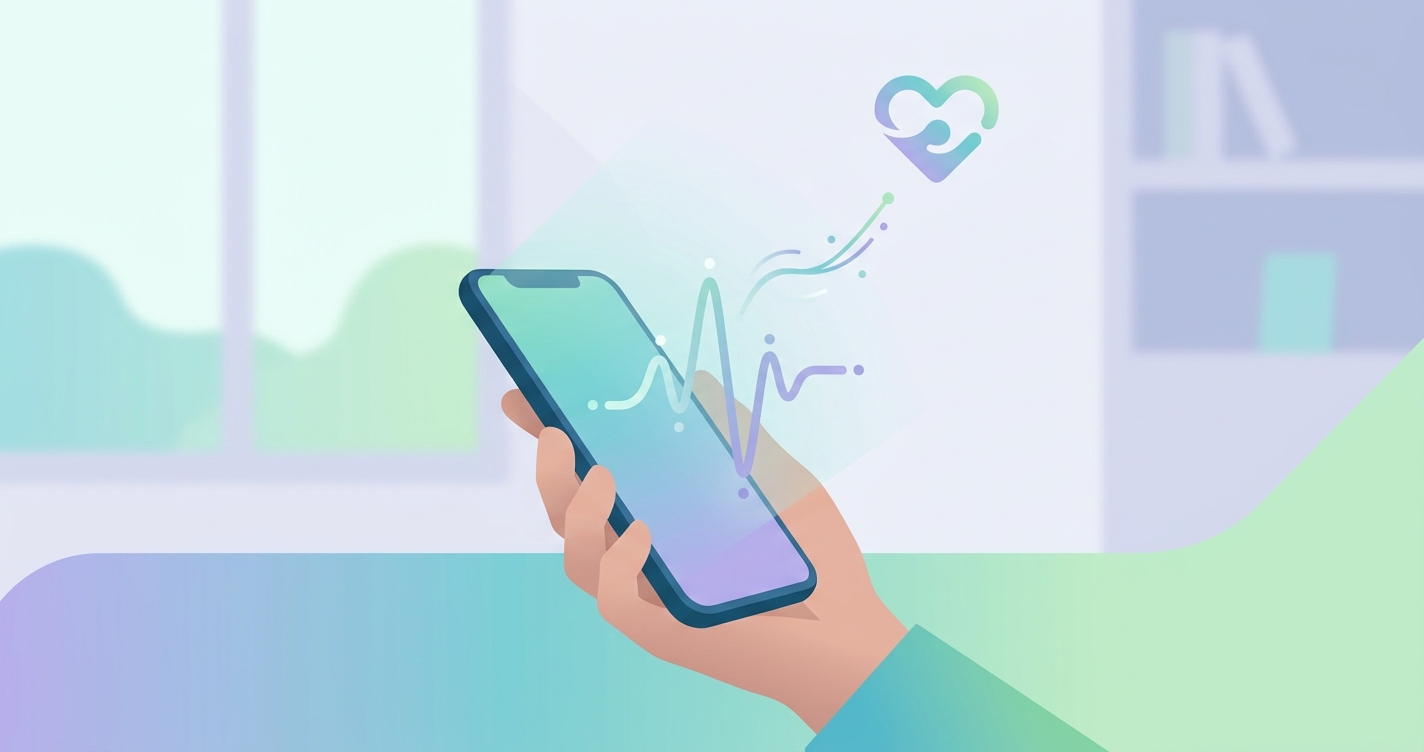
If your care team has asked you to recover at home and check in through the device already sitting on your kitchen counter, the question is a fair one: can an aging smartphone really do anything useful for your doctors? The short answer is that a remote patient monitoring camera does not need to be the newest model to be clinically useful. The same front and rear cameras used for video calls and photos can pick up subtle color changes in your skin tied to your pulse, and increasingly to other vital signs. For the people who run care-at-home programs, this shift matters less because it is novel and more because it removes the single biggest reason monitoring programs stall: getting patients to actually use the equipment.
"Approximately five billion smartphones are already capable of monitoring resting heart rate, presenting a significant opportunity to broaden access to health tracking.", Google Research, 2024
What a remote patient monitoring camera actually measures
The underlying method is called photoplethysmography, usually shortened to PPG. When your heart beats, it pushes a pulse of blood through the small vessels just under your skin. That pulse changes how much light your skin absorbs and reflects, by an amount far too small for the human eye to notice. A camera sensor, however, can detect it. Software analyzes the tiny frame-to-frame variations in skin color across a short video clip and reconstructs a pulse waveform, much like the clip-on sensor a nurse places on your fingertip in a clinic. The technique done at a distance is often called remote PPG, or rPPG.
A remote patient monitoring camera built on this principle does not ask the patient to wear anything, charge anything, or pair anything over Bluetooth. The patient holds up a phone or sits in front of a tablet for a short capture window. From that same signal, researchers have extracted heart rate, heart rate variability, respiratory rate, and in some work estimates of blood oxygen and blood pressure trends. Heart rate and respiratory rate are the most mature; blood pressure remains an active research target.
For program directors, the strategic point is device economics turned upside down. Traditional remote patient monitoring assumes you ship hardware to a home. Camera-based monitoring assumes the hardware is already there.
How camera-based monitoring compares to traditional RPM
The table below frames the operational tradeoffs that matter to a care-at-home program, not just the technology.
| Factor | Camera-based RPM | Wearable sensors | Peripheral devices (cuff, oximeter) | | --- | --- | --- | --- | | Patient must own equipment | Uses existing phone or tablet | No, shipped to patient | No, shipped to patient | | Up-front hardware cost per patient | Low to none | Moderate to high | Moderate | | Charging or battery burden | Phone only | Daily charging required | Battery replacement | | Setup complexity | Open an app or link | Pairing, fitting, syncing | Cuff placement, calibration | | Common reason for dropout | Connectivity, lighting | Forgetting to wear or charge | Misuse, lost device | | Reverse logistics on discharge | None | Return shipping, sanitizing | Return shipping | | Vitals captured | HR, respiratory rate, trends | HR, activity, sometimes SpO2 | Single targeted vital |
The pattern that emerges is that cameras trade one set of problems for another. You give up the continuous, always-on stream of a worn sensor, and you take on dependence on lighting and a stable connection. What you gain is the elimination of the logistics and compliance burden that quietly drains most programs.
Practical advantages that come up repeatedly in program planning:
- No device to procure, configure, ship, track, sanitize, or recover.
- Nothing for the patient to charge, which removes a frequent failure point overnight.
- Faster enrollment, because onboarding can happen during the discharge conversation.
- Lower barrier for patients who already video call family, a familiar motion.
- A single platform can scale across many conditions without new hardware per use case.
Industry applications across care-at-home programs
Post-discharge and hospital-at-home
The transition home is the riskiest window in many care journeys. A remote patient monitoring camera lets a patient submit a brief vitals check during a normal daily routine, giving virtual nursing teams a trend line for heart rate and respiratory rate without sending a kit. For hospital-at-home models that are already managing acute patients outside the building, removing the hardware step shortens the time between admission to the program and the first usable data point.
Chronic disease and population health
For population health teams managing large panels of patients with heart failure, COPD, or hypertension, the economics of shipping and maintaining devices to thousands of people is often the limiting factor. Camera capture changes the unit cost of adding one more patient to something close to the cost of software. That makes it realistic to monitor wider, lower-acuity groups who would never have justified a hardware deployment.
Underserved and rural populations
Device cost and reverse logistics fall hardest on safety-net and rural programs. Because smartphone ownership is now widespread even among lower-income groups, a camera-first approach can reach patients who would be excluded by a hardware budget, provided connectivity and digital-literacy support are addressed.
Current research and evidence
The evidence base for camera-based vitals has matured quickly. In 2024, Google Research described a Passive Heart Rate Monitoring system that uses a phone's front-facing camera to estimate heart rate during ordinary use, reporting a mean absolute percentage error below 10 percent against electrocardiogram reference values, and performance the team described as reaching wearable-level quality for daily resting heart rate. Notably, that work was trained and tested across nearly 700 diverse participants and more than 350,000 video clips, and was designed to perform across all skin tones, addressing an earlier limitation where melanin made the optical signal harder to detect in darker skin.
Independent validation has tempered the enthusiasm in useful ways. A real-world study published in EP Europace in April 2024 evaluated smartphone PPG for rate and rhythm monitoring in patients with atrial fibrillation under unsupervised conditions. The rhythm-detection algorithms performed strongly, while the PPG-derived heart rate tended to underestimate higher heart rates, a reminder that motion, lighting, and arrhythmia all stress the signal.
Adoption research points in the same direction. A scoping review on barriers to digital health adoption in older adults, informed by Innovation Resistance Theory, found that lower digital literacy, usability problems, and concerns about privacy, not skepticism about the underlying science, were the dominant reasons older patients disengage. Qualitative work on rural and regional RPM programs has similarly flagged connectivity and access to suitable devices as recurring obstacles. For a program director, the takeaway is that the camera removes the hardware barrier but does not remove the human one. Onboarding support, clear instructions, and a familiar interface still decide whether a patient stays engaged past week one.
The future of camera-based monitoring
Three directions are worth watching. First, passive capture, illustrated by the Google work, moves the field from scheduled check-ins toward measurements gathered during normal phone use, which could lift adherence further by asking nothing extra of the patient. Second, the menu of vitals is expanding from heart rate and respiratory rate toward more contested signals such as blood pressure trends and oxygen saturation, where validation will determine clinical acceptance. Third, regulatory and reimbursement frameworks are still catching up to monitoring that uses no dedicated device, and how camera-derived vitals fit existing billing codes will shape how fast health systems deploy them.
None of this displaces worn sensors entirely. The realistic near-term model is layered: cameras for broad, low-friction coverage and trend detection, with worn or peripheral devices reserved for patients whose acuity justifies continuous or single-vital precision. The strategic value of a remote patient monitoring camera is that it lowers the floor for who can be monitored at all.
Frequently asked questions
Does my phone need to be a recent model to work?
Generally no. The method relies on standard camera sensors that have been common for years. Very old or low-resolution cameras and poor lighting degrade the signal, but a typical smartphone from the last several years is usually sufficient for heart rate and respiratory rate capture.
Is the camera watching me all the time?
No. Most clinical implementations capture short, deliberate clips during a check-in rather than recording continuously. Passive approaches under research capture brief moments during normal use, and any responsible deployment should make data handling and consent explicit.
How does this compare to the finger clip a nurse uses?
Both rely on photoplethysmography, the same optical principle. The clip presses a sensor against your skin, while the camera reads the signal from a distance. The contact sensor is less affected by lighting and motion, which is why camera methods work best with good light and a still subject.
Can a camera measure blood pressure?
Blood pressure estimation from a camera is an active research area, not a settled capability. Heart rate and respiratory rate are far more mature. Treat any blood pressure figure from a camera as a trend signal pending stronger validation.
Circadify is building toward this model of camera-first remote monitoring, designed around the reality that the most reliable device is often the one the patient already owns and knows how to use. Care-at-home and population health leaders evaluating how to widen coverage without widening logistics can explore a structured RPM pilot program to test camera-based monitoring against their own adoption and cost benchmarks.