RPM for Behavioral Health: Monitoring Stress and Anxiety Remotely
Research-based analysis of how RPM behavioral health stress anxiety programs use remote monitoring to support triage, engagement, and between-visit care.
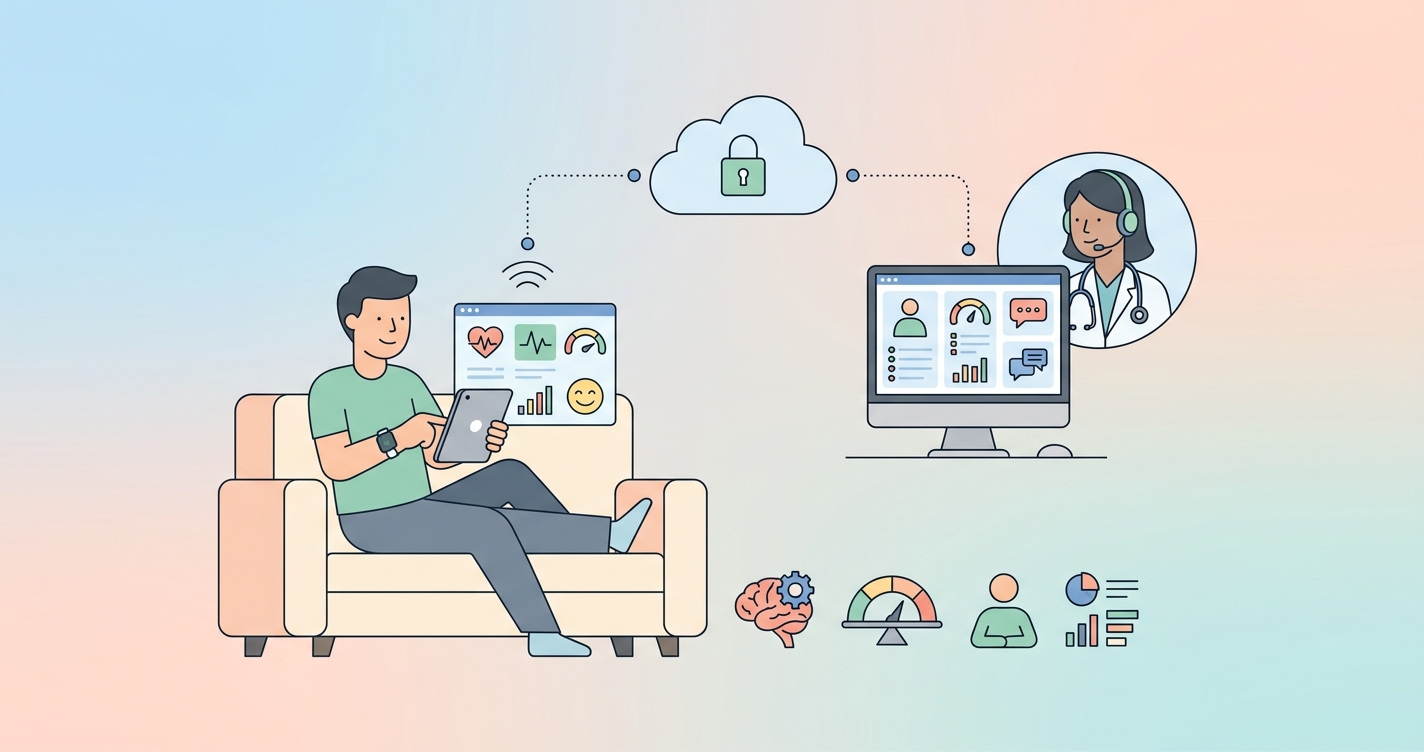
RPM behavioral health stress anxiety programs are getting attention for a simple reason: psychiatric symptoms do not follow appointment schedules. Stress spikes, sleep disruption, panic symptoms, and disengagement often show up between visits, not during them. That makes remote patient monitoring more relevant in behavioral health than many health systems expected a few years ago. The real question now is not whether behavioral health can use RPM. It is which signals are worth tracking, how those signals fit clinical workflow, and where lower-friction tools such as camera-based check-ins may fit alongside symptom surveys and nurse outreach.
"Sensors are potentially useful for detecting anxiety and for initiating and directing interventions, but more work is needed on acceptability and effectiveness." — R. Dobson, L.L. Li, K. Garner, T. Tane, J. McCool, and R. Whittaker, JMIR Mental Health (2023)
Why RPM behavioral health stress anxiety programs are expanding
Behavioral health has always had a visibility problem. Clinicians usually see patients in scheduled intervals while the hardest moments happen outside the clinic. That gap is why the American Psychiatric Association now frames remote patient monitoring as an increasingly important extension of behavioral care, especially for mood, sleep, activity, stress, and craving signals that may shift between visits.
There is also a practical workforce reason. Hospital systems, virtual care teams, and population health groups are being asked to manage more patients with anxiety, depression, trauma-related symptoms, and burnout while protecting scarce clinician time. RPM becomes attractive when it helps teams sort which patients need outreach today and which patients can stay on a lower-touch pathway.
Comparison table: common RPM approaches for behavioral health stress and anxiety
| Monitoring approach | What it usually captures | Operational upside | Common limitation | Best fit |
|---|---|---|---|---|
| Patient-reported surveys | Mood, anxiety severity, symptoms, sleep quality | Easy to deploy and clinically familiar | Depends on consistent self-reporting | Outpatient psychiatry, therapy, collaborative care |
| Wearables | Heart rate, HRV, sleep, activity, physiologic stress proxies | Passive longitudinal data | Device adherence and charging burden | Higher-acuity or research-heavy programs |
| Smartphone passive sensing | Activity patterns, phone use, mobility, interaction frequency | Low extra hardware burden | Privacy and consent concerns | Digital mental health programs |
| Camera-based check-ins | Short-session vital signs and brief symptom context | Familiar device, low logistics burden | Not continuous monitoring | Virtual nursing, care-at-home, stepped-care screening |
| Hybrid RPM workflow | Survey + passive signal + clinician triage | Broader picture of patient status | More workflow design required | Health systems building scalable behavioral RPM |
What behavioral health teams are actually trying to monitor
Stress and anxiety are not single metrics. They are clusters of physiologic, behavioral, and self-reported changes that become useful only when interpreted in context.
That is why most serious RPM behavioral health stress anxiety programs do not rely on one signal alone. They combine measures such as:
- symptom severity questionnaires
- sleep disruption and insomnia patterns
- resting heart rate or stress-related physiologic change
- activity decline or social withdrawal proxies
- missed check-ins or sudden disengagement
- clinician review of trend changes over time
I think that last point matters most. In behavioral health, monitoring works when it informs a human decision. If the workflow cannot answer who reviews worsening signals and what happens next, then the program is just collecting anxious data about anxious patients.
How RPM changes the stress and anxiety care pathway
The case for RPM in behavioral health is not constant surveillance. It is better timing.
A patient with rising stress symptoms may not need hospitalization, but they may need a same-week therapist touchpoint, medication review, coaching outreach, or stepped-up digital support. A patient whose symptoms are stable may not need the same level of clinical attention that week. Remote monitoring gives teams a way to sort those paths more intelligently.
Luiza Palmieri Serrano and colleagues wrote in their 2023 systematic review in The Permanente Journal that RPM practitioners consistently saw value in continuous monitoring, patient self-care, and more efficient communication. At the same time, the review covered 13 articles published between 2017 and 2021 and found familiar challenges: increased workload, privacy concerns, data accuracy questions, and the risk of making patients more anxious if programs are poorly designed.
That tradeoff is especially important in behavioral care. Monitoring can support reassurance and earlier intervention, but a badly framed program can also make patients feel watched rather than supported.
Where camera-based RPM fits in behavioral health
Most of the published behavioral health RPM literature focuses on wearables, apps, or passive sensing. Even so, camera-based RPM has a plausible role in this space because many health systems want lower-friction check-ins rather than another shipped device.
That role is narrower than some vendors imply. Camera-based monitoring is not a replacement for psychotherapy or a stand-alone anxiety diagnosis tool. It is more useful as part of a structured workflow that may include brief vital sign capture, symptom questions, and protocol-based escalation.
For health systems already building virtual nursing or hospital-at-home pathways, that matters. Behavioral health needs often overlap with medical follow-up, especially after hospitalization, during oncology treatment, in cardiac recovery, or inside chronic disease management where stress and anxiety affect adherence. A short, smartphone-based check-in can be easier to operationalize than a device-heavy program when the goal is recurring visibility rather than round-the-clock biometrics.
Industry applications
Post-discharge behavioral follow-up
Patients discharged after psychiatric admission, emergency evaluation, or major medical events often enter a fragile period at home. RPM can help teams track missed check-ins, physiologic stress signals, and symptom changes during that window.
Collaborative care and population health
Primary care groups managing large anxiety and depression panels need a way to identify who is drifting before the next appointment. RPM can support stepped care by flagging worsening patterns that deserve outreach.
Hospital-at-home and complex care programs
Behavioral symptoms often complicate home-based medical care. Anxiety can drive unnecessary escalation, while untreated stress can reduce adherence. Remote monitoring gives teams more visibility without requiring a separate in-person workflow.
Digital behavioral health programs
App-based therapy and coaching programs need better retention and triage. RPM can help identify disengagement, rising symptom burden, or the need for a more intensive level of care.
Current research and evidence
The evidence base is still mixed, but it is moving in a useful direction.
Dobson, Li, Garner, Tane, McCool, and Whittaker reported in their 2023 JMIR Mental Health scoping review that only 11 studies out of 1,087 screened records met inclusion criteria for sensor-based anxiety detection and in-the-moment intervention. That is not a mature evidence base. Still, most of the included studies showed improvements in anxiety or stress-related target variables, which suggests the clinical idea is promising even if implementation standards are still uneven.
Serrano, Maita, Avila, Torres-Guzman, Garcia, Eldaly, Haider, Felton, Paulson, Maniaci, and Forte add another operational perspective. Their practitioner-focused systematic review drew on 2,351 clinicians across specialties and found that teams valued continuous monitoring and faster communication, but worried about workload, privacy, and technology burden. Behavioral health RPM inherits all of those issues, and probably feels them more sharply because patient trust is central to adoption.
A broader digital mental health meta-review by Joseph Firth, John Torous, Simon Rosenbaum, and colleagues looked across 18 meta-analyses, 285 randomized controlled trials, and more than 100,000 participants. Their conclusion was not that digital mental health tools replace conventional care. It was that they can reduce symptom burden, including anxiety symptoms, when used as part of real treatment pathways. That is probably the most realistic frame for RPM too.
The American Psychiatric Association's behavioral health RPM guidance lands in roughly the same place. Remote monitoring can help bridge gaps between visits, but only when programs are built around consent, patient-centered design, clear review pathways, and clinical integration.
What makes behavioral RPM useful instead of intrusive
The programs that seem most credible tend to share a few traits:
- patients know exactly what is being tracked
- teams explain what triggers outreach and what does not
- data collection stays lightweight enough to sustain adherence
- escalation rules are clear before the first alert arrives
- monitoring supports treatment rather than replacing human care
That is the difference between a supportive program and a surveillance project.
The future of RPM behavioral health stress anxiety programs
I do not think the future of behavioral RPM is a single magic biomarker for anxiety. It looks more like blended monitoring: brief self-report, lightweight physiologic signals, cleaner triage logic, and better routing to the right level of care.
That also means the winning programs will probably look boring in the best possible way. Fewer devices. Shorter check-ins. Less dashboard theater. More clarity about which patient needs a call today.
Camera-based RPM fits that direction because health systems are asking for tools patients can actually complete with the devices they already own. In behavioral health, that kind of low-friction design may matter as much as the sensing itself.
Frequently asked questions
What does RPM monitor in behavioral health?
Behavioral health RPM may track symptom surveys, sleep patterns, activity, physiologic stress proxies, missed check-ins, and other indicators that help clinicians spot worsening anxiety or disengagement between visits.
Can RPM diagnose anxiety disorders remotely?
No. RPM can support monitoring and triage, but it does not replace clinical evaluation, diagnosis, or psychotherapy. It is best used as part of a broader care pathway.
Why is RPM useful for stress and anxiety care?
Stress and anxiety often change between appointments. RPM helps care teams see trend changes earlier, prioritize outreach, and support stepped care instead of waiting for the next scheduled visit.
Where does camera-based RPM fit in behavioral health?
Camera-based RPM fits best in short recurring check-ins, especially where health systems want lower-friction monitoring tied to virtual care, post-discharge support, or hybrid medical-behavioral workflows.
RPM behavioral health stress anxiety programs are still early, but the direction is clear: providers want more visibility between visits without building a device logistics business. Solutions like Circadify fit into that broader shift toward lower-friction remote monitoring for health systems. For related reading, see The Clinical Workflow for Camera-Based Remote Patient Monitoring and How RPM Reduces Emergency Department Overcrowding.