RPM for Cardiac Rehabilitation: How Remote Monitoring Helps
Research-based analysis of RPM cardiac rehabilitation monitoring, including participation gaps, program design choices, and evidence on outcomes in home-based rehab.
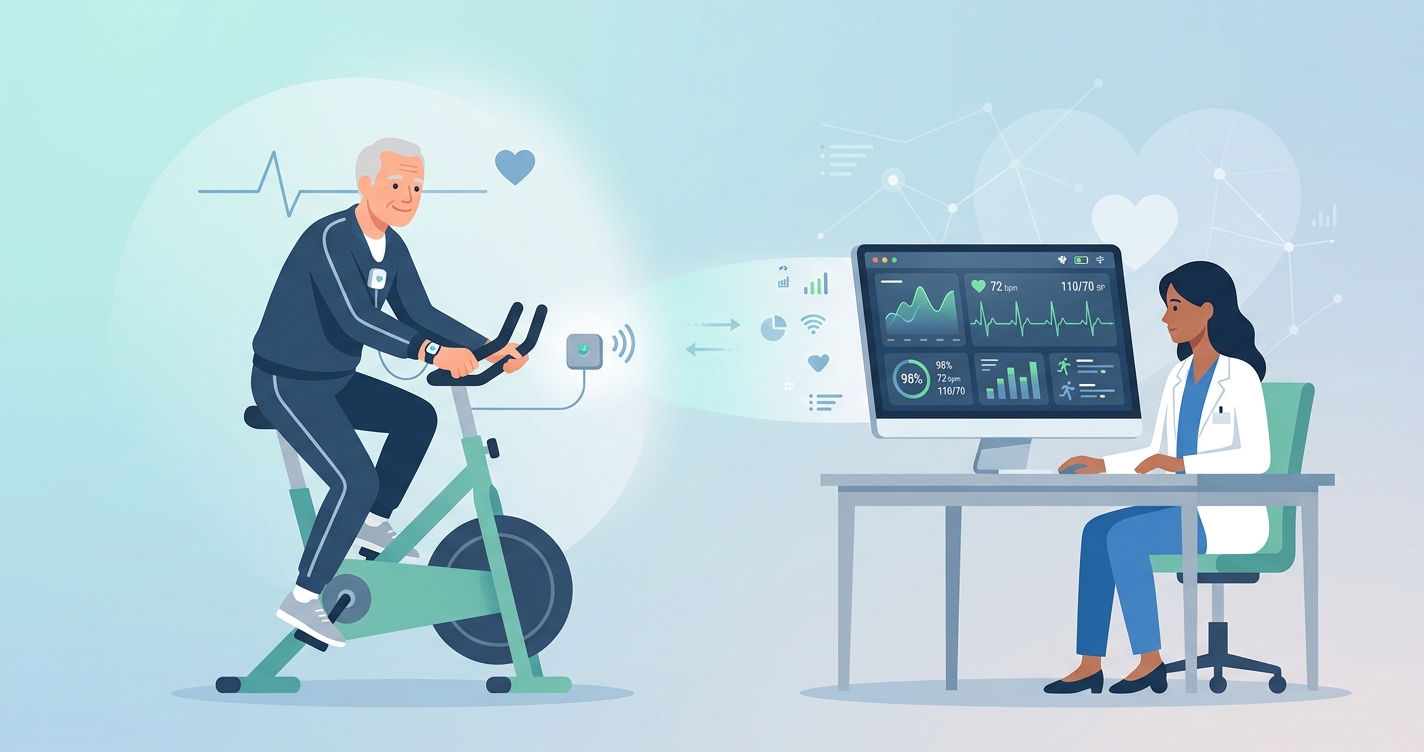
RPM cardiac rehabilitation monitoring has moved from a pandemic workaround to a durable care-delivery model. That shift is easy to understand. Cardiac rehab works, but attendance has been a problem for years. Patients recovering from myocardial infarction, coronary revascularization, heart failure, or other cardiac events often face transportation barriers, work conflicts, limited local program capacity, and the plain difficulty of returning to a clinic several times a week. Remote patient monitoring gives health systems another way to keep rehab connected to the patient instead of tied to the building.
"Only about 25% of Medicare recipients participated in cardiac rehabilitation in 2016, and only 27% completed the full course." — American Heart Association summary of Medicare participation data
Why RPM cardiac rehabilitation monitoring matters now
The case for remote monitoring in cardiac rehab starts with underuse. The American Heart Association, American Association of Cardiovascular and Pulmonary Rehabilitation, and American College of Cardiology have all supported broader home-based cardiac rehabilitation because the center-based model leaves too many eligible patients out. The problem is not a lack of clinical evidence for rehab itself. The problem is access.
Remote monitoring changes the operating model. Instead of treating cardiac rehab as a place patients visit, it treats rehab as a structured longitudinal program that can follow the patient home. A care team can review symptom reports, heart rate trends, blood pressure readings, exercise logs, medication adherence, and recovery milestones without requiring every touchpoint to happen on site.
A 2024 scientific statement on core components of cardiac rehabilitation kept the emphasis on exercise training, risk factor management, psychosocial support, and secondary prevention. RPM fits because it helps those components travel. It does not replace rehab. It helps deliver rehab with more continuity.
Comparison table: center-based vs RPM-enabled cardiac rehab
| Program dimension | Traditional center-based rehab | RPM-enabled cardiac rehab | |---|---|---| | Patient travel burden | High | Lower, with many visits shifted home | | Monitoring cadence | Usually tied to scheduled sessions | Can include between-visit check-ins | | Staffing model | In-clinic supervision dominates | Hybrid of virtual review and targeted escalation | | Access for rural patients | Often limited | Broader reach if devices or camera sessions are supported | | Adherence risk | Missed sessions due to logistics | Better continuity, but digital engagement still matters | | Data captured between sessions | Limited | More regular physiologic and symptom data | | Best fit | Patients who can reliably attend on site | Programs trying to expand access and follow-up |
What remote monitoring actually adds to cardiac rehab
In practice, RPM cardiac rehabilitation monitoring is less about collecting data for its own sake and more about keeping patients inside the program. A remote model can include connected blood pressure cuffs, scales, pulse oximeters, heart rate data, symptom questionnaires, or camera-based vital sign check-ins depending on the pathway. The point is not to overwhelm patients with gadgets. The point is to give clinicians enough visibility to coach, reassure, and intervene when recovery starts to drift.
The most useful contributions usually fall into a few buckets:
- more frequent observation between formal rehab sessions
- faster identification of missed exercise goals or symptom changes
- easier follow-up after discharge when motivation is fragile
- stronger continuity for patients who cannot come in three times a week
- better documentation of engagement across the rehab episode
That matters because rehab failure is often operational, not clinical. Patients miss one session, then three, then they quietly disappear.
Industry applications
Post-PCI and post-MI recovery
Patients discharged after percutaneous coronary intervention or myocardial infarction often need a monitored ramp back into physical activity. Home-based cardiac telerehabilitation studies have shown that remote monitoring can improve exercise capacity and support structured recovery outside the hospital. For health systems, that means rehab can start sooner and stay more visible during the vulnerable early weeks.
Heart failure follow-up
Heart failure patients benefit from rehab, but they are also the group most likely to trigger concerns about symptom fluctuation, weight change, and decompensation risk. RPM gives care teams a way to watch for warning signs while preserving the educational and behavioral support that makes cardiac rehab valuable in the first place.
Rural and capacity-constrained programs
This may be the cleanest use case. If a health system has one rehab center serving a large geography, traditional attendance becomes unrealistic for many patients. Home-based rehab backed by remote monitoring helps extend program reach without pretending geography no longer matters.
Hybrid cardiac rehab models
A lot of programs will not go fully remote, and they probably should not. The more durable model is hybrid: initial assessment and higher-risk sessions in person, followed by remote check-ins, home exercise tracking, and targeted in-clinic follow-up when the patient or clinician needs it.
Current research and evidence
The evidence base has gotten harder to dismiss. In a 2024 systematic review, Yating Li and colleagues concluded that remote cardiac rehabilitation in coronary heart disease patients was safe, with a low incidence of exercise-related serious adverse events and no exercise-related deaths reported across the reviewed studies. The same review found favorable long-term outcomes, including better adherence and improvements in quality of life compared with what many health systems see in fragmented center-only participation.
A separate systematic review and meta-analysis on home-based cardiac rehabilitation using wearable sensors found that the model was feasible and effective as a multicomponent intervention. That point matters because cardiac rehab is not just monitored exercise. It is exercise training plus medication reinforcement, coaching, risk-factor management, and behavior change. Remote monitoring helps hold those pieces together.
The utilization gap is still enormous. American Heart Association reporting on Medicare data found that only about one in four eligible beneficiaries participated in cardiac rehab, and completion rates were worse than they should be. That is the sort of number that changes how an executive should frame the problem. The issue is not whether to protect the old model. It is whether the old model can reach enough of the population to matter.
There is also meaningful long-term evidence from the Veterans Health Administration. In a Journal of the American Heart Association study led by David C. Maron and colleagues on the Healthy Heart Program, veterans who participated in home-based cardiac rehabilitation had a 36% lower risk of death over a median 4.2 years of follow-up. Only 44% of eligible veterans enrolled, which says something important on its own: even improved access does not remove every barrier, but it can still produce measurable survival benefit.
Where RPM succeeds and where program design still matters
Remote monitoring does not fix a weak rehab program. It gives a strong program more reach.
Programs tend to work better when they:
- define which metrics are reviewed routinely versus only on escalation
- keep patient tasks simple enough to repeat for 8 to 12 weeks
- make it clear who responds when symptoms or vitals move out of range
- connect remote monitoring to coaching, not just dashboards
- use hybrid visits when risk level or patient confidence calls for them
Some programs overbuild the technology and underbuild the workflow. That is usually the wrong trade. Cardiac rehab patients do not need a science project. They need a program that feels doable on a Tuesday morning.
The future of cardiac rehabilitation monitoring
The near future looks less like a single winning format and more like segmentation. Lower-risk patients with transportation barriers may do most of their rehab from home with regular remote review. Higher-risk patients may begin in person, then shift into hybrid follow-up. Camera-based vitals, passive check-ins, and software-first RPM models will likely get more attention because they cut some of the device friction that causes dropout in longer monitoring programs.
The strategic implication is straightforward: health systems that want more cardiac rehab participation will need delivery models that are lighter, not heavier. RPM is attractive because it can make rehab more present in daily life without asking every patient to behave like a frequent clinic commuter.
Frequently asked questions
What is RPM cardiac rehabilitation monitoring?
It is the use of remote patient monitoring tools within a cardiac rehab program to track vitals, symptoms, activity, and recovery progress while patients complete some or all of rehab from home.
Does remote cardiac rehab work as well as center-based rehab?
Current evidence suggests home-based and remotely supported cardiac rehab can achieve outcomes comparable to center-based rehab for many patients, especially when the program is structured, supervised, and tied to clear escalation protocols.
Which patients benefit most from RPM in cardiac rehab?
Patients who face transportation barriers, rural access limits, work constraints, or difficulty attending frequent on-site sessions often benefit the most. Hybrid models can also work well for patients who need some in-person supervision but not every encounter on site.
Does RPM replace the care team in cardiac rehabilitation?
No. It changes how the care team stays connected to the patient. The value comes from clinician review, coaching, symptom follow-up, and timely escalation, not from data collection alone.
For RPM cardiac rehabilitation monitoring, the real opportunity is better reach without giving up structure. Health systems do not need fewer cardiac rehab patients. They need fewer patients falling out of cardiac rehab because the delivery model was too rigid for real life. Solutions like Circadify are part of the broader shift toward lower-friction remote monitoring that can support home-based and hybrid recovery pathways. For related reading, see What Is Remote Patient Monitoring? RPM Technology Explained and How Health Systems Reduce Readmissions With RPM Programs.