RPM for Maternal Health: Remote Monitoring for High-Risk Pregnancies
A research-based look at RPM maternal health high risk pregnancy monitoring, with evidence on hypertensive disorders, engagement, workflow design, and care access.
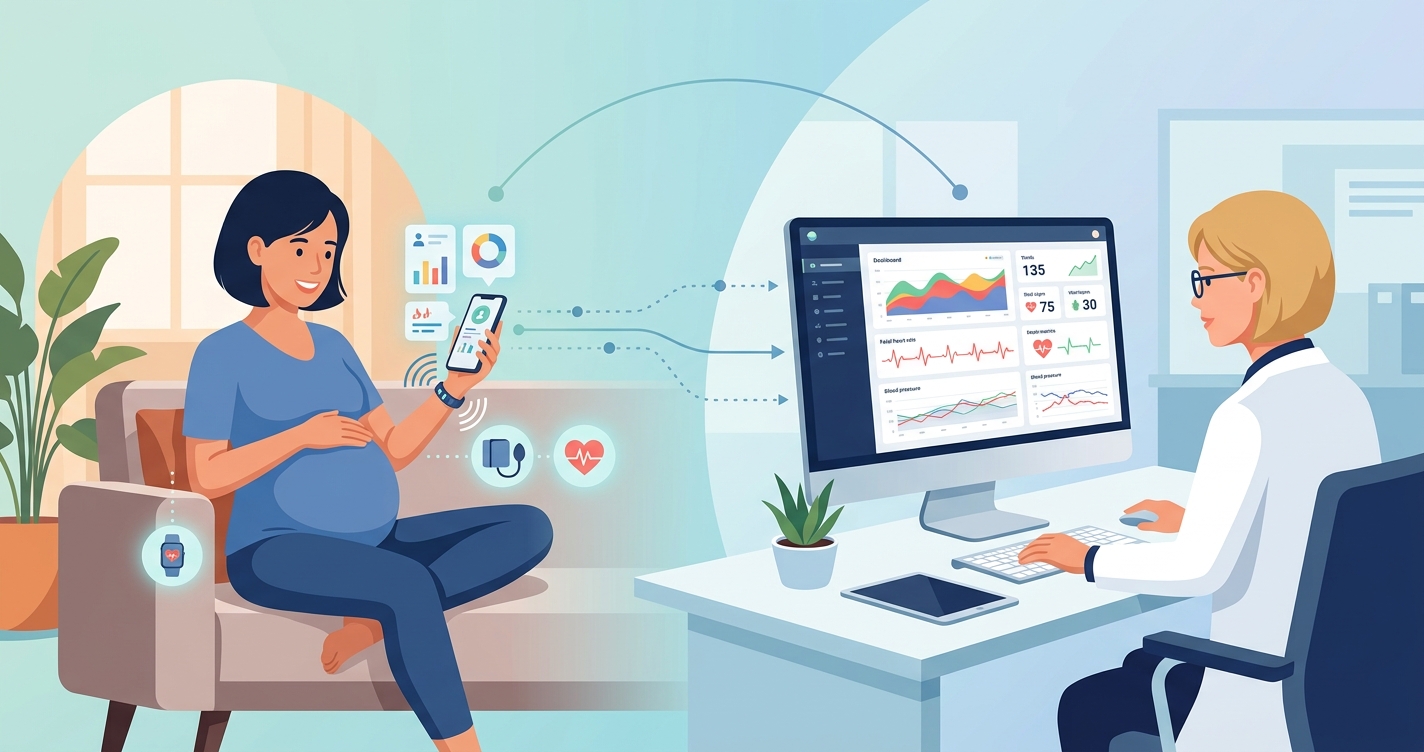
RPM maternal health high risk pregnancy monitoring is moving from pilot language into everyday operating language for obstetrics teams. That shift makes sense. High-risk pregnancy care usually depends on frequent blood pressure checks, symptom tracking, fetal surveillance, and fast escalation when something starts to drift. The problem is that traditional monitoring models ask pregnant patients to absorb the travel, scheduling, and repeat-visit burden at exactly the moment when care needs are rising. Remote patient monitoring changes that equation by moving part of the surveillance workload into the home.
"Connected blood pressure cuffs increased engagement by 2.13 times more measures per day than unconnected cuffs that required manual entry." — Mia Charifson and colleagues, JMIR mHealth and uHealth (2024)
RPM maternal health high risk pregnancy monitoring is really about earlier visibility
High-risk pregnancies are not one condition. They are a cluster of situations where routine prenatal follow-up may not be enough: chronic hypertension, gestational hypertension, diabetes, prior preeclampsia, multifetal pregnancy, fetal growth concerns, and a long list of social risk factors that make in-person surveillance harder to sustain. In practice, RPM has gained traction because it gives care teams more chances to see trouble earlier.
That is the real value proposition. More readings. Fewer blind spots. Better continuity between visits.
Researchers at George Washington University looked at 823 pregnant patients using the Babyscripts platform and found that almost one-third of the cohort identified as Black while 32% were Medicaid or Medicare recipients. Their retrospective review found a non-significant trend linking higher remote-monitoring engagement with greater preeclampsia detection. I would not oversell that result. Still, it points to something important: when patients stay connected to the monitoring workflow, clinicians get more opportunities to catch dangerous patterns before they become emergencies.
The same pattern shows up in hypertension-focused literature. Dorien Lanssens, Thijs Vandenberk, and Wilfried Gyselaers at Hasselt University have spent years studying remote monitoring in pregnancy-related hypertension. Their PREMOM work suggests that structured remote blood pressure and symptom monitoring can reduce prenatal admissions and make follow-up more continuous for women with gestational hypertensive disorders.
Comparison table: where RPM fits in high-risk pregnancy care
| Care dimension | Traditional office-centered monitoring | RPM-enabled maternal monitoring | |---|---|---| | Blood pressure follow-up | Intermittent, visit dependent | Frequent home readings with faster review | | Visibility between appointments | Limited | Better trend detection between visits | | Escalation timing | Often after symptoms worsen | Earlier alerts when readings drift | | Patient burden | Repeated travel, parking, childcare, missed work | More monitoring from home | | Data capture | Spot checks | Longitudinal trend data | | Best fit | Lower-risk routine surveillance | Hypertensive disorders, postpartum follow-up, access-challenged populations | | Workflow risk | Missed visits create blind spots | Data-review burden if staffing rules are unclear |
Why maternal RPM adoption keeps centering on hypertension
If you want to understand why obstetric RPM is gaining budget attention, start with hypertensive disorders of pregnancy. They are common, dangerous, and measurable. Blood pressure can be tracked at home. Escalation thresholds can be defined. And unlike more abstract digital-health promises, this is a problem administrators already know costs them time, admissions, and avoidable complications.
A large integrated-care study cited by the American Medical Association reported that postpartum patients enrolled in remote monitoring were 43% more likely to have normal blood pressure, 56% more likely to have a blood pressure measurement within 20 days of discharge, and 50% more likely to receive physician evaluation in that same window. Those are not small changes. They suggest that the real gain is not just convenience. It is tighter postpartum follow-up in a period where hypertension often worsens after delivery, not before.
I keep coming back to postpartum surveillance because it exposes the weakness of old workflows. A patient goes home with instructions, maybe with a cuff, and the care team hopes she reappears on schedule. Hope is not a monitoring model.
A related 2024 observational study on the Delfina Care Platform found that connected cuffs produced 2.13 times more daily blood pressure measures than devices requiring manual entry. That detail matters because maternal RPM programs often fail in boring ways. Manual entry gets skipped. Bluetooth pairing breaks. A patient is managing a newborn and is not in the mood to troubleshoot a portal.
The more friction a program adds, the less reliable it becomes.
- High-risk pregnancy monitoring works best when data capture feels routine, not technical.
- Connected devices generally outperform manual workflows on engagement.
- Clinical gains depend on response protocols, not just device distribution.
- Postpartum hypertension is still one of the clearest near-term RPM use cases in obstetrics.
Industry applications
Antenatal monitoring for hypertensive disorders
This is the best-established maternal RPM pathway. Patients measure blood pressure at home, sometimes along with weight or symptom reports, and the data flows back to a nurse, obstetrician, or centralized maternal-care team. Lanssens and colleagues showed in their pilot and cost-analysis work that this model can support women with gestational hypertensive disorders without relying on office visits for every checkpoint.
For health systems, the practical appeal is simple: home-based blood pressure surveillance is easier to scale than repeated in-clinic observation slots.
Postpartum follow-up after delivery
Postpartum care is where many maternal RPM programs prove their value. The first week or two after discharge is messy. Families are sleep-deprived. Transportation is harder. Symptoms can be minimized until they become dangerous. Remote monitoring gives clinicians a reason to stay in the loop during that unstable period.
That is why so much of the strongest evidence is postpartum rather than purely prenatal. It is also why care-at-home program directors are paying attention. Post-discharge maternal surveillance looks a lot like other successful RPM categories: frequent check-ins, simple measurements, clear escalation rules.
Remote fetal surveillance in selected high-risk pregnancies
The fetal-monitoring side is less standardized than blood-pressure RPM, but it is moving. A 2025 feasibility study on remote maternal-fetal telemedicine monitoring suggested that home ultrasound and cardiotocography may be workable and acceptable for selected high-risk pregnancies. The evidence base is still developing, and most systems are not going to roll this out broadly tomorrow. Still, it signals where the field is heading: more home-based data collection for patients who currently shuttle between clinics for surveillance.
Access support for rural and underserved populations
Maternal RPM also has a geography problem to solve. High-risk pregnancy programs are often concentrated in larger systems, but the burden of travel lands on the patient. The George Washington University cohort is useful here because it reflects a population that was not exclusively affluent or digitally pristine. Diverse payer mix and community context matter. If a program only works for highly resourced patients, it is not much of a maternal-health strategy.
Current research and evidence
The evidence is now strong enough to support cautious scaling, especially for hypertension-related use cases.
First, the Hasselt University group led by Dorien Lanssens has been among the more durable academic teams in this space. Their research on pregnancy hypertension found that remote monitoring can reduce prenatal admissions and support more continuous surveillance. That work helped move maternal RPM from concept to workflow design.
Second, the George Washington University review of 823 patients using the Babyscripts platform offers a useful implementation signal. It did not prove that RPM alone improves outcomes, but it showed that engagement patterns can be studied in real prenatal populations and may relate to detection of preeclampsia.
Third, the integrated-care hypertension program covered by the AMA reported concrete postpartum improvements: more blood pressure checks, more physician evaluation, and better blood pressure normalization after discharge. Operationally, that may be the clearest argument for buyers deciding whether maternal RPM belongs in standard obstetric service lines.
Fourth, the device-connectivity data from Mia Charifson, Timothy Wen, Bonnie Zell, Priyanka Vaidya, Cynthia I. Rios, C. Funsho Fagbohun, and Isabel Fulcher is hard to ignore. When connected cuffs generate more than twice as many daily readings as manual-entry devices, the procurement conversation changes. You are no longer debating features. You are debating whether the workflow will actually produce usable data.
Finally, a 2025 systematic review and meta-analysis on remote fetal health monitoring in high-risk pregnancies reported better fetal surveillance performance, including reduced neonatal asphyxia and less meconium-stained amniotic fluid in some included studies, while several other maternal and delivery outcomes remained similar to routine monitoring. That sounds about right for a field still maturing: meaningful wins in selected endpoints, but not universal superiority across everything.
Where health systems get maternal RPM wrong
The most common mistake is thinking the program is the device.
It is not. Maternal RPM is a staffing model, a review model, and an escalation model. The hardware and software are only the front end. If no one owns inbox review, same-day outreach, and after-hours routing, then a beautiful dashboard does not solve much.
The second mistake is overbuilding. High-risk pregnancy programs do not need five different sensors on day one. Most need one reliable monitoring pathway, clear patient instructions, and a response protocol clinicians trust.
The third mistake is ignoring workflow friction. Maternal care is full of interrupted routines. Patients miss readings for understandable reasons. Good programs assume imperfect adherence and design around it.
The future of maternal RPM
I do not think maternal RPM will remain a niche service line for much longer. The economics and the clinical logic are too aligned. Obstetrics teams need more continuity. Patients need fewer avoidable trips. Health systems need earlier warning when blood pressure, symptoms, or fetal signals are moving in the wrong direction.
The near-term future probably looks like this:
- broader standardization of postpartum hypertension monitoring
- more use of connected devices rather than manual-entry workflows
- tighter integration of maternal RPM into EHR and virtual-nursing teams
- selective expansion into fetal surveillance for the highest-risk cohorts
- lower-friction software models that reduce setup burden for patients
That last point matters for the broader RPM market. Solutions like Circadify fit into a wider shift toward simpler remote monitoring models that ask less of patients and give care teams faster visibility. For related reading, see How Federally Qualified Health Centers Use RPM for Underserved Populations and How Rural Hospitals Use RPM to Extend Their Reach.
Frequently asked questions
What does RPM for maternal health usually monitor in high-risk pregnancies?
Most programs start with blood pressure, symptoms, and sometimes weight or glucose depending on the pregnancy risk profile. More advanced programs may add fetal-monitoring workflows for selected patients.
Which maternal RPM use case has the strongest evidence today?
Hypertensive disorders of pregnancy, especially postpartum blood pressure monitoring, have the clearest evidence base and the most practical workflow fit for health systems today.
Does remote monitoring replace in-person high-risk obstetric care?
No. It works best as an extension of specialist and obstetric care, not as a replacement. The value is better visibility between visits and earlier escalation when risk increases.
Why does device connectivity matter so much in maternal RPM?
Because manual entry creates drop-off. Connected devices produce more usable readings, reduce workflow friction, and make it easier for busy patients to stay engaged during pregnancy and postpartum recovery.