What if my fever spikes in the middle of the night and no one knows?
How RPM with no wearable enables 24/7 passive overnight monitoring of fever and deterioration to help population health teams reduce adverse events at home.
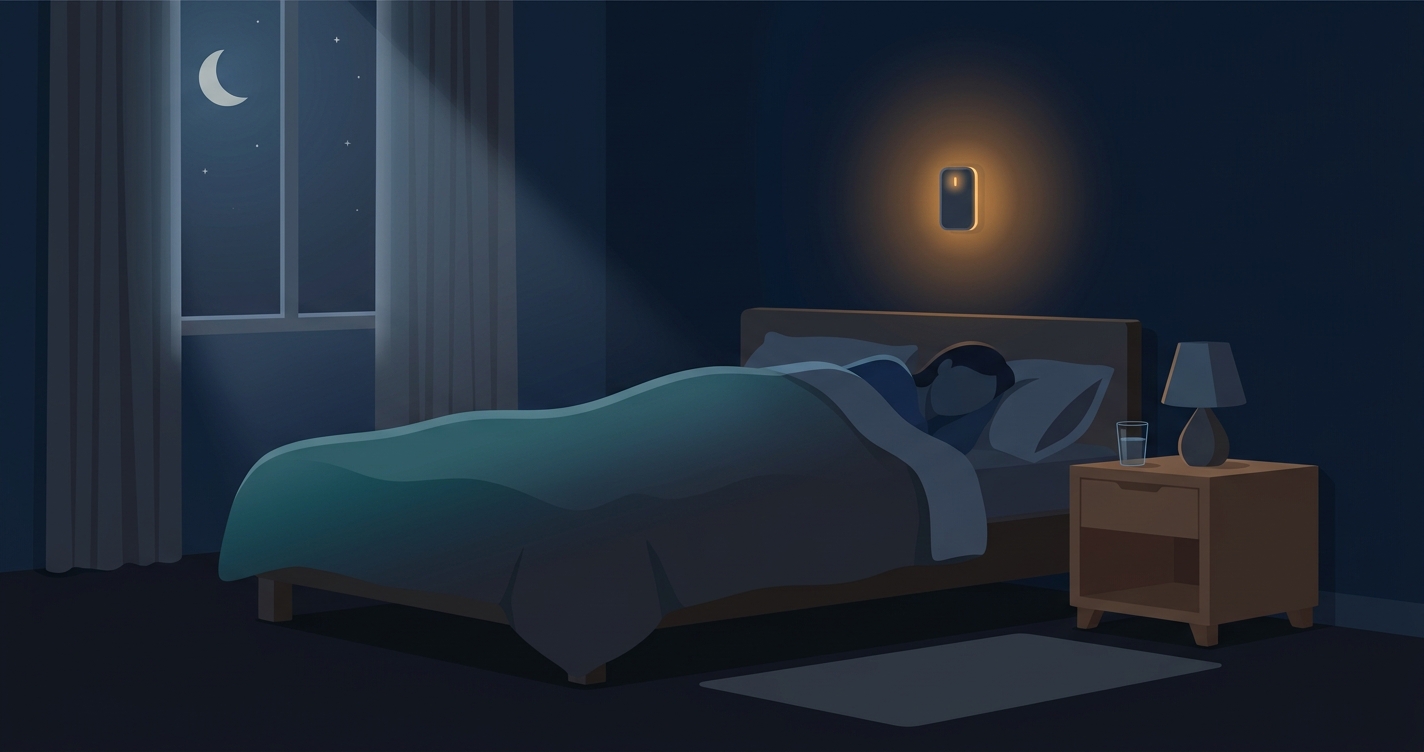
The most dangerous hours in a home-based care program are the ones no one is watching. A fever that climbs from 99 to 103 between 2 and 4 AM, a respiratory rate that drifts upward while a patient sleeps, an early sepsis signature that announces itself hours before the patient feels sick enough to call. For population health leaders, the question a patient asks at the kitchen table is the same question that should keep a program director up at night: if something goes wrong while I am asleep, will anyone know in time? This is precisely where RPM no wearable enters the conversation, because the technical answer to overnight coverage hinges on whether monitoring depends on a patient remembering to wear, charge, and tolerate a device through the night.
A retrospective record review using trigger tool methodology found that 37.7 percent of home healthcare patients experienced an adverse event, and the majority of these events were judged preventable., Adverse events in patients in home healthcare, PMC, 2023
The gap between intent and coverage is an operational problem, not a clinical one. Most programs do not lack the will to monitor patients overnight; they lack a reliable data stream during the exact window when staffing thins, when patients sleep through device alarms, and when a wrist-worn sensor has been taken off and left on a nightstand. The result is a coverage curve that dips at night, which is also when failure-to-rescue risk peaks.
Why RPM with no wearable changes the overnight equation
Failure to rescue, the inability to prevent death or serious harm after a complication develops, is consistently linked to reduced staffing during nights and weekends and to gaps in continuous observation. In the traditional hospital, the safety net for those hours is the monitored bed. In the home, that net frays. A 2023 analysis by De Vries and colleagues published in the context of hospital-at-home programs questioned whether continuous wearable monitoring should be routine, noting a high volume of alerts, many erroneous or self-resolving, which creates alarm fatigue rather than safety. The deeper issue is adherence: a monitoring stream is only protective if it is actually running.
RPM no wearable refers to passive, ambient sensing that captures physiological signals without anything attached to the patient. Camera-based and radar-based systems can estimate respiratory rate, heart rate, movement, and in some configurations surface temperature from across the room. Because nothing must be worn, the overnight data stream does not depend on the patient's behavior. This is the structural difference that matters to a population health VP modeling adverse-event reduction: a contactless platform removes the single most common point of failure in nighttime monitoring, which is the human decision to take the device off before bed.
| Monitoring approach | Overnight data continuity | Patient action required | Common failure mode | Suitability for unattended night hours | |---|---|---|---|---| | Wearable sensor (wrist or chest) | Depends on wear and charge | Wear nightly, recharge, sync | Removed at night, dead battery, skin irritation | Moderate, adherence-dependent | | Spot-check devices (cuff, oral thermometer) | None between checks | Active measurement | No data while asleep | Low | | Bedside tethered monitor | High | Stay connected to leads | Tangling, patient disconnects leads | Moderate, intrusive at home | | RPM no wearable (camera or radar) | Continuous and passive | None during sleep | Line-of-sight or room positioning | High for unattended hours |
The contrast is not about which sensor is most accurate in a controlled lab. It is about which approach actually produces data at 3 AM in a real bedroom where a patient is asleep and uncoached.
Key reasons passive sensing maps to the overnight problem:
- It captures trends during the unmonitored window when deterioration often begins quietly.
- It eliminates charging and re-application, the two tasks patients skip most at night.
- It reduces the equipment-logistics burden that strains hospital-at-home staffing.
- It avoids the skin breakdown and sleep disruption that cause patients to abandon wearables.
- It supports trend-based early warning rather than waiting for a patient-initiated call.
Industry applications for population health programs
Post-discharge and hospital-at-home cohorts
The 30-day window after discharge is when readmission and deterioration risk concentrate. A passive overnight stream gives transitional care teams a way to detect a rising respiratory rate or sustained tachycardia before a patient phones in feeling unwell. For hospital-at-home programs operating under a 30-minute emergency response expectation rather than immediate in-room presence, earlier warning is the only practical lever to compress the time from deterioration to intervention.
Sepsis and infection surveillance
Fever and rising heart rate are early, nonspecific signals of infection. Because these signals frequently move overnight, a monitoring model that goes dark while the patient sleeps misses the earliest part of the curve. Trend-aware passive monitoring is suited to flagging the slow climb that precedes a frank fever spike, which is the difference between a same-night nurse call and a morning ER arrival.
Patients who live alone
For the substantial share of home-based patients without an overnight caregiver, the absence of a witness is the core risk. Ambient monitoring functions as that witness, surfacing a change to a remote nurse even when no one else is in the house to notice it.
Current research and evidence
The evidence base is moving from feasibility toward clinical signal quality. A preliminary accuracy assessment of contactless body temperature monitoring by infrared camera, published on Semantic Scholar and ResearchGate, examined how well non-contact thermal sensing tracks measured temperature, while a separate experimental study on non-contact body temperature monitoring using low-cost thermal cameras in smart home environments tested prototype deployment outside the lab. A 2025 review of radar-based monitoring for non-contact detection of nocturnal hypoglycemia, indexed in PubMed, documents how radar captures respiration, heart rate, and body movement during sleep, the same physiological channels relevant to overnight deterioration.
On the operational side, the JMIR analysis "Hospital Is Not the Home," examining remote technology for acute and transitional care across the United States and United Kingdom, catalogs the practical barriers that undermine home monitoring, including device burden and connectivity. The De Vries 2023 work on continuous vital signs monitoring in hospitalized-at-home patients frames the central tension directly: continuous monitoring may benefit higher-risk patients most, but only if alert volume is managed and the data stream is dependable. Taken together, the literature points the same direction for population health teams: the value of overnight monitoring is bounded by adherence and alert quality, both of which a no-wearable model is positioned to improve.
It is worth stating plainly that contactless physiological estimation is an active research area, and signal quality varies by parameter, positioning, and environment. The case for RPM no wearable in the overnight window rests less on out-measuring a clinical-grade sensor and more on producing usable trend data during the hours when other approaches produce nothing at all.
The future of overnight passive monitoring
Three developments will shape the next several years. First, multimodal fusion, combining camera-derived and radar-derived signals, will improve robustness against the positioning and line-of-sight limits that affect any single ambient sensor. Second, alert logic will shift from single-threshold alarms toward personalized trend baselines, directly addressing the alarm-fatigue problem that current continuous-monitoring research flags. Third, reimbursement and program design will increasingly reward demonstrated reductions in adverse events and failure-to-rescue, which favors monitoring models that actually run overnight rather than those that look complete on paper but go dark when the patient sleeps. For population health leaders, the planning question is shifting from whether passive monitoring is feasible to how to operationalize it across cohorts where nighttime risk is highest.
Frequently asked questions
How can a fever be detected at night without a thermometer or wearable? Contactless systems use camera or radar-based sensing to estimate physiological signals associated with fever and deterioration, such as rising heart rate, elevated respiratory rate, and in some configurations surface temperature, without anything attached to the patient. Research on infrared and thermal camera temperature estimation and radar-based overnight physiological monitoring supports the technical direction, though signal quality varies by parameter and environment.
Why not just use a wearable for overnight monitoring? Wearables can work, but they depend on the patient wearing and charging the device every night. The most common overnight failure mode is the device being removed before sleep or running out of battery, which produces exactly the data gap programs are trying to close. RPM no wearable removes that behavioral dependency.
Does passive monitoring create more false alarms? Alarm fatigue is a documented risk for any continuous monitoring, as the 2023 hospital-at-home literature notes. The mitigation is trend-based, personalized alert logic rather than fixed thresholds, which reduces non-actionable alerts while preserving sensitivity to genuine deterioration.
Which patients benefit most from overnight contactless monitoring? Higher-risk post-discharge patients, hospital-at-home cohorts, patients with infection or sepsis risk, and patients who live alone without an overnight caregiver. These are the groups where the unmonitored night window carries the most adverse-event risk.
Circadify is building toward this space with a camera-based, contactless approach designed to keep the overnight data stream running without the wearable compliance gap that undermines most home programs. Population health teams evaluating how to close the nighttime coverage curve can explore an RPM pilot program at circadify.com/solutions/remote-patient-monitoring.