Why is my hospital asking me to check my temperature every morning with just a camera?
A research-style look at the temperature check remote camera model now used in hospital-at-home programs, and what it means for contactless vital signs.
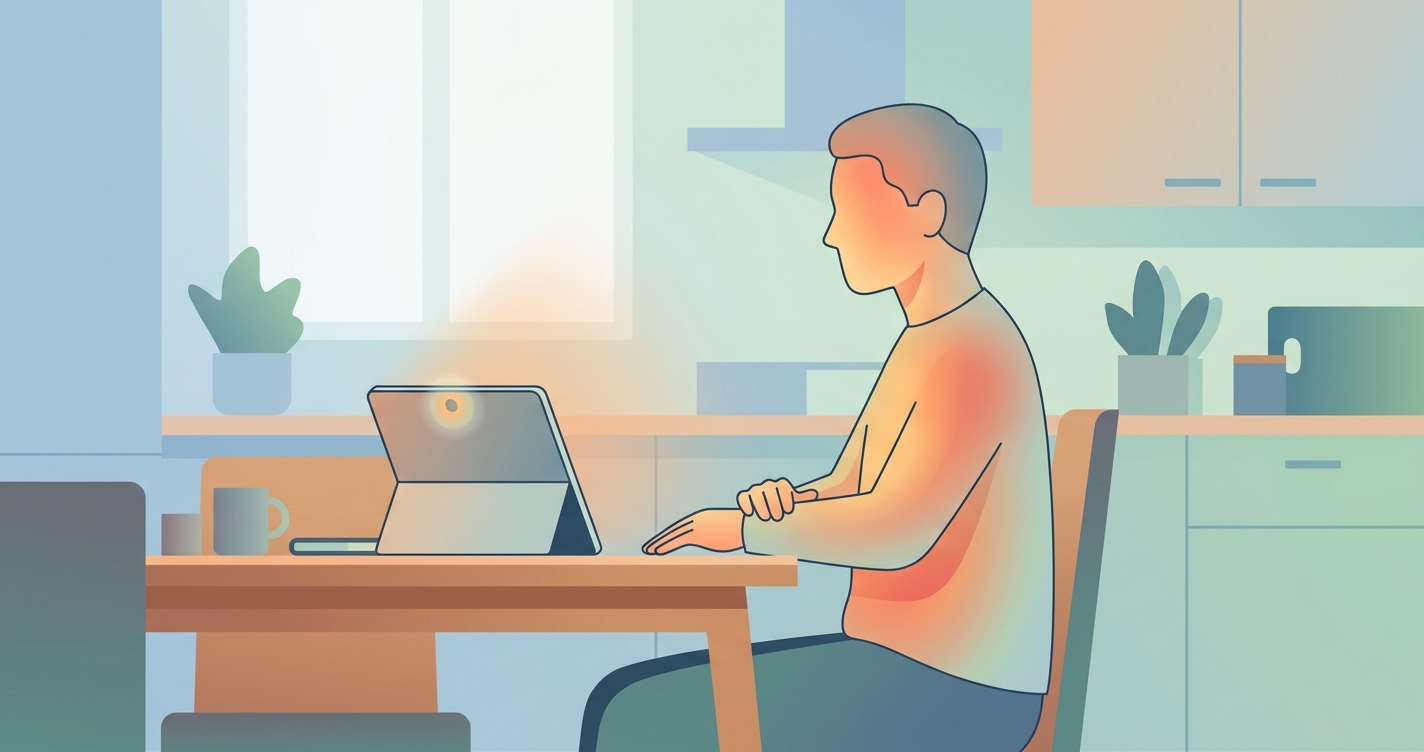
If your care team handed you a tablet at discharge and asked you to sit in front of the camera each morning instead of using a glass thermometer, the instruction can feel backwards. A temperature check remote camera workflow looks less like medicine and more like a video call. Yet the request reflects a deliberate operating decision by hospital-at-home and post-discharge programs that are trying to collect reliable vital signs from thousands of patients without shipping, sanitizing, and replacing physical devices. For the directors running these programs, the camera is not a gimmick. It is an answer to a logistics problem that has quietly limited remote monitoring for years.
Thermal imaging cameras typically measure surface temperature within plus or minus 1 to 2 degrees Celsius depending on model and environment, while contact clinical thermometers in one comparison held a standard deviation near 0.5, according to a 2023 device accuracy review published in Research Progress in Mechanical and Manufacturing Engineering.
That accuracy gap is exactly why the morning camera check is designed the way it is. It is built for trend detection and triage, not for replacing a single high-precision reading.
What a temperature check remote camera actually measures
A temperature check remote camera does not work the way a forehead thermometer does. Two distinct technologies sit behind the phrase, and care-at-home directors evaluating vendors should know which one they are buying.
The first is infrared thermography. A thermal sensor reads the heat radiating from your skin, usually the inner corner of the eye or the forehead, and estimates surface temperature. The second is remote photoplethysmography, often shortened to rPPG. This uses an ordinary RGB camera to detect tiny color changes in the skin caused by blood flow, which lets software estimate heart rate, respiration, and in some systems a temperature-correlated signal. Many consumer-grade tablets carry only an RGB camera, so the morning check you are doing may be inferring a thermal trend from blood-flow patterns rather than reading raw heat.
Neither approach is meant to give a laboratory-grade core temperature. They are meant to flag change. A reading that drifts up two days in a row matters more to a nurse than whether this morning was 99.1 or 99.4. The program is watching the slope, not the single point.
Here is how the camera approach compares with the tools it is replacing.
| Method | Contact required | Patient effort | Best use | Typical accuracy note | | --- | --- | --- | --- | --- | | Glass or digital oral thermometer | Yes | Moderate, manual logging | Spot diagnostic reading | High precision, depends on technique | | Forehead infrared gun | Brief, close range | Low | Quick screening | Sensitive to placement and ambient temp | | Wearable skin patch | Yes, continuous | Low once applied | Continuous trend | Drifts with adhesion and battery life | | Thermal camera (infrared) | No | Low, sit and look | Fever screening, trend | Plus or minus 1 to 2 C surface estimate | | RGB camera with rPPG | No | Low, sit and look | Multi-vital trend capture | Improving with machine learning models |
The pattern in that table explains the morning routine. The camera trades a little single-reading precision for something programs value more at scale: there is nothing to clean, charge, lose, or teach.
Why care-at-home programs prefer the camera
For directors managing hundreds of discharged patients, the appeal is operational before it is clinical. The contactless temperature check remote camera model removes several recurring failure points:
- No device shipping, return logistics, or reprocessing between patients
- No infection-control concern from shared contact thermometers
- No batteries, charging cradles, or Bluetooth pairing failures
- No manual transcription, since readings flow straight into the chart
- Lower abandonment, because patients keep using a screen they already understand
Wearable and peripheral RPM programs have long struggled with attrition. Patches fall off, cuffs end up in a drawer, and pulse oximeters get borrowed by family members. A camera check that takes thirty seconds and requires no equipment beyond the tablet already in the home sidesteps most of those drop-off points. The morning timing is also intentional. A consistent daily window controls for circadian temperature variation and gives the algorithm a stable baseline to compare against.
Industry Applications
Hospital-at-home programs
Acute-level care delivered at home depends on frequent, reliable vitals. A daily camera temperature check gives the virtual nursing team an early signal for post-surgical infection, pneumonia, or sepsis without dispatching staff. When a reading crosses a threshold, the system escalates to a live clinician call or an in-person visit.
Post-discharge transitional care
The first two weeks after discharge carry the highest readmission risk. A simple morning check builds a daily touchpoint with patients who would otherwise have no contact until a follow-up appointment. The routine itself improves engagement, and the temperature trend adds an objective layer to patient-reported symptoms.
Skilled nursing and congregate settings
In facilities with limited nursing hours, camera-based screening at a shared kiosk or in-room tablet lets one nurse review trends across many residents quickly, reserving hands-on assessment for the people whose data actually warrants it.
Current research and evidence
The evidence base is candid about both strengths and limits. A 2023 device accuracy review in Research Progress in Mechanical and Manufacturing Engineering compared clinical thermometers against thermal cameras and found the contact thermometer more precise, with thermal models landing within roughly plus or minus 1 to 2 degrees Celsius depending on conditions. A separate body of work summarized in MDPI on best practices for infrared thermography identified the main accuracy drivers: skin emissivity, distance from the sensor, ambient temperature and humidity, and calibration. Those findings are why serious programs standardize the environment, asking patients to sit at a consistent distance in a normally heated room.
The more interesting trend is what machine learning adds. An arXiv study on fever detection with infrared thermography reported that pairing a convolutional neural network with thermal input drove root mean square error down to about 0.22, a meaningful improvement over raw sensor readings. Researchers have also shown that using an external temperature reference source alongside the camera can cut absolute measurement error below 0.12 degrees Celsius. In other words, the hardware alone is approximate, but software calibration and reference correction close much of the gap. That is the direction commercial platforms are moving.
It is worth being clear about scope. None of this positions a camera as a replacement for a confirmatory clinical thermometer when a precise number is required. The research supports the camera as a screening and trend instrument, which is exactly the job the morning check is assigned.
The Future of contactless temperature monitoring
The trajectory points toward multi-vital capture from a single camera session. Instead of a standalone temperature check remote camera step, the same thirty-second look is increasingly used to estimate heart rate, respiratory rate, and temperature-correlated signals together, then compare all of them against the patient's own baseline. As reference-correction methods and neural network calibration mature, the accuracy gap with contact devices should keep narrowing, and regulatory pathways for software-based vital sign estimation will shape which claims vendors can make.
For care-at-home leaders, the strategic question is shifting from whether contactless monitoring is good enough to where it fits. A realistic near-term model uses the camera for daily passive screening across the whole population, then reserves contact devices and clinician visits for the smaller group the trend data flags. That tiered approach is what makes monitoring affordable at scale.
Frequently asked questions
Is a camera temperature reading as accurate as a thermometer? Not for a single precise number. Research consistently shows contact thermometers are more accurate for an exact reading. The camera is built to track your trend over days and flag meaningful change, which is what triage decisions usually depend on.
Does the camera record video of me? Most clinical systems process the image to extract vital sign data and do not store continuous video of your home. Specifics vary by program, so ask your care team how images are handled, retained, and protected under their privacy policy.
What if the reading looks wrong one morning? Single readings are expected to vary with room temperature, distance, and timing. Care teams look at the pattern across several days. If a value is concerning, the system typically prompts a repeat check or a nurse follow-up rather than acting on one data point.
Why every morning specifically? A fixed daily time controls for normal temperature swings across the day and gives the software a stable baseline. Consistency makes a small upward drift easier to detect early.
Camera-based monitoring is moving from pilot curiosity to a practical operating model for health systems that need vitals without the device overhead, and Circadify is building in this space. Care-at-home directors evaluating a contactless approach can explore an RPM pilot program at circadify.com/solutions/remote-patient-monitoring.