What Is Ambient Monitoring? The Future of RPM Without Devices
A research-based look at ambient monitoring, including why health systems see RPM without devices as a lower-friction model for home-based care.
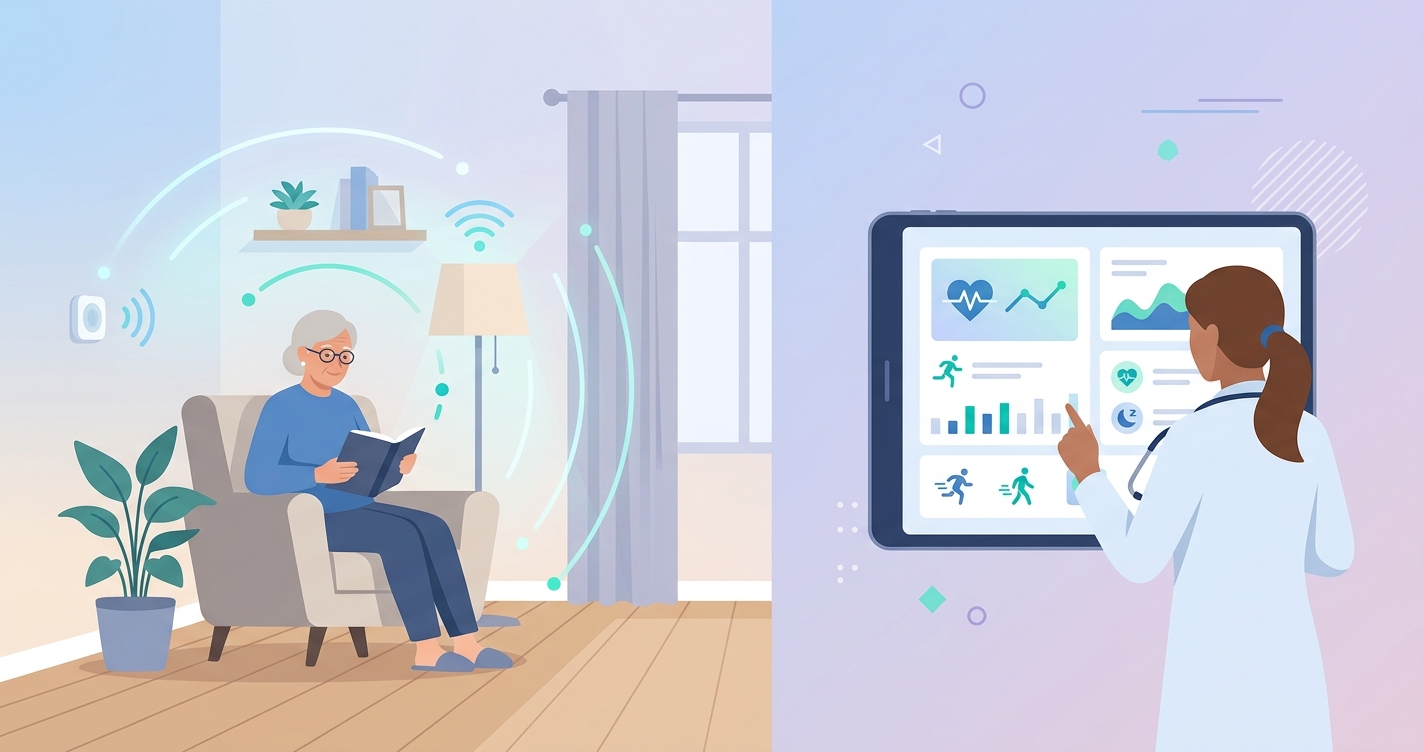
Ambient monitoring future RPM no devices is starting to sound less like a futuristic slogan and more like a practical operating question for health systems. Traditional remote patient monitoring helped prove that home-based care could work, but it also exposed a stubborn problem: every added device creates one more point of friction. Someone has to ship it, pair it, charge it, remember it, troubleshoot it, and keep using it. Ambient monitoring tries to reduce that burden by moving more of the sensing into the environment, the phone, or the background of care.
"Beneficiaries receiving care through the AHCAH initiative generally had a lower mortality rate than those treated in traditional inpatient settings." — CMS report on the Acute Hospital Care at Home Initiative, released September 30, 2024
Ambient monitoring future RPM no devices: what the term actually means
Ambient monitoring refers to remote monitoring that happens with little or no active patient effort. Instead of asking a patient to wear a patch, clip on a pulse oximeter, or log measurements into an app every day, the system gathers signals through tools that sit more quietly in the background. That can include smartphone-based passive sensing, room sensors, radar, motion detection, contactless camera workflows, sleep tracking, and other software-led check-ins that do not depend on a bag of peripherals.
The distinction matters. Ahmed Alboksmaty, N. Solomons, S. Gul, A.L. Neves, and Paul Aylin wrote in their systematic review of home RPM using ambient sensors that wearables can be difficult to sustain over time, which is exactly why unobtrusive sensing keeps coming back into the conversation. Their review screened 5,653 records and included six US studies. The evidence base was still limited, but the logic was clear: if long-term adherence is the bottleneck, the next generation of RPM has to ask less from the patient.
Comparison table: device-heavy RPM vs ambient monitoring
| Monitoring model | What the patient has to do | Operational burden for health systems | Data cadence | Best fit |
|---|---|---|---|---|
| Device-heavy RPM | Wear, charge, pair, and use dedicated peripherals | Higher logistics, replacement, support, and onboarding load | Intermittent unless devices are used consistently | High-acuity pathways needing dedicated hardware |
| Smartphone-led passive sensing | Keep a familiar phone nearby and complete light check-ins when needed | Lower hardware burden, more software and workflow design | Frequent background or short-session data capture | Broad outpatient and post-discharge follow-up |
| In-home ambient sensors | Live normally while sensors monitor motion, respiration, or activity patterns | Front-loaded installation burden, lower daily patient effort | Continuous or near-continuous | Frailty, elder care, hospital-at-home, fall-risk pathways |
| Contactless camera workflows | Use a phone or tablet camera during guided sessions | Lower logistics than peripheral kits | Scheduled spot checks | Programs seeking low-friction vitals capture |
That table is a simplification, but it gets to the operational point. Ambient monitoring is not one technology. It is a design choice. The idea is to make monitoring feel less like homework.
Why health systems are interested in RPM without devices
Most executives are not asking for RPM without devices because it sounds elegant. They are asking because too many programs stall at the last mile.
A device-centric model creates predictable headaches:
- inventory management and shipping delays
- pairing failures and technical support calls
- patients forgetting to charge or wear hardware
- uneven adherence after the first few weeks
- more staff time spent managing equipment than managing care
Essam Rama of the University of Cambridge, along with Sharukh Zuberi and colleagues from Luton & Dunstable Hospital, Royal Free Hospital, and Imperial College London, reviewed passive-sensor remote monitoring studies in Sensors in 2025. Their conclusion was cautious but useful: passive sensing showed clinical utility across conditions including dementia, Parkinson's disease, cancer, and cardiopulmonary disorders, while reducing reliance on active patient interaction. That is the part health systems care about. Lower-friction capture does not automatically guarantee better outcomes, but it changes the operational math.
Industry applications
Hospital at home
Hospital-at-home models are one of the clearest reasons ambient monitoring is getting serious attention. David Levine of Mass General Brigham led a national 2024 study in Annals of Internal Medicine covering 5,858 hospital-at-home patients treated under federal waivers from July 2022 through June 2023. The in-program mortality rate was 0.5%, and 30-day readmissions were 15.6%. Those numbers do not prove that every home-based program should use ambient monitoring. They do show why health systems want monitoring methods that are easier to scale inside the home.
In that setting, RPM without devices can help teams keep eyes on patients without turning every room into a miniature supply closet. Ambient tools are especially attractive when the goal is regular visibility into respiration, movement, sleep disruption, symptom drift, or brief contactless vital-sign sessions rather than continuous management of multiple peripherals.
Post-discharge monitoring
The post-discharge window is where many RPM programs either earn their keep or expose their limits. Patients go home tired, overwhelmed, and usually not excited about learning another stack of equipment.
Ambient monitoring can fit this period because the care team often needs trend visibility more than complicated setup. A phone-based or contactless workflow is not trivial, but it is often easier to sustain than a kit with several moving parts. That matters when nurses are trying to identify which patient needs a callback today, not which patient forgot how to pair Bluetooth yesterday.
Older adult and frailty pathways
Ambient monitoring also has a natural place in older-adult care, especially where the real signal is not a single number but a pattern change. Slower walking, fewer room transitions, more nighttime restlessness, reduced activity, and altered sleep can all matter before a formal acute event shows up.
Alboksmaty and colleagues focused their review on elderly populations for a reason. This is a group where adherence barriers are not hypothetical. If RPM depends on perfect daily use of dedicated hardware, the model will break for a meaningful share of patients.
Oncology and longitudinal specialty care
Passive sensing has also started showing up in oncology. Agent-search surfaced a review on smartphone-based passive sensing in cancer monitoring, which described low-burden use of accelerometers, geolocation, and device-use patterns to track fatigue, recovery, and safety events. I would not overstate that literature yet. Still, it points in the same direction: future RPM may collect more from ordinary behavior and less from patient chore lists.
Current research and evidence
The ambient-monitoring evidence base is still young, but it is getting more concrete.
Alboksmaty, Solomons, Gul, Neves, and Aylin found only six studies in their ambient-sensor review, all from the US. That is not a huge foundation. Still, they reported potential cost savings and a clear rationale for unobtrusive sensing in older adults. I think that nuance matters. This is not a mature field with every workflow question solved. It is a field where the operational problem is obvious enough that research keeps pushing toward lower-burden designs.
Rama, Zuberi, Aly, Askari, and Iqbal added a broader 2025 view in Sensors, reviewing passive-sensor monitoring across several disease areas. Their paper is useful because it moves the conversation beyond one narrow care setting. The common thread was not that passive sensors replace clinicians. It was that passive sensors may create a steadier stream of usable information when patient effort is limited.
Then there is the care-delivery backdrop. CMS reported in 2024 that beneficiaries treated through the Acute Hospital Care at Home initiative generally had lower mortality than comparable inpatients, with lower mortality across all top 25 MS-DRGs and statistically significant differences in 11 of them. Patient and caregiver feedback was also described as overwhelmingly positive. Ambient monitoring is not the whole reason hospital-at-home works, obviously. But if care is going to keep moving into the home, monitoring tools will have to become less intrusive, not more.
What ambient monitoring changes for operations
The biggest shift is not technical. It is organizational.
Ambient monitoring changes what staff spend their time on:
- less focus on shipping and device replacement
- fewer setup barriers during enrollment
- more emphasis on triage rules and escalation thresholds
- better fit for short, repeatable home-based check-ins
- more chances to monitor functional decline, not just spot vitals
That last point is easy to miss. Device-based RPM often centers on isolated physiological readings. Ambient monitoring can widen the lens toward behavior, recovery pattern, mobility, and daily stability. For many care-at-home pathways, that broader context is the whole point.
The future of ambient monitoring
I doubt the future is truly "without devices" in a literal sense. Phones, tablets, sensors, and cameras are still devices. What changes is who does the work. In older RPM models, the patient carried more of it. In ambient monitoring, more of the work shifts to software, environment, and workflow design.
That is probably the right direction for health systems. Programs do better when the patient burden is modest, the escalation path is clear, and the monitoring method fits ordinary life at home. Some high-acuity pathways will still need dedicated hardware. No serious operator should pretend otherwise. But a lot of RPM volume sits in the middle: post-discharge follow-up, hospital-at-home check-ins, virtual nursing, chronic disease review, and frailty surveillance. Those are exactly the places where lower-friction ambient monitoring could matter most.
Frequently asked questions
What is ambient monitoring in healthcare?
Ambient monitoring is remote monitoring that collects health-related signals with little active effort from the patient, often through background smartphone sensing, in-home sensors, radar, motion tracking, or contactless camera workflows.
Is ambient monitoring the same as remote patient monitoring?
It is better understood as a subset or evolution of RPM. Ambient monitoring still falls under remote monitoring, but it aims to reduce patient effort and hardware friction.
Why are health systems interested in RPM without devices?
They want monitoring programs that are easier for patients to stick with and easier for staff to operate. Device logistics, pairing issues, and weak long-term adherence have slowed many RPM deployments.
Does ambient monitoring replace traditional medical devices?
Not completely. Some pathways still need dedicated hardware. Ambient monitoring is most attractive where lightweight, repeated, low-friction observation is more valuable than shipping a full peripheral kit to every patient.
Ambient monitoring is really a bet on simpler home-based care. For health systems building lower-friction RPM programs, solutions like Circadify fit into that broader move toward software-led monitoring that patients are more likely to complete. For related reading, see The Clinical Workflow for Camera-Based Remote Patient Monitoring and How Rural Hospitals Use RPM to Extend Their Reach.